
Byung-Chul Han, philosopher: ‘A lot of people read me, but I’m not a millionaire’
The famous thinker spoke to EL PAÍS to clarify that he is not the ostentatious figure that he believes some articles have made him out to be
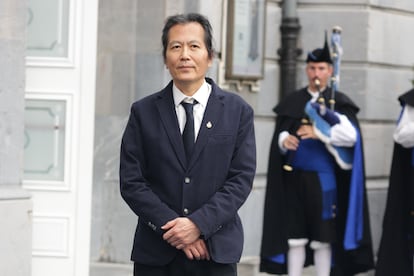

Byung-Chul Han wants to talk about his pianos. He has two, a Steinway and a Fazioli. He also wants to talk about his garden, which he loves to work in. “Happiness comes from working with your hands,” he says. “For Heidegger, thinking was manual labor, for Paul Celan, good poetry was as well. Without this labor, there is no happiness, no thought, no action.”
Han, a German philosopher of South Korean descent, the thinker who sells books on contemporary malaise like hotcakes, the man they call the rock star of philosophy, was awarded this year with Spain’s Princess of Asturias Award for Communication and Humanities. He says he feels honored to follow in the footsteps of other Germans who have received the same recognition: Günter Grass, Hans Magnus Enzensberger and Jürgen Habermas.
The key to Han’s success lies in his role as a vessel for earlier thinkers who examined the trajectory of the contemporary world, like Michel Foucault, Guy Debord, and Zygmunt Bauman. Han updates that intellectual lineage for a public that sees itself reflected in his critiques of self-exploitation, hyperconnectivity, acceleration, and the emptiness of existence in the neoliberal order.
During his trip to Asturias to receive the award, Han gave one interview — and it was by his own request. Last Friday, the morning before the ceremony, EL PAÍS went to Oviedo’s Reconquista Hotel, where award-winners, officials and journalists awaited on stately carpets to listen to Han and catch of glimpse of his hands. He has delicate hands.
Han receives us in his hotel room. He does not allow his voice to be recorded, notes may only be taken by hand (though he points out that this journalist is typing hurriedly on a phone screen instead of using pen and paper, a sign, he remarks, of how we’ve almost forgotten how to write by hand). He prefers to speak in German, with the help of an interpreter. This is the reason for our visit: the philosopher is upset with how some media outlets have portrayed him after attending his talks and his first-ever press conference on October 21. He feels they have depicted him as ostentatious, as if he were a frivolous millionaire, because of mentions of his two pianos and his garden — objects with which, he insists, he interacts through manual work.
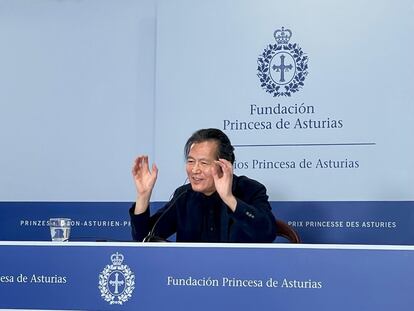
“It’s a scandal! I’m not a wealthy man,” he says. “You don’t get rich with philosophy, especially when it’s so easy to pirate my books. Anyone could easily download them on the internet. It’s a catastrophe for publishers and authors.” With respect to his pianos, whose mention was portrayed as a sign of his ostentatiousness, Han explains that though they still make beautiful music, they are antiques. His Steinway is around 60 years old; “it’s small, but it has wonderful tone,” he shares. The Fazioli is also old. He says they aren’t worth much. “A lot of people read me, but I’m not a millionaire.”
It may be, thinks Han, that there was a misunderstanding when it came to his use of the German word flügel, a polysemous term that means “bird’s wing” and “grand piano.” “Heidegger also says that thought is elevated by the wing of Eros, and that wings allows us to reach a place where no one has yet set foot, a space that no one has experienced,” he says. Plato, Han continues, also speaks of thought in reference to Eros, which brings us closer to the idea of the “Good” and the “Beautiful” — thinking, too, is a kind of flight toward the heavens of the Ideas. Thus, Han has two pairs of flügel, the wings that allow him to fly with his thoughts — and the grand pianos.
Spiraling thoughts
In person, Han has a curious way of thinking and speaking: he does so in a spiral. He returns constantly, almost obsessively, to the same point. In this case, it is his displeasure with how he has been represented in certain publications. But with each turn, new branches and digressions emerge, and it is hard to predict where they will lead to. “My thinking feeds from Bach and the romantic music of Schumann and Schubert,” he says.
Two years ago, a public reading of his work was held for the first time at an event in Leipzig during which he was accompanied by a pianist performing pieces by Schumann and Bach. “In that reading, I wanted to express my thoughts in a way that could be heard. At the end, the pianist came up to me and said, ‘This wasn’t a reading, it was a Mass,’” he remembers. Han’s work In Praise of the Earth, which is dedicated to his garden, is permeated by Schumann’s sound, like the composer’s Gesänge der Frúhe (Songs of the Morning).
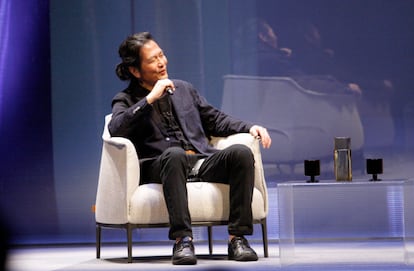
Another issue that, according to Han, may have contributed to a misunderstanding is that of his properties. He has an apartment in Berlin that was once subsidized housing, and that is where he keeps his Steinway piano. “I would love to have a house with a garden in the center of Berlin, but that’s impossible to afford, so I have one on the outskirts in Spandau, where the Fazioli piano is,” he says. “Prices are lower out there.” At the end of last year, Han put this house up for sale because he was unable to take care of the garden due to health issues. According to this newspaper, the asking price was $990,000.
Han’s complaints, in a way, connect to the technological critique that runs through his work. “Many publications, including traditional publications, seem to have been absorbed by the spirit of social media. They are more concerned with causing a scandal than being careful with their content,” he says. In Germany, in his view, this doesn’t happen as often. They are more serious there. “Don’t you think?” he asks, on at least three occasions. “I don’t have an ego. When I think, I am no one; when I play the piano, I am no one; if I’m no one, I can’t be vain,” he says.
Perhaps he’s not rich in money, but doing manual labor, playing the piano and working in his garden, requires another kind of wealth: that of time. Is Han rich in time? “I have a lot of time, I don’t have an agenda, I am probably the only professor who doesn’t. I don’t give talks, I only have a meeting every once in a while,” he says. These days, debate rages over whether it is more important to have access to money or time. “I don’t really see that as a debate. There are people who have a lot of money and a lot of time. In fact, you can buy time with money,” he says.
For Han, revolution seems almost impossible. “We are cattle. Cattle of work, of performance, of communication. Electoral cattle, consumption cattle. And cattle doesn’t leave its stable, it doesn’t see the world, because its feed is in the stable.” In a talk at the Laboral University in the Spanish city of Gijón, Han irreverently encouraged students to “play hooky,” “ignore your parents,” “don’t attend class” and to go and see the world and nature. Han laments that what he meant as a provocative, inspiring boutade was taken literally — as a call for truancy.
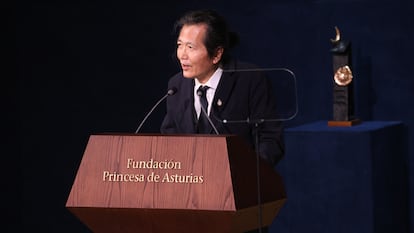
Hours after that talk, Han would speak from the stage at the Campoamor theater, in the Princess of Asturias award ceremony, to the elites gathered in box seats and in the presence of Spain’s royal family. He warned that smartphones, once conceived as tools, have turned us into their tools. He called on politics to rein in the runaway technological horse and reclaimed the philosopher’s critical mission — the role of the Socratic gadfly. And he didn’t mince words: “Today we think we are freer than ever, but in truth, we live under a despotic neoliberal regime that exploits freedom.” He made no mention of his pianos or apartments.
Sign up for our weekly newsletter to get more English-language news coverage from EL PAÍS USA Edition









































