
Emily Goligoski, researcher: ‘I have a policy for the use of devices in class. How can I compete against dopamine while teaching some theory?’
The writer and professor has spent years analyzing the evolution of audiences and information consumption. She’s not optimistic about the future
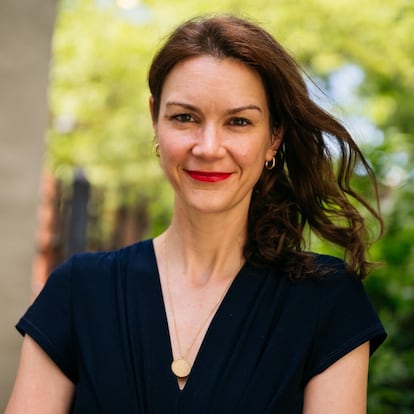

Emily Goligoski is an audience expert. She has spent years researching how to understand the people who consume the news online and how to improve their user experience. She has worked with or contributed to outlets such as The New York Times, CNN and The Guardian, as well as institutions like Columbia University and New York University.
“I don’t have a perfect answer,” Goligoski cautions before sharing some of her reflections on the future of audiences. Since the arrival of the internet, the media has been plagued by constant complaints and doubts. EL PAÍS spoke with Goligoski after a talk she gave at the recent Mozilla Festival held in Barcelona.
Question. You are concerned about the “persistent homogenization” of audiences. What does this involve?
Answer. We work in an industry obsessed with measuring everything: visits, users. I’m worried about what gets lost along the way. Many newsrooms have been debating for years whether or not they should let reporters know the performance of their stories. This idea of reducing everything to a single metric that supposedly indicates whether something was useful worries me. In the long run, it might not serve our best interests.
Q. The interests of the media or of society?
A. Both. In independent media, it’s really important that everyone working on the product understands who their readers are and what those readers need. If you only look at quantitative data on how something has performed, it’s sorely lacking. And it makes the work less satisfying.
Q. There is no clear alternative.
A. Relying on a single indicator to determine whether something was good or bad doesn’t help, because it also ignores what else was happening at the time: what other stories were on the homepage, the other ways we competed for people’s attention. And if we make decisions about what to cover, how, and for whom in such a reductive way, it ultimately also reflects a lack of imagination and curiosity.
Q. Now it seems that subscriptions are becoming the norm.
A. I’ve noticed that phenomenon. There’s another relevant element now as well: the rise of independent creators and journalists who publish under their own names through platforms like Substack. Independent journalists tend to have a clearer sense than general market publishers of who their audience is and what they want. I’m surprised that many of these authors don’t use the surveys the platform offers more often. Behavioral data — open rates, reading time — tells you part of the story, but I would ask readers for their opinions.
Q. Why?
A. It’s an extraordinary tool. It’s a research methodology, a way to gather what people see from their perspective, what their opinions are about the news or a topic. Everyone likes to be asked for their input. And it can guide what should be covered and what to address in the future.
Q. Should the media treat its audience better?
A. We haven’t been creative enough in thinking about how to engage the audience. I’d like us to stop thinking only in terms of “producer” and “subscriber,” and start exploring models where there’s a two-way exchange of knowledge that’s less transactional. I know it’s hard. I’m really empathetic to people who are doing this work because the way that modern newsrooms are structured, there is not the space or time or incentives to go and understand these things.
Q. Is there too much navel-gazing in the media?
A. I’d like to see the media investigate more, for example, the article’s page: it’s had various tweaks, yes, but ultimately, the digital article page has remained quite static over time. When we study other ways of conveying information, point of view, or tone, and look beyond our own peer set, we discover interesting alternatives: theater, TikTok, or even physically meeting at a festival.
Q. A recent trend is news avoidance.
A. The sheer amount of competition for our attention is really concerning to me. The fatigue it creates and, sometimes, the feeling that the news is depressing. I think about this a lot, especially when covering major elections and politics. I’m even concerned about it with my graduate students. I have to set a policy in class for the reasonable use of devices. If I think about social media as dopamine manufacturers while teaching some theory, how am I possibly going to compete with that?
Q. The same applies to news articles.
A. Exactly the same.
Q. Is there any cause for optimism?
A. Translation. Before, 10 years ago, almost everything was only in English. Now I see more media outlets translating their content into multiple languages, and it’s very important. I do think there is something in the Substack and independent writer approach that is really promising: it reinforces the idea that this work doesn’t come for free and has value. Finally, I see so much talent and curiosity in my graduate journalism students. I’m excited about the talent pipeline.
Q. But do people under 25 watch the news?
A. In my client research, I absolutely see that TikTok and Instagram are the start and end point for young people in the U.S. For publishers, I’m obviously concerned because these platforms aren’t owned or operated by the media. We’re at the mercy of the platforms and deploy resources to meet their exact specifications, not realizing all of that is necessarily going to change. As for the audience, I’m very concerned, without a doubt.
Q. Is it shrinking?
A. Yes. If we look at the Reuters data, it’s not painting an optimistic picture. This is going to force us to be creative.
Q. And we’re not.
A. No.
Q. Are we conservative?
A. Yes.
Q. What options are there?
A. Sometimes it starts with an old-fashioned letter to the editor: you have a question, and I’ll investigate to answer it. Other times it’s “we need your help to investigate”: like crowdsourcing, and then publishing the findings. That’s tremendous cause for optimism. It’s also very important to acknowledge and be transparent about funding.
Q. Why?
A. We still have an outdated approach to marketing: we don’t want to talk about ourselves, and when we do, it sounds like we’re overly proud of ourselves. Telling people how the work was done works much better. How many plane trips were involved in that reporting? How many hours of work? Quantify it. That, to me, is a much better way to get someone to open their wallet.
Sign up for our weekly newsletter to get more English-language news coverage from EL PAÍS USA Edition









































