
Yanis Varoufakis: ‘The technolords control our minds’
The former Greek finance minister warns of the dangers of what he calls cloud capital, the driving force behind technofeudalism
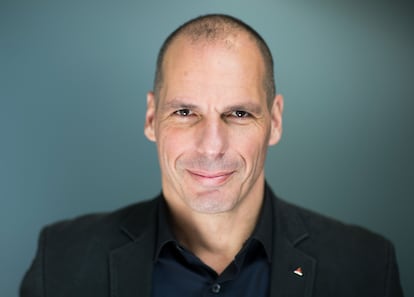
During the pandemic, many ongoing trends accelerated without us fully noticing. Yet in Greece, former finance minister and prominent leftist Yanis Varoufakis (Athens, 1961) was paying close attention to how technology companies — the so-called Big Tech — were growing at breakneck speed. With millions of people locked down at home, working and shopping online, glued to screens and cloud computing, these companies became omnipresent and all-powerful. In the United States, between 2020 and 2022, there was a 52% increase in screen time in the under-18 age group.
Armed with colossal amounts of personal data, giants like Facebook, Twitter, Google, Alibaba, or Amazon achieved what was once unthinkable: knowing their users better than the users know themselves. No longer content with just spotting behavioral patterns, they began to anticipate, exploit, and shape them — trapping millions in a relentless cycle of digital dependence: the circuit of cloud rent.
Varoufakis concluded that something fundamental had changed: capitalism, as we had known it for more than two centuries, was dead. In its place arose technofeudalism, a new order controlled by technolords — a handful of ultra-wealthy players who extract rents from users and subordinate the old capitalists. His hypothesis remains controversial, even irritating to the Marxist left to which he belongs. But today, few doubt that Big Tech has accumulated unprecedented power. Sooner or later, citizens and governments will have to confront them to shape a different future. Those who fail to understand this soon will end up being ruled by algorithms, says Varoufakis, who answered questions from EL PAÍS by email.
Question. We are witnessing an unprecedented accumulation of wealth. Media outlets report that Elon Musk could become the first trillionaire, while the global middle class stagnates. In the United States, real income is comparable to 1974; in China or Brazil, millions have escaped poverty, but without matching the increase in productivity or corporate profits. How did we get here, and what can we anticipate from this scenario?
Answer. We arrived here through the natural process of capitalist accumulation, which organically produces crises that, in turn, provoke interventions by political agents representing capital. Their purpose is to shift wealth to those they represent through policies that liquidate public assets to artificially reinforce asset owners’ rates of return at the expense of the working and middle classes. The more this process continues, the greater the inequality and the deeper the anxiety of the beneficiaries — the ultra-rich — whether from fear that the many will revolt against them or that the fictitious capital they rely upon will implode.
Q. The 2008 financial crisis marked a turning point. Shortly before, the iPhone and social networks inaugurated another stage: the prelude to technofeudalism. What are its basic characteristics?
A. The 2008 crisis took down nearly every bank in the U.S. and Europe. To float the banks again, governments and central banks printed about $35 trillion, while at the same time practicing austerity by suppressing wages and social benefits, among other measures. The result was a coexistence of massive liquidity and low demand, leading to weak investment in goods and services. The only companies that invested some of the printed $35 trillion were those that, initially located in Silicon Valley, founded Big Tech on the back of a new form of capital I call cloud capital. That marked the beginning of technofeudalism.
Q. Has neoliberalism truly ended as you maintain, or are we witnessing the overlap of two forms of capitalism in a new era of digital technology?
A. Neoliberalism was never a reality. It was merely the legitimizing ideology (neither new nor liberal) of the financialization-globalization process that began after the end of Bretton Woods in the early 1970s. Now, under technofeudalism, power is shifting from Big Finance to Big Tech, and thus, neoliberalism is finished — even as an ideology.
Q. One of the most radical transformations is the use of our information as raw material and commodity. Why is the attention economy such a dominant feature of the global economy today?
A. The attention economy has existed since the first advertisements appeared. But, under technofeudalism, something far more serious is happening than merely capturing our attention and stealing our data. Cloud capital, the driving force of technofeudalism, trains us to help it insert desires into our minds. Once it has done that, it directly satisfies those desires — bypassing normal markets by sending commodities straight to us and granting its owners the power to extract enormous cloud rents. Amazon, for example, claims a 30% to 40% share of the final product price. For this reason, data’s central role in Big Tech’s rise is now the least of our concerns. We need to move beyond just discussing the attention economy or obsessing over our data being stolen by Big Tech. Once these cloud rents account for more than 20% of total spending — and therefore total income — our economies no longer function as expected under capitalism. This is why we must focus on what drives technofeudalism: a new form of capital, cloud capital.
Q. Technofeudal power extends beyond the extraction of cloud rents to shaping the real world, especially through Big Tech’s ability to influence government efforts at regulation. What are the social, political, and environmental consequences of digital technologies?
A. Capital has always had governments dance to its tune. Cloud capital, which powers the new technofeudal order, wields even greater power: it can control our minds directly on behalf of its owners. For instance, even if our European governments wanted to rein in companies like Google or Meta, these companies hold immense power over them — all they need to do is threaten Europeans with suspension of access to YouTube or Instagram.
Q. How did the promise of free exchange and horizontality of the early internet era transform into a corporate system that turns information into merchandise and private profit?
A. All tyrannies begin with a promise of liberation. The Internet’s conversion from a commons to the technofeudal realm, built upon a tremendous concentration of cloud capital, occurred because of two key developments. First, users were denied the chance to prove their identities online, which allowed Google, Microsoft, and the financial sector to monopolize our digital identities. Second, after the 2008 catastrophe, private banks offered much of the money that central banks had printed to Big Tech at nearly zero interest. Big Tech wasted no time using state money to build up its arsenal of cloud capital.
Q. Are you suggesting that the Internet has become a form of tyranny ruled by technofeudal elites, where opting out of the digital world is possible but comes at a significant personal cost?
A. What I am suggesting is that the Internet, while still useful to people and movements seeking autonomy, has been colonized by cloudalist corporations that have constructed cloud-fiefs, enclosing vast numbers of people and keeping them there through network effects and switching costs.
Q. To what extent is technofeudalism genuinely different from monopolistic capitalism in other historical periods?
A. While technofeudal lords, or cloudalists, may appear similar to monopoly capitalists of the past, they are profoundly different. Henry Ford and Thomas Edison, like Jeff Bezos and Mark Zuckerberg, owned enormous amounts of capital, manipulated politicians to advance their business interests, and bought media to control public opinion. However, they owned conventional capital — means of production such as conveyor belts and electricity generators — that churned out products for everyone to buy. In contrast, Bezos and Zuckerberg own cloud capital, which produces nothing physical to purchase. Their cloud capital produces power on their behalf. They then extract rents from customers, capitalists, and workers in the capitalists’ factories. There is no greater difference than this. The reason? An economy where wealth accumulates increasingly as rents (as opposed to profits reinvested in commodity production) is destined to die.
Q. Can you explain why it is destined to die?
A. For the same reason that a highly lethal virus dies after it has killed all its potential hosts. Cloud capital-wielding technofeudal corporations manage to extract increasing amounts of value created by human workers in the traditional capitalist economy as cloud rents. The more cloud rents they extract, the deeper the entire system sinks into unviability.
Q. In technofeudalism, we work for datalords without even realizing it, unlike classical capitalism, where it was much clearer whom one worked for. How has this new super-class emerged with such unprecedented economic and political power?
A. Through capital’s latest mutation: cloud capital. As I said, cloud capital is not produced by means of production. It is not machines built to produce goods or other machines. Cloud capital is a constructed means to grant its owners enormous power to control other people’s behavior. Is it any wonder these owners quickly evolved into our new ruling class?
Q. You offer a revealing data point: in past companies like General Electric or Exxon-Mobil, 80% of revenue went to pay for labor. In contrast, Big Tech employees receive less than 1% of revenue, because most of the work is done for free by billions of “cloud serfs.” Can you explain this?
A. The cloud capital that Meta and Google (owners of Instagram and YouTube, respectively) use to extract cloud rents is much more than just machines, fiber optic cables, etc.; it is, primarily, all the posts that users have uploaded and the network effects this mass of material produces (e.g., if you leave Instagram, you lose access to others’ posts, and your posts become invisible to them). All the labor users put into their posts has contributed to Meta’s and Google’s cloud capital. But this labor is mostly performed for free. This explains why only a tiny share of these companies’ revenue goes to wages.
The power of the technolords
Q. What does the image of the leaders of Big Tech and AI — except Musk — with Donald Trump, as happened recently, signify to you?
A. Donald Trump has an intriguing relationship with the technofeudal lords of Big Tech. On one hand, he humiliates them; on the other, he empowers them. Many commentators took the photo of his inauguration as proof that the tech-lords were his courtiers. I saw that photo as evidence of their humiliation. Yet, at the same time, Trump leverages them to usurp state power and offers them incredible new opportunities to profit — for example, by privatizing the dollar through dollar-denominated so-called stablecoins. He is looking to make dollar-denominated stablecoins like Tether the currencies in which cloud capital is traded — at least in the West and countries like Malaysia and Indonesia. This is what he wants Big Tech to help him achieve.
Q. Your analogy between feudalism and digital platforms has been criticized as excessive or merely metaphorical. Doesn’t your thesis risk obscuring, rather than clarifying, the real dynamics of power and exploitation in contemporary capitalism?
A. My critics often mistake my argument for claiming we have somehow returned to feudalism. That has never been my argument. My position is that we have moved to a new societal structure based on a mutated form of capital for wealth accumulation — unlike feudalism, which relied on land. The rise of this mutant capital, cloud capital, means that markets are replaced by cloud-based fiefdoms and profits by cloud rents. So, this new system shares some features with feudalism but is fundamentally built on capital, not land. Also — and this is crucial — because cloud capital is not productive, technofeudalism is parasitic and wholly depends on an ever-shrinking traditional capitalist sector, which, however, has lost its dominance in the distribution of income, wealth, and power. This is the best way to understand power and exploitation in today’s societies.
Q. To clarify, doesn’t the majority of the world’s workforce still operate within a capitalist system rooted in private ownership of the means of production and the extraction of surplus value from wage labor, as Marx described?
A. Yes. But that does not diminish my technofeudal hypothesis. Let me remind you that even in 1860, most people still worked under feudal relations of production, not capitalist ones. Yet feudalism was already dead and capitalism had taken its place.
Q. What is the geopolitical impact of technofeudalism, especially in developing countries?
A. The rise and concentration of cloud capital in just two places — the United States and China — lie behind the new Cold War between the U.S. and China. Developing countries recognize this and increasingly see the U.S. as willing to risk war (trade wars, but also actual wars) to maintain its hegemony. This is why even countries that are not natural allies of China are drawing closer to Beijing.
Q. Can you elaborate? How is technofeudalism reshaping alliances among developing countries in light of the U.S.-China rivalry?
A. Saudi Arabia is a perfect example. A long-standing ally of the United States, it is clearly hedging its bets by transferring resources into what I call in my book China’s cloud finance system. This is why Saudi Arabia decided to join BRICS+ as an associate member and, I suggest, allowed Beijing to broker a rapprochement with Iran.
Q. Leaving China aside for a moment: in the West, several of these technolords — such as Peter Thiel or Elon Musk — not only identify as libertarians but also as anarcho-capitalists seeking to maximize profits while eroding the state. What role does this ideology play in the consolidation of technofeudalism?
A. The tech-lords have forged a new ideology — I call it techlordism — that is replacing neoliberalism. In short, techlordism replaces neoliberalism’s liberal individual with an amorphous HumAIn (a human-AI continuum), and thus replaces neoliberalism’s fundamentalist belief in the divine mechanism of the market with another divinity: the algorithm, which bypasses the decentralized market’s signal processing functions in favor of a perfectly centralized mechanism matching buyers and sellers.
Q. Can the state limit this power through regulation, or is it already too late?
A. There are things states can do to check technofeudal power: for example, impose interoperability and regulate what algorithms can do. However, it’s only in China that such measures have been taken, because only there are political institutions not entirely captured by private capital.
Social reflections
Q. Marx, to whom you return in your book, was a visionary of the nineteenth century. Does he still provide answers for an information-based economy powered by AI, or do we need new categories to think about the relationship between capital, labor, and humanity?
A. If philosophers return to Plato and Epicurus for life’s meaning today, there’s nothing puzzling about Marx’s continued relevance for understanding capital accumulation now. In fact, Marx is more relevant in our technofeudal world than ever. Take AI: everyone can see how companies like OpenAI have flagrantly violated intellectual property rights to train their large language models, appropriating our collective and individual property, cheapening it, and selling it back to us to collect rents that do not flow back into the circular flow of income. Unlike hapless social democrats who propose regulation but lack ideas for regulating companies like OpenAI, Marx provides the only solution: socialize cloud capital — make all of us equal shareholders.
Q. Your book is dedicated to your father, who taught you about history, technology, and metallurgy as an early lesson in historical materialism. Your mother, also featured, gave you your first lesson in Marxism. These memories point to values such as justice, equality, and self-determination. What reflections do you have when you contrast these lessons against the current state of the world, where so many revolutions ended in dictatorships and movements like the Indignados or Occupy fizzled out without major consequences?
A. Your question preoccupied me greatly after I finished writing Technofeudalism. I also wondered what the generation of my parents and grandparents can still teach us. So I sat down and answered this very question — in the form of my new book, published this month in English (entitled Raise Your Soul). The gist of my answer, if I can summarize, is that we must develop the capacity to fight both the authoritarianism born of concentrated capital and the darkness within us — the force in the shadowy parts of our soul that causes revolutionaries to so easily become despots.
Q. You quote philosopher Fredric Jameson: “It is easier to imagine the end of the world than the end of capitalism.” Where do you see sources of hope for change amid so much inequality today? What role does democracy — imperfect and threatened — play in your thinking? Is there a way out of the technofeudalist labyrinth?
A. Ironically, judging by the angry reactions from many leftists to my Technofeudalism, taking me to task for daring to claim that capitalism is dead, Jameson’s dictum seems most applicable to my comrades on the Left! Where do I find hope? In the tendency of exploitative, capital-based systems to undermine themselves. Of course, to seize on that tendency, Democrats must use cloud capital and turn it against its owners, just as revolutionaries once seized printing presses to agitate and educate.
Q. How can democrats around the world actually use cloud capital to challenge its owners, and is this truly possible in societies where data is so concentrated and electronic surveillance nearly total?
A. This is not the first time in history when, while power was ruthlessly concentrated, the powerless managed to empower themselves. As Marquis de Condorcet quipped, the secret of power lies not in the minds or weapons of oppressors, but in the minds of the oppressed.
Q. How do you envision the social and political transition from our current mess to a truly democratic digital economy? What role would citizens — as consumers and users — play in that transformation? Do we have any real agency, or are we merely “cloud serfs”?
A. As always, in every era and every exploitative system, nothing will change until citizens mobilize, becoming agents of change rather than playthings of social forces — capital especially — beyond their control.
Q. How can we remain optimistic about achieving a truly democratic digital economy when most trends, right or left, seem to justify only pessimism or, at best, skepticism?
A. I find hope in a dialectical view of the world we live in. Through this lens, reality is never harmonious but rather constructed from contradictions — the coexistence of things that should not be able to exist simultaneously, yet somehow do. Light, as Einstein showed, is both particles and waves. Humanity can feed everyone, yet widespread hunger persists. So, whatever reality we inhabit is riven by contradictions that will eventually be resolved. Everything, in other words, can be different. And since technofeudalism is perhaps the greatest contradiction of all, I choose to remain hopeful.









































