
How animated films helped develop more lethal military drones
The 3D modeling systems used in the film industry have been key to enabling unmanned aircraft to navigate and aim their weapons with greater precision
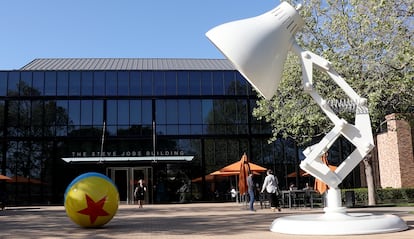

Animated films and military drones have something in common. One of the key technologies in the success of this type of movie has also been crucial in enabling unmanned aerial vehicles (UAVs) to gain precision and become a lethal tool widely used in wars like those in Gaza and Ukraine. This technology is 3D rendering, or object modeling, systems developed in some cases by the studios. In cinema, this technology is used to create more realistic animations; drones use it to better understand the space they navigate and reach their target.
In 1995, Pixar released the first feature film in history created entirely with computer animation: Toy Story. The quality of the images and animation — far superior to anything seen before — set a new standard. Part of its success was due to a piece of software called RenderMan. Designed by the Pixar team, the program was responsible for rendering complex 3D images — for the first time, it could convincingly capture details like shine, textures, skin, hair, and lens effects. This rendering system gave the characters, settings, and objects on screen that signature Pixar finish, and marked a departure from the days of polygonal shapes. The toys seemed to move naturally.
RenderMan was conceived at the University of Utah in the 1970s, where one of Pixar’s founders, Ed Catmull, earned his doctorate precisely on rendering problems. Catmull is probably the only person to have won both an Oscar (2008) for his contribution to the animation industry and a Turing Award (2019), considered the Nobel Prize of computer science, for his “for fundamental contributions to 3D computer graphics, and the revolutionary impact of these techniques on computer-generated imagery (CGI) in filmmaking and other applications.”
What is less well known is that the research conducted by Catmull and his colleagues was funded by the U.S. Defense Advanced Research Projects Agency (DARPA). One of Catmull’s colleagues at the University of Utah, the Vietnamese-born scientist Bùi Tường Phong, came to the U.S. in the 1970s precisely through DARPA, as revealed by Theodore Kim, an associate professor of computer science at Yale, who worked at Pixar and was a colleague of the Asian researcher.
Dr. Phong, as he was known in academic circles, is the creator of the shading and lighting algorithms that bear his name and that for half a century have been a mainstay of computer-animated films and 3D video games. “Bùi Tường’s algorithms excelled at depicting plastics, and are one reason that the film Toy Story, the first entirely computer-animated feature film, was about toys,“ Kim wrote in Time magazine.
Why would the Pentagon want to support these kinds of projects? The advances of the Hanoi-born scientist were transferred to F-16 fighter jet flight simulators in the 1980s, significantly improving their graphic resolution. And advanced rendering programs, such as RenderMan, built upon Dr. Phong’s work, have been fundamental to the recent success of military drones. Pixar denies to EL PAÍS any relationship between RenderMan and the military industry.

These are the “other applications” that were not specified when Catmull received the Turing Award: unmanned aerial vehicles, in order to fly, must execute faithful 3D representations of their surroundings. Since they have no eyes, they move through a virtual world that must be built from scratch with extreme precision and recalculated at high speed. The most complex part of this process is modeling people or objects in motion: the drone must know that a car is a car and not a tank, or whether what it has in front of it is a soldier, a child, or a dog.
All of this is possible with RenderMan. The same system that has been able to make a group of toys run around a room can be used to represent people on the 3D map that drones use as a spatial reference. “These devices need a very sculptural view of space to understand what a bridge, a person, or a tree is. That is very difficult to model,” explains Lorena Jaume-Palasí, an expert in ethics and philosophy of law applied to technology, adviser to the European Parliament on AI, and founder of centers such as Algorithm Watch and The Ethical Society.
From children’s movies to killing children
There is a strong link between the U.S. film industry and the military. In a 1953 letter to Senator William Benton, then-president Dwight D. Eisenhower wrote: “The hand of government must be carefully concealed, and, in some cases I should say, wholly eliminated. [...] A great deal of this particular type of thing [referring to presenting the history of the United States to the world] would be done through arrangements with all sorts of privately operated enterprises in the field of entertainment, dramatics, music, and so on and so on.”
Eisenhower coined the term “military-industrial complex” during the height of the Cold War, referring to the complicity between the powerful arms industry and government policy. He also launched DARPA, which ultimately proved vital to Pixar’s success. In the 1990s, following the collapse of the Soviet Union, “policy discussions focused on reorienting defense research spending so that research not only served national defense but also that it ultimately benefited the commercial sector. The new military-entertainment complex is one of the effects of this shift,” concludes Tim Lenoir of Stanford University in his article All but War Is Simulation: The Military-Entertainment Complex.
The RenderMan case illustrates how the links between Hollywood and the Pentagon extend beyond propaganda and the battle of narratives: there has also been a transfer of seemingly innocuous technology — such as 3D modeling systems, which has subsequently been used to kill. “The connections between the military and computer industries, and more specifically the field of computer graphics, are a reality,” says Jacob Gaboury, a professor of film and media at the University of California, Berkeley, and a specialist in the history of computer graphics. “Almost all computer research in the 1970s and 1980s was funded by the Pentagon,” he adds.
“There’s a direct connection between Toy Story and the drones that identify and shoot children in Gaza,” says Samantha Youssef, an animation director with two decades of experience in films and video games at Walt Disney Animation, Filmax, and Ubisoft. The Canadian artist explained three months ago in an interview that many large computer animation productions, like those she has worked on, are perhaps unintentionally “developing robotics coated with artistic layers”: 3D animation and rendering programs help represent space, helping to understand how a character moves.
“All the advances in our technology serve to improve that representation,” she says. Youssef argues that RenderMan, Pixar’s flagship technology, which she has used at several different companies, was created with an underlying military purpose. “This technology needed to be developed so that processors could understand depth and navigation in virtual space,” she points out.
The mention of Gaza is no coincidence. U.N. reports and testimonies from doctors on the ground corroborate the deaths of children killed by drone fire from the Israeli Armed Forces. Some reports indicate that foreign doctors have treated more than a hundred children, all with gunshot wounds to the head or chest inflicted at long range, suggesting they were not collateral victims. A forensic analysis indicates that these shots are consistent with those fired by sniper drones.
Sign up for our weekly newsletter to get more English-language news coverage from EL PAÍS USA Edition









































