
Chelsea Manning, former intelligence analyst: “If someone were to publish a massive leak today, people would say ‘oh this isn’t true”
The source of the first major leak of state secrets in the internet age, when she worked for the US, now seeks to reconnect with her life after a decade and a half of fame and activism
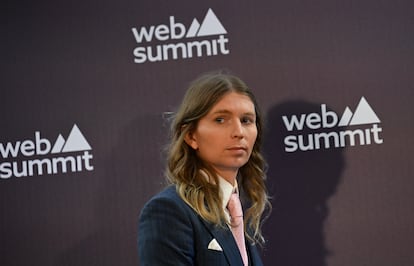
“I was very young when all this stuff happened,” says Chelsea Manning, 37. “All this stuff” was leaking hundreds of thousands of secret U.S. government documents to WikiLeaks in 2010. Manning was stationed in Iraq as an intelligence analyst and saw horrific things that she believed Americans needed to know. She was then imprisoned until 2017. Released after transitioning to a woman, she returned to prison in 2019 and wrote her memoirs.
“I’ve been busy for like a decade and a half,” she says, with enormous irony, and now she wants to better understand how it all works: “Apart from being in prison or being in the military or being a sort of activist or political figure, I don’t really have like a lot of life experience outside of those things. So I’ve been trying to live,” she explains via a video call with EL PAÍS.
Manning is in a process that began in 2023, and she hopes to share more details in a talk — which she is still writing and has no title — at the Mozilla Festival 2025, which will be held in Barcelona between November 7 and 9.
Manning has been described as one of the biggest whistleblowers of the 21st century, and she even calls Edward Snowden “Ed.” She was the first to go to jail for revealing secrets. She knew she would lose her career and her future, but she thought prison was a less likely outcome. Now she’s a security consultant.
Question. With your experience, you are trying to better understand how the world of information has changed over the years. However, you stepped away from the world for a while.
Answer. We’re flooded with information, it’s so overwhelming. One of the experiences that I’ve taken from that is to turn off the feed for a while. I’m really excited to talk about my experience of not ingesting everything for a bit.
Q. You have said that time spent on social media is Zuckerberg’s or Musk’s, not your own.
A. Exactly. I don’t think that they’re in control of the way we consume information. They make money off of our time. They don’t necessarily control it, [but] they certainly benefit and tune these things to be able to continue to take up our time. At one point it was for advertising, and at this point it just seems to be to keep us sedated and not really dig too deeply into the things that are happening in society. Television and various mass media forms have taken on this role as well. The amount of information is designed to be overwhelming.
Q. Designed?
A. Yes, we’re overwhelmed by design and I’m going to explain in detail [in the Barcelona talk] what this means and how we set up our society in ways that you wouldn’t even think of, to not really interact with each other in a human-to-human manner in our daily life. There’s always a third party involved, there’s always a transaction: buying tickets, going to an event, to a party, where Partiful [a widely used app for organizing parties] is collecting the data. I went down the list of all of these different kinds of ways in which we’ve turned human-to-human interactions into a commodifiable data collection mechanism, a social networking mechanism, and what that is doing to how we interact with each other.
Q. Does that overwhelming amount of information make it more difficult for there to be massive leaks like those of the 2010s?
A. Yes. In the early 2010s, the internet became much more accessible, especially with the advent of the smartphone. It became much more integrated into people’s lives. Until then, the mass media was still the dominant form and the government had a much tighter grip on the information environment, in terms of being able to control what people had access to. That changed in the late 2000s, and with that obviously came what happened in 2010 and what happened in 2013 with Ed [the Snowden leaks]. It’s important to remember that until then, the public had never had access to that kind of information. Now it’s widely available and widely known. In the U.S. now, everything is done in the open: you post the video of what you’ve just done, you talk about what your goals are, and this incentivizes people to have different interpretations of what that means, and whether it’s good or bad.
This much more complex and much more ecosystem-focused information environment changes things. If someone were to publish a massive leak like the Epstein files today, I don’t think it would be this humongous shit, people would say ‘oh this isn’t true or this is generated by AI or this is misinformation.’ The mere existence of deepfake technology means you don’t even necessarily have to use it to dispel the truth. You could have 200 or 300 witnesses and countless cell phones recording something, and people would still say, “Well, we’ll never know for sure.” We saw this happen in Ukraine, at the beginning of the Russian invasion, and the last two years of documented footage of what’s been happening in the Gaza Strip, for instance.
Q. It’s pretty amazing to think of something like WikiLeaks in that context.
A. It happens all the time now.
Q. You’ve said that at home in 2022 you had a better understanding of what was happening in the Russian invasion of Ukraine than you did of the Iraq War in 2010 as an intelligence analyst on the ground. Has the world changed more between when you went to prison and being released in 2017, or since then?
A. Way more. I’m trying to understand that. I’m trying to navigate that myself. In order to understand the environment, I needed to engage with it in a new way. I’ve been doing a lot of things that I had never done before. I was doing things that people wouldn’t necessarily necessary think, “Oh, this is something that Chelsea Manning would do.” I did some DJing and that was very visible. But I did a lot of very similar things in my own life. I’ve been going on a personal exploration to figure out who I am. It’s not something that I documented on social media. I decided to do it outside of the digital realm. I’m going to engage with some really hard questions, become more open and engage with things within myself and within society, on a much different playing field than information and technology, getting into to areas like philosophy, art, music, meditation.
Q. So you’re no longer a security consultant?
A. That’s how I pay my bills. It’s still my job, but it’s not my life.
Q. And three years ago, it was your job and your life?
A. I would say that my life was much more uncertain. I engaged a little bit more on the political side of things, especially as a writer and commentator. It was a bit more like, “Oh, these are important things that I want to do.” Probably, in retrospect, I needed a little bit more grounding and experience to really grow internally as a person. I feel that in the last couple of years I’ve been really growing, but in a deeper way, not just intellectually or physically, but also spiritually, in who I am.
Q. It must be strange when people say that you should be “on the Mount Rushmore of the fight against public secrets,” alongside Julian Assange or Snowden.
A. I was pigeonholed in this role. I was very young, whenever all this stuff happened and I never really got to figure out what I want. You know, who am I? Why am I here? Like in an almost existential and religious way. I’ve been able to work through that. I occasionally have to do press and I occasionally have to do interviews but I’ve been shying away from that more and more for the last couple of years. Even in the last year, the process has gotten so much deeper
Q. But will you stop analyzing digital world issues?
A. No, I don’t think I’m quitting. I think I’m just contextualizing it and trying to get a deeper understanding. I had to do these things in order to come up with some bigger and deeper questions. We’ve been channeled into a way of thinking about these kinds of things — privacy, technology, AI — and how it interacts with our society. We’ve had tunnel vision in how we’ve interpreted this. I had to step back in order to come up with some observations about that.
Sign up for our weekly newsletter to get more English-language news coverage from EL PAÍS USA Edition









































