
AfroféminasGPT: A decolonial and anti-racist AI
Activist Antoinette Torres Soler has developed a GPT model that puts the thoughts and voices of Afro philosophers, politicians and creators center stage

When ChatGPT is asked to define racism, it answers, “it is not just an attitude, but a power and exclusion structure across the social, economic, cultural and political.” AfroféminasGPT, on the other hand, defines it as “a power structure that builds a hierarchy of human beings based on supposed racial differences, to legitimize domination, exclusion and dehumanization. It operates in language, images, bodies, laws, economics, aesthetics, and memory. And it is maintained through silence, ignorance, denial and the symbolic reproduction of stereotypes.” To arrive at this answer, AfroféminasGPT resorts to thinkers such as bell hooks, Kimberlé Crenshaw and Stuart Hall. Released at the end of October, it is the brainchild of Antoinette Torres Soler.
In 2022, the US company OpenAI presented the Generative Pre-Trained Transformer (GPT), an artificial intelligence model designed to understand and also generate natural text, one capable of conversing, writing, translating and reasoning, all while adapting to the style or purpose required. Since then, its most popular version, ChatGPT, has been in the spotlight for reproducing racial bias. Research published in scientific journals such as Nature and The Lancet has warned that these systems make biased judgments regarding groups such as African-Americans.
“No one explains how useful this can be for activism,” says Torres, who set out to build an anti-racist, ethical and decolonial AI model in May. Her initiative is the result of more than a decade of work against racism and discrimination against women of color.
Racism, a shared experience
Almost 20 years ago, when Torres left Cuba and settled in Spain, she faced the challenging reality of being a female immigrant of African descent. Her experience prompted her to look for others subjected to similar discrimination, providing her with a mirror that would reflect her own story. Then what she calls “the miracle” happened and women’s experiences across the globe came together. “You realize that the life experience of a Black woman in Spain is similar to that of a Black woman in Argentina, in Colombia, in Germany. What you think is a personal opinion is, in reality, a structural problem,” she explains.
And so in 2013, she came up with Afroféminas, an Afrofeminist platform that promotes equality, representation and racial justice. Its purpose was to make the multiple ways of living and expressing Blackness visible, and also to educate on the different manifestations of racism. It is a cause that combines study, reflection and the dissemination of voices from the global north and south – currents that are intertwined in Torres’ activism, as well as in her studies in philosophy, the arts, mathematics and the exact sciences.
Torres lives in Zaragoza, a Spanish city that is becoming known as the epicenter of technological innovation in Europe, with more than 20 data centers and nearly €50 billion in investment. It is no coincidence that what is now AfroféminasGPT has been incubated there.
Training opportunities are coming thick and fast to the northeast of Spain and, last May, Torres was able to take a crash course in AI that transformed her outlook. “The moment they explained GPT to me, I realized it was very applicable,” she says. At 50, Torres describes generative AI as fertile ground for social movements. “Regardless of the contradictions that there may be in AI – and I am aware of them – there is room to create, even to preserve knowledge.”
A repository of Black thought
Technically, whoever designs a GPT chooses how to train it, and with what resources as well as the tone in which it will express itself. “You decide the texts at its disposal, the authors you want to cite,” explains Torres. It is also possible to choose whether or not the model connects to the internet, which influences its independence. The GPT of Afroféminas does not do so, “precisely because the networks are plagued by racism, machismo and multiple biases,” Torres points out.
After learning how the system works, Torres focused on curating a version trained exclusively from texts by authors of Black and decolonial thought such as bell hooks, Angela Davis, Frantz Fanon, Stuart Hall and Octavia E. Butler. Unlike others, the model is based on ethical principles. It is configured from royalty-free content – fragments of PDF texts that anyone can find on the internet and which are often shared between activists. “It’s not a book that I bought, photocopied and fed in. I understand that there are many things that are still unknown about AI; we do not know exactly where it is going to take us, but what I am clear about is that all the steps I am taking are as ethical as possible. That’s the right way to go, as I see it,” she says.
The result is a space where icons of the global north coexist on an equal footing with thinkers from the south. Chimamanda Ngozi Adichie (Nigeria), Victoria Santa Cruz (Peru) and Yuderkys Espinosa Miñoso (Dominican Republic) share the same space. It is a pedagogical and political proposal based on Black knowledge. Torres points out that “we have always complained about cultural appropriation and how Afro-descendant knowledge ends up being diluted or whitened. AfroféminasGPT preserves those voices and their contributions, without interpretations,” she says.
Representation and Afrofuturism
During its first weeks online, AfroféminasGPT has received more than 800 queries, which reflects the interest that it is generating. Its creator considers it a success, especially as it is an initiative of an independent collective working without public or private support, and which is sustained by small donations.
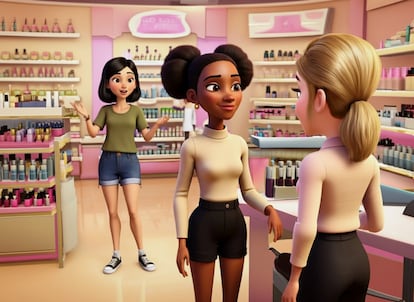
Working with GPT is not Torres’ endgame. She believes that these tools make Afrofuturism possible, opening the door to imagining better worlds. In recent months, Torres has produced a couple of experimental short films using AI. The first, The Wastebasket, explores the “white masks” referred to by psychiatrist and philosopher Frantz Fanon: the need for many Black women to adapt to the dominant canon in order to survive; “those masks that we put on to be accepted,” Torres explains.
For Torres, AI is not a substitute for creative work, but an opportunity to dispute representation as it stands. Her position on the debate around AI in art is clear. “I create figures of Black women, contexts where there are Afro-descendant people in positions of value. No one has done it before. No one has taken the trouble to say how we want to be seen. No one can tell me that I am detracting from something that hasn’t been done before,” she explains.
Sign up for our weekly newsletter to get more English-language news coverage from EL PAÍS USA Edition









































