
Naomi Osaka grows under the inspiration of ‘Kill Bill’: ‘Playing like this, she can win Wimbledon’
Inspired by Tarantino’s film, the Japanese-born, US-raised player recovers the most intimidating version of herself on a surface where she didn’t feel comfortable. She will play Muchová for a place in the semifinals

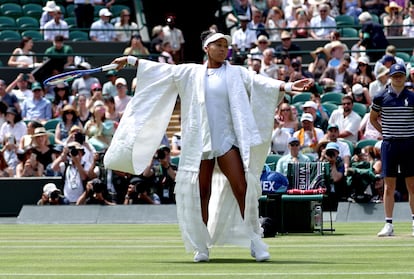
It’s midmorning at the Somerset Road entrance to Wimbledon, and there is a buzz because it is no ordinary day. The king is back — Roger Federer. Impeccably suited, the Swiss genius walks toward the Centre Court facilities with that unique, buoyant gait of his, flanked by an elegantly uniformed entourage (all wearing sunglasses) in a scene that echoes Reservoir Dogs and that opening set to Little Green Bag. The movie that now inspires Naomi Osaka — the shooting star who burst on the scene and then, for reasons not entirely clear, vanished — is also by Tarantino. In her laudable effort to return to the top of the tennis world, the Japanese player has been walking the runway and these days wears a kimono with a specific origin: Kill Bill.
“I was thinking about my favorite movies also. I love Kill Bill. I remembered absolutely falling in love with Lucy Liu’s character. She has an all-white kimono, and I remember thinking that was really cool,” the world No. 14 told the BBC. Seven years ago she touched the tennis heavens when she first rose to No. 1 in the ranking— but after winning four majors, she walked away. There were several factors at play: pressure, anxiety, expectations and, also, a complex personality. Multifaceted. Different, perhaps.
“I’m simply myself,” she says. And she is. From that existential crisis to her current rebirth, Osaka has been writing a personal, distinct story; at her own pace, with all its nuances and that singular way of expressing herself: she speaks softly, sometimes in a whisper, but her messages carry a lot of emotional weight. Some people adore her, others loathe her. In any event, she continues on her path, with all the marketing trappings and peculiarities that accompany her, but bound by the simple and plain law of tennis: on the court there are no distinctions that matter, and to keep regaining lost ground and get back on the leading train —she paused her career for a year for maternity— she has had to redouble her efforts. She wants it and, judging by what we’ve seen, she is not far off.
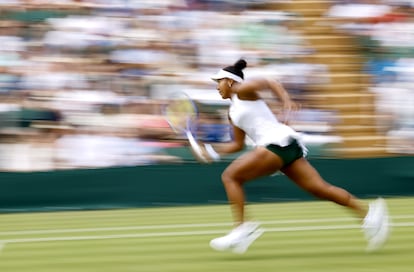
“It took me quite a long time to understand clay-court tennis and now I feel something similar with grass,” she said last week. “But now I feel I can take advantage of my strengths on this surface,” she added, while stressing the physical and movement work. Although over the past five years her appearances at Grand Slams have been almost nominal —except for the semifinals she reached at last year’s U.S. Open— and she has not won a trophy since February 2021, the Japanese player, now in the athletic maturity of 28, has shown signs of improvement this season that are gradually restoring her intimidating power. Proof of that was Sunday’s victory over Aryna Sabalenka of Belarus.
Serve and fluidity
The world No. 1 succumbed to this format which, in reality, is nothing more than a very practical rehabilitation: hide your flaws, highlight your strengths. As simple as it is effective. And, as if by magic, a player who had offered modest results on the green —21 wins and 16 losses to date— and who had never passed the third round in London, would reach the semifinals if she defeats Czech Karolína Muchová this Tuesday.
After getting through the third round, Osaka said coach Tomasz Wiktorowski has helped her better understand the fluidity that grass requires. However, she insisted the evolution is less about any one specific change than about having recovered her old pattern. That is, the serve and the groundstroke as pillars, plus added sharpness in movement and maneuvering. From there, you again see a more incisive and also bolder version of her; alongside the baseline percussion there is a notable number of net approaches, averaging 11 per match. In any case, the statistics sheet shows the serve is decisive.
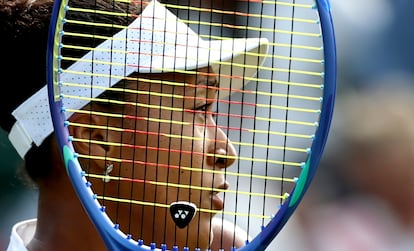
Osaka averages almost six aces per round (5.6), second only to Muchová; no player has benefited more than she has from first-serve points —she has held 81% of them— and she also leads the average percentage of service games held (95%); she has only been broken twice and, despite the aggression —with a peak of 198 km/h— she has committed just five double faults.
“My confidence is very high.” “I approach matches with a very steady mindset,” she notes, while the legendary Martina Navratilova, who holds the overall record for wins at the All England Club (120, compared with Novak Djokovic’s 106), says that if the Japanese player can keep competing “with so much freedom and joy,” she could win the British major. “Absolutely.” “I think she no longer feels that pressure on her,” Navratilova said Sunday on Tennis Channel, while wondering how Osaka will react after beating Sabalenka. Speaking to the same channel, former world No. 1 Jim Courier said that “at that level she can beat anyone” and posed the million-dollar question: “Can Osaka sustain it for three more matches?”
Sign up for our weekly newsletter to get more English-language news coverage from EL PAÍS USA Edition









































