
Carlos Alcaraz: ‘I’m a sensitive person who is quite affected by emotions’
The world number one chats with EL PAÍS after becoming the youngest men’s player to complete the Career Grand Slam
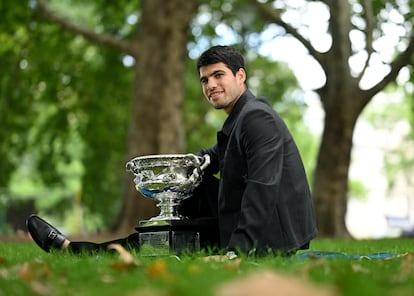

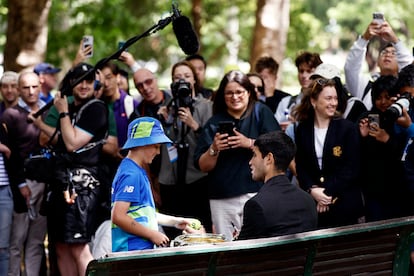
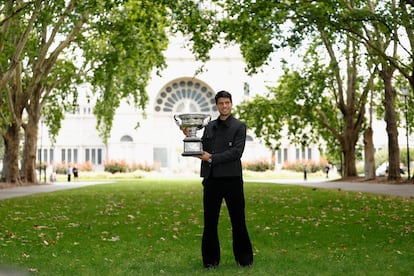
Carlos Alcaraz (El Palmar, Murcia; 22 years old) is taking a walk early in the morning, tracing a straight line of 200 meters through the beautiful gardens of the Royal Exhibition Building in the Carlton district of Melbourne. The world number one is surrounded by a crowd of about 100 people and two long rows of towering plane trees, interspersed with colorful Indian reeds. He enjoys posing in dark clothing. An elegant jacket, bell-bottom trousers, and loafers give him a very sophisticated air. He is tired, but in good spirits. The night before, he won the Australian Open for the first time to become the youngest men’s tennis player to complete the Career Grand Slam; that is, to win each of the sport’s four major tournaments — the Australian Open, Roland Garros, Wimbledon, and the U.S. Open — at least once. His presence attracts more and more onlookers, so the conversation with EL PAÍS will finally take place on the third floor of the Crown Hotel, where he has been staying during these past three weeks of sweat, progression, and, ultimately, joy. More and more photos are being taken of him. He has seven Grand Slam titles and is a superstar, but he behaves and answers question like just a regular kid from Murcia.
Question. You know what? It’s killing us…
Answer. What is?
Q. Typing so much to talk about you.
A. Well, I’d say that’s a nice problem, wouldn’t you?
Q. Undoubtedly, but will you ever tire of winning?
A. No, I don’t think so. The truth is, as I was saying the other day, I hate losing. I hate it when you don’t know how to do something or play something, when a friend is better than me at something… I always try to improve, I try to do everything I can to beat them. I think that’s what defines me, and I apply it in every tournament, one after another, always trying to give my best. I like seeing how I improve and how I grow, and trying to keep going down that path, giving my absolute best. That’s the beauty of that ambition.
These days everyone can give their opinion and it’s easy to read them; it’s good, but sometimes I read too much…
Q. Where does this strong desire come from? Is it related to having four siblings at home? Is it something you train for, or is it simply who you are?
A. Well, I think this comes from having an older brother [in his case, Álvaro, now his head coach’s assistant]. I’ve always wanted to win at everything. I remember when I played with my brothers [Ángel and Jaime, the other two], whether it was football, table tennis, basketball, or board games, it didn’t matter, whatever it was, I wanted to beat them at everything; but, like any good little brother, I never won at anything, so I’ve always kept trying and I’ve developed that ambition. It’s stayed with me forever.
Q. You desperately wanted to win in Australia and you’ve also expressed your ambition to win the Davis Cup in November. Isn’t this double objective at the end of the season dangerous? Won’t you be tempted to relax?
A. My team has played a fundamental role in keeping me motivated and fresh. Off the court, I need to be very calm, to be well, to feel good in order to compete; you can’t force playing well, it comes naturally when I’m calm and feeling good off the court. I enjoy it because it’s what I love. I think that’s what will help me keep taking steps forward in each tournament, and there are also some very important tournaments coming up that I’m excited to play in. All of that motivates me to keep giving it my all.
Q. After beating Djokovic, you slipped in a couple of messages recalling “many” who doubted you and were “wrong.” Settling some scores?
A. They weren’t messages, it’s simply reality. I wasn’t questioning what people were saying, nor was I implying that I did it for them, nor was I trying to prove anything… It’s just that nowadays we live in a time when people express their opinions and it’s very easy to read them, and sometimes I read too much… But well, I think that seeing other people’s opinions is good; sometimes they’re negative and sometimes positive, but in the end they’re just different points of view. The important thing is how you manage everything and how you approach the tournament having read that.
I haven’t been on the tour for very long, a relatively short time, and in the end you mature and grow. I’ve experienced a lot, some very beautiful moments and some very bad ones, both on and off the court
Q. Well, you didn’t handle it too badly...
A. I took it in stride. I focused on how I was training and feeling, and whether I was capable of doing really good things here in Australia. So when I won, I couldn’t help but think about those comments saying I wouldn’t be able to do it, that I wouldn’t play good tennis; in other words, that I was going to lose soon.
Q. You’re being politically correct. Let’s be clear: despite everything you’re achieving, you’ve taken more than a few hits. External pressure is always intense. Do you consider that unfair?
A. I think it’s a bit, how to put it, difficult. In the end, people have expectations of you because they know what you’re capable of and that you can win the tournament, and when you don’t, it’s normal. As I was saying, we’re at a point where everyone can have an opinion and you can read it, and those kinds of messages reach us athletes. Some messages are constructive, but others aren’t pleasant or depend on the person. They really get to you.

Q. And does it make you think about it a lot?
A. Personally, sometimes I have doubts, or I’m left with quite negative thoughts. The power of words is very, very significant; if you say something and don’t use the right words, it can completely change the story. It’s difficult to understand, but these are people’s expectations, and we have to respect them.
Q. You are a sensitive, open-minded guy, but at the same time there comes a point where you seem able to detach yourself from everything. Is that accurate?
A. Well, sometimes things affect me, and I try not to show it. Sometimes it makes me doubt myself when people question me, when they think I’m not capable, especially after defeats or during difficult times in my career; it’s hard when people doubt you, and it affects you internally. However, it’s important to separate the professional and personal aspects of my life.
Q. What’s the interior like?
A. I’m a sensitive person who is quite affected by emotions, both for better and for worse, but then, once on the court and competing, you have to try to be as strong as possible to face all the difficulties that come your way.
I think the big difference between good players and the best is wanting the difficult moments to arrive
Q. You’re 22 and you’ve been doing this for four or five years now, living it to the fullest, with all kinds of experiences. Are you learning to handle disappointments better? Are you a little less naive? Do you like the way this industry operates?
A. I haven’t been on the tour for very long, a relatively short time, and in the end you mature and grow. I’ve experienced a lot, some very beautiful moments and some very bad ones, both on and off the court. From there, you start to understand a little more how tournaments, and that industry you mentioned, work; you become familiar with the situations, and I think it’s like everything else: when you’re little, you think it’s going to be one way, and then, as you get more involved and understand a little bit about how things work, you realize it’s totally different from what you thought. That’s part of life, and you realize that things aren’t always as you’ve idealized them.
Q. How on earth can someone dance, laugh, and joke around so much before such an important final, with so much at stake as on Sunday? Tell me your secret, please.
A. I just wasn’t very nervous yet. Naturally, you always want to be well and feel good, and I take it very naturally; I tried to do so.
Q. You command the stage very well for your age.
A. We tried, we tried... [laughter]. As I said, I’m still very young and I have a long way to go, many experiences to live and learn from, but I’ve already lived through a lot. I don’t consider myself a mature person, but I’ve managed to grow thanks to those experiences that I’ve had to face in a bad way; those are the ones that have made me grow and enabled me to face these moments today in this way, with armor. The key is not to give it too much importance, especially when there are four or five hours left until the match; to give it as little importance as possible. It’s about enjoying the moment and being yourself.
Q. Yes, you did tense up during the semifinal against Zverev, hence the cramps. Sometimes it’s just assumed you have everything more or less under control. Are we wrong?
A. It’s something we’ve worked on, trying not to give anyone any clues, in general, that we’re tense, that we’re struggling in the moment. You have to get used to the moment and feel comfortable, want it to come so you can face it in the best way possible and not let it affect you; I think that’s the big difference between good players and the best, wanting the difficult moments to arrive. Obviously, in every match, whether it’s the first round or the final, there are always nerves and tension.
Sign up for our weekly newsletter to get more English-language news coverage from EL PAÍS USA Edition









































