
Summer, relaxation, and cutting-edge style: Why Roger Federer dubbed Australia ‘the Happy Slam’
Tennis players have applauded the tournament’s evolution, with Melbourne Park setting the pace organizationally and registering record attendances. ‘Having too many people is a good problem for us,’ said Novak Djokovic
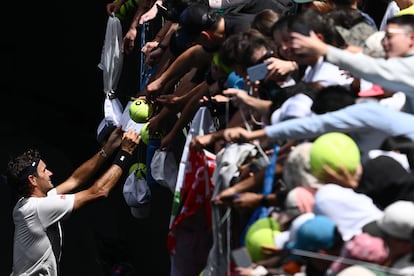

Just stepping onto the double step of the tram car, at any time of day, is enough to understand a lot: Melbourne, or something like happiness itself. No rushing, no pushing, no crowding, just order and civility. Tennis player Daria Kasatkina, recently naturalized, said recently in an interview with The Guardian: “Everyone is so chill, like ‘if you’re late, you’re late, mate.’ It’s OK, take it easy, don’t worry about it.” This chimes with the good vibes in a summary by Roger Federer in 2007, now registered as the tournament’s official nickname: “This is the Happy Slam.” No doubt about it.
Six years after his last match at the tournament as a professional and three decades since his first visit, the maestro reappeared at the complex this year, beaming from ear to ear: “Many players enjoy escaping the European winter. We meet up here after a few days off and the preseason, and there are always very positive vibes. The fans are really passionate about it, and the organization is perfect. It evolves year after year. Everything is made really easy. The hotels are close by, the stands are packed. This is, without a doubt, one of the best places in the world to play tennis.”
On a terrace at Melbourne Park, an ATP employee remarks on how everything has changed completely: “Twenty-five years ago, there were barely any courts here…” Novak Djokovic, who discovered this place in 2003 as a junior and went on to make it his own with 10 titles, confirms this. “I remember we used the gym at a club [Collingwood], across the road. They let us use the changing rooms, the ice baths, the indoor courts, everything. Then they kept expanding it, and in that sense, I think Australia has always been one of the best,” the 38-year-old Serb observes, referring to the quality of the facilities and the location.
Unlike Roland Garros, Wimbledon, or the US Open, which are more confined or limited by ownership issues, the Australian Open has greater potential for expansion, and season after season, the tournament’s management enriches it. Every year brings advancements or new features, whether it is new courts, redesigns, or tweaks. Those in the tennis world agree that it’s the most cutting-edge event and the trendsetter, to the point that representatives from other leading tournaments travel to Melbourne to adopt ideas that are later implemented in Paris or London; New York, however, lags behind from an organizational standpoint.
While players there risk being caught in traffic jams during their travels, at the first major of the year they spend barely 10 minutes commuting. In fact, many team members prefer to travel by strolling along the banks of the Yarra River. Added to this is a magnificent tennis atmosphere, historically without excesses or shortcomings. Nothing like the inattentiveness and noise of the crowd at Flushing Meadows, or the tension that sometimes surrounds the action on Court Philippe Chatrier. “The people of Australia love the sport and understand its values,” observes Djokovic.
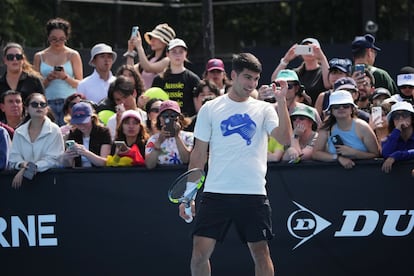
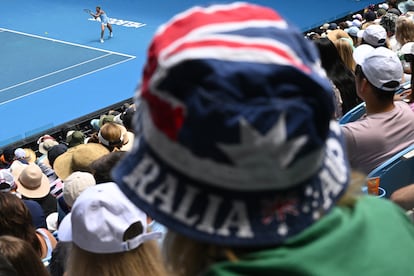
From that perspective, the fan response is greater than at other major tournaments. Last year saw a record attendance of 1.2 million people over the two weeks, and this Thursday — the date of the latest figures provided by the organizers — almost 104,000 people visited the complex. Coincidentally, some complaints have surfaced about the overcrowding. “Having too many people, at this or any other tournament, is a very good problem for us,” Djokovic conceded after beating Francesco Maestrelli 6-3, 6-2, 6-2; “it’s a good sign. I really like the mentality here, that desire to constantly improve.”
Although the golden age of Australian tennis is long gone —the days of Ken Rosewall, Rod Laver, Roy Emerson, Evonne Goolagong, John Newcombe or Margaret Court — tennis is one of the most popular sports in a country dominated by cricket, rugby and Australian rules football (AFL), and the network of clubs and training schools is extensive; there are around 1,300 nationwide, of which about 300 are located in Melbourne.

“Every year I come, I notice improvements,” says Carlos Alcaraz. “They have one of the best infrastructures in terms of courts, indoor courts [the first major to have three], and spaces for renovations. Everything here is made very easy; I love coming every year. It’s clear the journey isn’t the best, it’s too long, but once you arrive, you enjoy it immensely. I haven’t visited too many places in Melbourne, but there are a few I love for strolling,” adds the world number one, who often walks with his family through the Royal Botanic Gardens. There, Djokovic has had the habit for 15 years of hugging a tree of Brazilian origin that, he says, brings him luck.
Judging by results, the Serb found a good ally. No player is more decorated in Australia, although the most recent champion was Jannik Sinner. The 24-year-old Italian took home a check for A$3.5 million, which this year has risen to A$4.15 million. Tennis Australia, led by Craig Tiley, has opted to increase the total prize money by 16%, and the players appreciate the gesture. Federer no longer competes, but he quickly grasped the essence of the place, to which he has returned with his family to relive old memories at the Happy Slam: “Every time I come here, I smile.”
Sign up for our weekly newsletter to get more English-language news coverage from EL PAÍS USA Edition









































