
The USMNT, an interracial and diverse team debuting under the shadow of Trump’s immigration raids
Mauricio Pochettino’s side, including 12 Black players and three Latinos, opens against Paraguay at the SoFi Stadium in Los Angeles, whose employees can strike if ICE deploys there
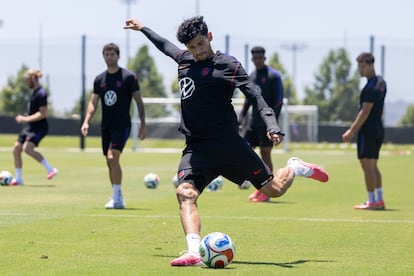

The World Cup circus begins and David Beckham will unveil his star on the Hollywood Walk of Fame this Friday. It is the entertainment industry’s nod to the World Cup, and almost the only one. On the Oscar boulevard, among parties and hustlers imitating Michael Jackson, you have to look hard to find references to the big soccer event, even though 20 miles away the United States opens its campaign against Paraguay on Friday afternoon.
The World Cup kicks off in the United States, in Los Angeles, at SoFi Stadium and with the U.S. men’s national team — a combination that, far from Hollywood glitz, carries significance in the country’s current political moment. California’s population — one of the first to take to the streets a year ago against immigration raids by U.S. Immigration and Customs Enforcement (ICE) deployed under Donald Trump — hosts the debut of a team that, regardless of what it does on the pitch, reflects the nation’s interracial and mixed heritage. Of the 26 players called up by Mauricio Pochettino, 12 are Black and three are Latino. That fact confronts the U.S. president with the reality of the territory he governs. And if that were not enough, the debut will take place in a venue whose workers have signed an agreement with the company that allows them to strike if ICE deploys there to carry out arrests.
At SoFi Stadium, the world’s most expensive sports venue according to the Guinness Book of Records (at almost $6 billion), it is almost impossible to take a step without hearing a word of Spanish. Located in Inglewood, south of Hollywood’s red carpets, its employees and passersby reflect the city’s demographics well — the world’s second-largest Mexican population. Among those who will stand for the U.S. anthem are, for example, Alejandro Zendejas and Ricardo Pepi, both forwards for the U.S. team. Zendejas is originally from Ciudad Juárez, Mexico, and grew up in El Paso, Texas, from six months of age, where Pepi was born. Pepi has confessed that he always leaned toward El Tri because of his parents, who are Mexican like Zendejas’, but in the end it was the U.S. team that showed more interest in him.
The Latino trio is completed by midfielder Cristian Roldán, whose father is Guatemalan, his mother Salvadoran, and who was born near Los Angeles. “I have suffered a lot of racism, but nothing comparable to that experienced by the Black community. It matters a lot to me to bring about that change,” he said five years ago when he joined an organization of Black players in Major League Soccer (MLS).
The inclusion of Latino children and young people in talent identification faces an economic barrier within the U.S. soccer system. To join an academy, each family must pay between $100 and $300 per month — a burden, above all, for the most disadvantaged sectors. For more than a decade, national federation reports from coaches have warned that this fee is a problem for spotting talented boys, especially at the youngest ages.
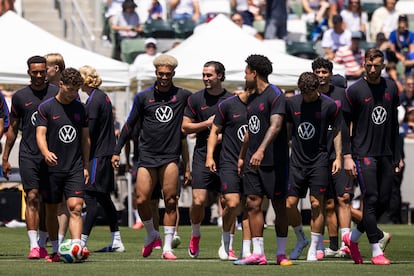
Among the squad’s Black players, stories of activism are public, though it remains to be seen whether these will also be voiced on the World Cup stage in the U.S. Perhaps the best known is that of Weston McKennie: five years ago the Juventus midfielder called Trump “ignorant and racist” amid the Black Lives Matter movement. Last summer, however, he visited the White House with his club and did not skip the ceremonial handshake. In central defense, Chris Richards sports tattoos of Martin Luther King — “a great inspiration” for him — as well as Muhammad Ali and Barack Obama. Further up the pitch is Timothy Weah, whose father, Ballon d’Or winner and former president of Liberia George Weah, said he was a victim of “the disease of racism” during his playing days. His son, a forward for Marseille, has been one of the few to complain about ticket prices.
Although wealthy and free from ICE’s threats, they are also a sign of the immigrant nation that is the United States. Defender Mark McKenzie, born in the Bronx, has a Jamaican father; forward Folarin Balagun has Nigerian parents; and striker Haji Wright has Liberian and Ghanaian ancestry. All make their debuts in Los Angeles, one of the cities to which Trump sent thousands of troops a year ago amid protests against immigration raids, leading the Democratic mayor, Karen Bass, to impose seven nights of curfew to curb the unrest. Those tense days actually disrupted the Club World Cup schedule.
Today downtown Los Angeles seems to breathe more easily. The nervousness is concentrated among the 2,000 SoFi Stadium employees who, in addition to wage demands, have obtained the company’s guarantee that they can strike if immigration raids occur. One who has so far avoided taking a stance is coach Pochettino. “We are not politicians. Our responsibility is to play,” he said.
Sign up for our weekly newsletter to get more English-language news coverage from EL PAÍS USA Edition









































