
Argentine soccer’s credibility battered by suspicions of corruption, biased refereeing, and controversial trophy awards
The latest decisions by the president of the AFA, Claudio ‘Chiqui’ Tapia, have been met with a backlash by fans
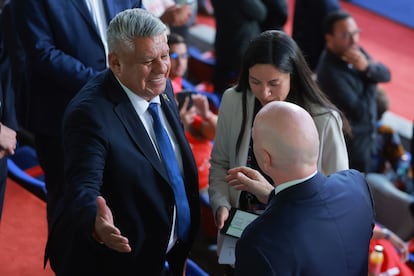

Argentine football could well also be declared a world champion of holding the most scandalous and incomprehensible tournaments. While Lionel Messi’s national team was crowned world champion at the Qatar 2022 World Cup and won back-to-back Copa América titles at Brazil 2021 and in the United States in 2024, the Argentine domestic leagues have sunk to a subterranean level, below the threshold of credibility. The Argentine Football Association (AFA) has created a two-headed figure that, symbolically, is beginning to tarnish the heroes of Qatar: street murals honoring the world champions have been vandalized by fans of various clubs, angered by the deluge of questionable refereeing decisions and sudden rule changes that are eroding the daily life of the tournaments, an emotional refuge for millions of Argentinians.
The first major symbolic image of repudiation on a Primera División (First Division) pitch occurred last Sunday, when Estudiantes de La Plata players turned their backs on their Rosario Central counterparts in the guard of honor before their Clausura round of 16 match. The Rosario-based team, which includes former Real Madrid winger Ángel Di María, had three days earlier, in an AFA office, been declared champions of a tournament that had already ended, without anyone even knowing there was a title up for grabs.
Amid the numerous peculiarities in the organization of tournaments, the Argentine First Division has 30 teams, a way for Claudio “Chiqui” Tapia, the president of the AFA, to exert power. Since the calendar isn’t long enough to complete home and away matches between all the clubs, the season is divided into two tournaments, the Apertura and the Clausura, which are further subdivided into two groups. The total points from both competitions are tallied in the so-called Annual Table, which, until last Thursday, was believed to only grant three places for the 2026 Copa Libertadores.
But not so: with the regular season, and therefore the annual standings, concluded the weekend before, the AFA waited four days and then unexpectedly declared the team that had finished in first place, Rosario Central, the champion. It was a tournament that didn’t have a name — because it wasn’t really a tournament — but it was called the 2025 League Champion. In an unusual scene, Di María, other Central players, the coach, and club officials went to the AFA headquarters to receive an award that took the entire soccer world by surprise.
In an attempt to justify itself, the AFA announced that it was an agreement reached between the directors of all the teams, but Estudiantes had already posted on social media that there had been no vote and that it had been a unilateral decision by the federation. It was another round in the ongoing feud between Estudiantes’ president and idol, Juan Sebastían Verón — a former Argentine international who played for Manchester United, Chelsea, and several Serie A clubs in Italy — and Tapia, a conflict that extends to other areas. The rest of the club directors, on the other hand, maintain a good relationship with the AFA president, or at least prefer not to confront him publicly: there is an underlying fear of being negatively impacted by refereeing decisions.
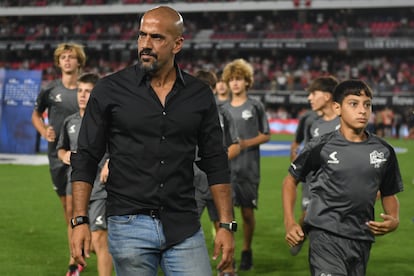
By a twist of fate, Central’s next match, just 72 hours after their unexpected championship win, was against Estudiantes, at home in Rosario. The AFA ordered the La Plata team to give the new champions a guard of honor, a gesture rarely performed in Argentina and never before mandated by the AFA. Rather than being a matter of sporting honor, it seemed like a form of humiliation or subjugation, but Estudiantes decided not to play ball: their players turned their backs on Central’s players, a message not against the Rosario club but directed at the AFA. The match ended with another surprise: Estudiantes won 1-0 and eliminated Central in the round of 16 stage of the playoffs.
The AFA then launched a bizarre counterattack: hours after the match, it announced that, according to a resolution issued in February, the guard of honor had to be carried out following a specific protocol and that any team that failed to comply would be sanctioned. According to this supposed document, “those forming the guard of honor must remain in their place, facing the players as they pass by, without making any movements or engaging in any conduct that disrupts the normal course of the protocol.” In other words, Estudiantes had violated the regulations.
However, computer experts — although even their extensive knowledge of the subject was not enough — verified that the PDF, albeit dated February, had been created in the final minutes of the match between Rosario Central and Estudiantes, precisely when most of Argentine football was already celebrating the latter’s act of defiance. It was even created with a version of Adobe released in September, meaning the document couldn’t have been composed at the beginning of the year. With the scandal brought to light, it was assumed the AFA would drop the case, but no: ultimately, the players and the president of Estudiantes, Verón, were sanctioned.
On Thursday, the AFA’s Disciplinary Tribunal suspended Verón for six months “from all football-related activities” and handed two-match bans to the 11 Estudiantes players who turned their backs during the guard of honor. Verón received a harsher penalty because, according to the tribunal, he admitted “giving the order that led to the behavior judged here, revealing that it was not an impromptu gesture by any player.” Among the sanctioned players are Uruguayan goalkeeper Fernando Muslera and Colombian striker Edwuin Cetré.
Argentine President Javier Milei seized the opportunity to support Estudiantes and criticize the AFA. Milei had previously displayed an Estudiantes jersey in September 2024 when he was pressuring the AFA to allow the introduction of SADs (Public Limited Sports Companies); a legal structure prohibited in Argentine football, where clubs are non-profit civil associations. Estudiantes, through Verón, presented a potential investor, American businessman Foster Gillett, who ultimately faced rejection from the club’s own members.
Soccer as political spoils
Following the Rosario scandal, Milei once again pulled out an Estudiantes jersey and resumed his attack against the AFA, adhering to a long-held ambition of most Argentine presidents: to seize control of soccer as a political prize. Tapia has also faced journalistic reports in recent days alleging money laundering involving millions of dollars through financial institutions linked to the AFA. Soccer leaders have denounced this as a “political destabilization operation.” A few months ago, Milei had halted his advances toward power over the sport when he was warned that Messi has a very good relationship with Tapia.
Beyond the political ramifications, the irregularities extend beyond the last Primera División championship, which was decided in an office rather than on the field. The previous week, the AFA’s Ethics Tribunal had also surprised everyone by suspending Walter Otta, the manager of Morón, a Second Division team, because he had allegedly spoken out against refereeing decisions that favored Deportivo Madryn, the team he was scheduled to face in the semifinals for promotion to the Primera División.
Otta, in fact, couldn’t sit on the bench for the game — his team lost and was eliminated — but he had never uttered that phrase: it was a fake news story circulating on social media that the AFA accepted as valid. The beneficiary was Deportivo Madryn, a team that had also advanced earlier thanks to another administrative decision, this time due to an alleged assault by Gimnasia de Jujuy officials on a match referee, which — as with the Morón coach’s (non)statements — no one could verify.
Amid refereeing decisions suspected of favoring teams close to the most powerful figures in the AFA — especially Barracas Central, the humble club that was presided over by Tapia between 2001 and 2014 and which in recent years rose from the Third Division to the First Division among numerous controversies — several murals honoring the 2022 World Cup-winning team began to be defaced. Last Saturday, during their match against Argentinos Juniors, Vélez fans loudly insulted the president of the AFA.
While the credibility of the VAR (Video Assistant Referee) system is also under attack, the AFA is multiplying the number of tournaments: in 2026 there could be nine different First Division champions, including the League Champion, the Clausura, the Apertura, the Copa Argentina, the Supercopa Argentina, the Trofeo de Campeones, the Supercopa Internacional, the Recopa de Campeones, and the Champion of the Year. In terms of imagination, Argentine soccer should also be declared world champion.
Sign up for our weekly newsletter to get more English-language news coverage from EL PAÍS USA Edition









































