
A natural evolution of cruelty
It’s not always the best-adapted animal that survives. Sometimes, it’s the one that exploits its fellow creatures
The theory of evolution — developed by Charles Darwin and Alfred Russel Wallace — familiarized us with concepts that are occasionally misunderstood, such as the survival of the fittest (not the strongest), competition between species, or selection pressure. These ideas, applied self-servingly to human society, led to concepts such as social Darwinism. Developed by Darwin’s cousin Francis Galton, this gave rise to false ideas, such as the presumed superiority of certain races, or to terrible realities, such as the eugenics laws that were applied in many countries, not just in Nazi Germany. Richard Dawkins and his theory of the so-called “selfish gene” didn’t paint a better picture when he stated that what matters in evolution isn’t the survival of the individual or the species itself, but rather the persistence of its genetic material contained within DNA.
Thanks to ecology and the work of biologists such as Lynn Margulis, we know that relationships in an ecosystem are much more complex than Darwin and Wallace described them to be. Sometimes, the species that survive aren’t those that compete best, but those that collaborate best. Symbiotic relationships — where two different species benefit from each other — are very common and can determine the survival of a species. Furthermore, we now know that these relationships have played a decisive role in evolution. For example, all of our cells contain an organelle called mitochondria, which was originally an independent bacterium that established a symbiotic relationship with a cell millions of years ago. If we can eat food today, it’s thanks to the symbiosis between bacteria and fungi in the roots of many plants, which provide nitrogen or phosphate to the plants. And plants, in turn, provide sugar to microorganisms. Therefore, on occasion, evolution also has a friendly side: it can tell us great stories of cooperation between species.
The fact that the situation is much more complex than initially thought — and that there’s more to it than just survival of the fittest — doesn’t mean that cruelty (by human standards) ceases to exist. Parasitic relationships — where one organism benefits at the expense of another, causing harm or even death — are very common. And sometimes, they can just be downright cruel...
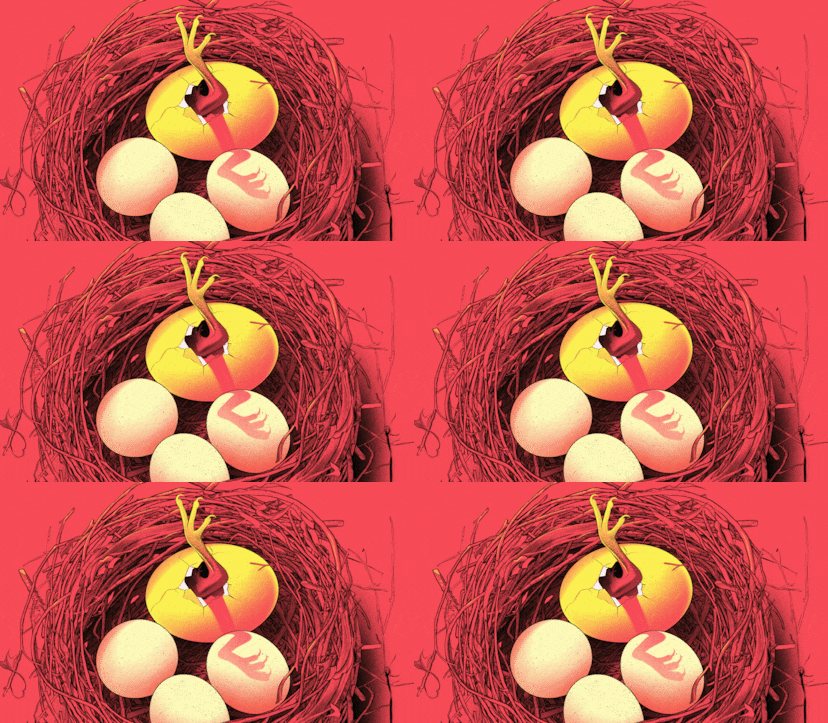
Among birds, there are so-called “brood parasites” who completely ignore their young. Through various tricks, they get other species to care for them. This behavior appears to offer an evolutionary advantage, as it has emerged independently in seven different lineages of unrelated birds. Each species or lineage uses different strategies to invade other birds’ nests.
Of all of them, the case of the indicator bird — popularly known as “the honeyguide” — is particularly gruesome. Its preferred victim is the little bee-eater. When a female honeyguide discovers a nest, she incubates her egg for a day, so as to ensure that it hatches before the bee-eater’s. Then, she places her egg next to the eggs that belong to her victim. Once hatched, the honeyguide waits for its chick’s foster siblings to hatch and — using its long, thin beak — begins to poke and bite them one by one, until they bleed to death… a process that can take up to seven hours. This ensures the honeyguide chick’s status as an only child: it will get all the resources that its foster parents can offer.
Cuckoos — medium-sized, slender birds — use another strategy. Once they hatch, they push the eggs containing their foster siblings (which haven’t yet finished the incubation period) out of the nest. At least this way of dying is quicker than bleeding to death.
In other lineages of parasitic birds, we find mothers who look like they’re straight out of a horror movie. But just because a bird is parasitic doesn’t mean it completely ignores its chicks. For instance, the female cowbird destroys the eggs in a nest before laying her own. Afterwards, she may hang around. If the parasitized parents discover the deception and expel the other’s egg, the cowbird mother will continue destroying all her victims’ eggs until they accept hers.
Nature isn’t all about competition and survival of the fittest. And yet, there are birds that haven’t caught on and continue to behave like schoolyard bullies.
A self-serving relationship
The honeyguide, like many bad people, is cruel to its peers, but flatters its superiors. This bird owes its scientific name (Indicator indicator) to an odd relationship it has developed with various communities across sub-Saharan Africa. Certain ethnic groups, such as the Hadza people, have developed a special call for these birds. The honeyguides, in turn, have a special call for humans: they use it to alert them when they’ve located wild honeycombs. Subsequently, the Hadza smoke the beehives and collect the honey. And, afterwards, the birds feast on the wax, the larvae, and the remains of the honeycomb. This is a full-blown symbiosis created by one of the cruelest brood parasites.
Sign up for our weekly newsletter to get more English-language news coverage from EL PAÍS USA Edition









































