
The volcano threatening the Spanish military base in Antarctica
Scientists and the military are monitoring in real time the deformation of Deception Island, where past eruptions destroyed stations erected by two other countries
The Chilean General Jorge Iturriaga, who is almost 90 years old, recalls spending the entire year of 1967 isolated from the rest of humanity. It was the year that the Beatles released their album Sgt. Pepper’s Lonely Hearts Club Band, the South African surgeon Christiaan Barnard performed the first heart transplant, and U.S. astronaut Gus Grissom, destined to be the first human to set foot on the Moon, was burned to death during a pre-launch test.
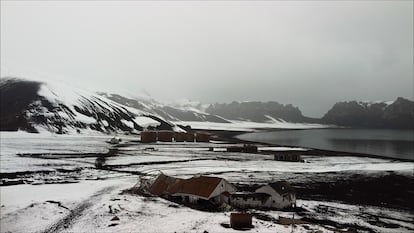
But Iturriaga knew nothing about any of it, because he was living on a Chilean military base built atop the emerged volcano that forms the remote Deception Island in Antarctica. The then-captain knew there had been eruptions in 1812, 1842 and 1912, practically every half-century, and that another one was due. But he asked the scientists, and they always gave him the same answer: “Don’t worry, it’s an extinct volcano.”
On December 4, 1967, after hundreds of earthquakes, the bowels of the earth opened up beneath the ice, and the Chilean military had to flee the island in haste. More than half a century has passed since then, and there, atop the volcano, now stands Spain’s Gabriel de Castilla base. Its residents are prepared for a hypothetical eruption.
Brigadier Alfredo Ojanguren is one of the 24 soldiers who spent the southern hemisphere summer at the base. He belongs to the legendary Galicia 64th Mountain Hunters Regiment, heir to the Tercios that fought in Flanders in the 16th century. He’s used to risking his life on missions in Afghanistan, but he’s wary of Antarctica, the only continent without any weapons or explosives.
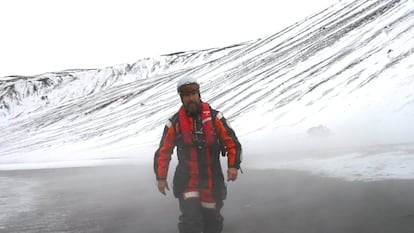
“Here, the threat isn’t another human being, but the hostile environment that surrounds us,” he warns, leaning on a Zodiac in front of the Chilean base that was destroyed by the 1967 eruption. Violent winds turn volcanic rock fragments into tiny flying razor blades. The temperature feels as low as minus 20 degrees Celsius (minus 4 Fahrenheit). “Antarctica welcomes you by telling you this is no place for you,” Ojanguren proclaims.
The Antarctic Treaty prohibits military bases, unless they are dedicated to science, such as the Gabriel de Castilla station, established in 1989 by the Spanish Army on Deception Island, about 1,000 kilometers (621 miles) south of the tail of South America. Ojanguren is tasked with accompanying the scientists, many of whom are volcanologists, on their risky expeditions outside the base. He carries a machete on his belt and a waterproof survival suit for cold waters. “If you fall in without this equipment, you’ll only last minutes alive,” he warns.
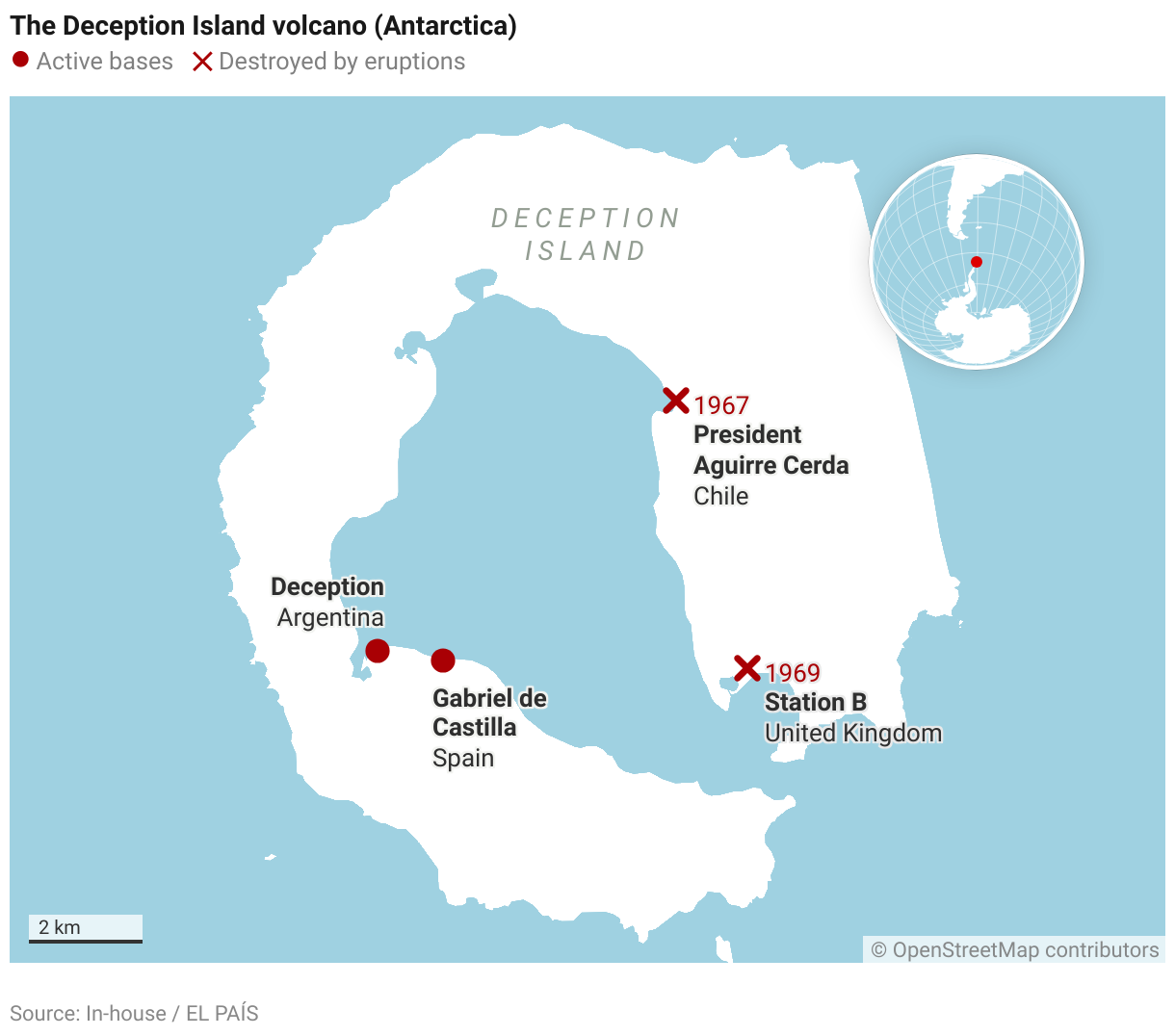
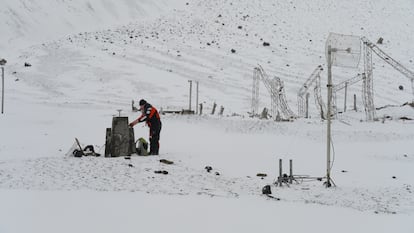
The volcanologist Belén Rosado is one of the researchers being escorted by the military. Her analyses confirm that the rise and fall of magma causes the volcano to periodically open and close its vents in a menacing manner. Her group, from the University of Cádiz in southern Spain, has for decades been measuring the distance between the Spanish base and the destroyed Chilean station, about six kilometers away (3.7 miles), on the other side of the volcano’s caldera, which is flooded by the Southern Ocean. The latest scare occurred in the 2019-2020 campaign, when a deformation was detected that forced the traffic light indicating volcanic activity to change from green to yellow. “If the trend had continued, it would have been 20 centimeters [7.9 inches] in one year, which is a lot,” the researcher notes.
The Spanish Ministry of Defense has published the following on its website: “Volcanologist Ramón Ortiz, from the CSIC [Spanish National Research Council], has studied the island’s seismic activity for more than 10 years, and has recorded more than 80 earthquakes a day. He asserts that this is a clear sign that there is a real danger, in the short term, of an explosive eruption that could cause the volcano to wake up abruptly. If that were to happen, Deception could be swallowed up by the sea, and there is no reason to think this won’t happen.”
Belén Rosado also believes the danger is real. “Yes, it’s true. But that’s precisely why we’re here, to measure all the parameters that give us indications of whether or not it might erupt,” she argues. This year, the volcano’s mouth has closed by about four centimeters. It seems “very relaxed.”
The skeletal remains of the Chilean base is a chilling reminder that the volcanic threat is, indeed, very real. General Jorge Iturriaga explains via video call that, on December 4, 1967, he and his colleagues were just leaving Deception Island, having been relieved by another detachment. He hadn’t seen a movie in over a year, so he was pleased when they showed one on the ship, even if it was the religious film Saint Therese of the Baby Jesus.
As the screening began, an officer entered the room and shouted, “Volcanic eruption on Deception Island!” Iturriaga and his colleagues rushed onto the deck and beheld a huge column of black smoke rising from what had been their home until just a few hours before. “The eruption was gigantic, it was truly hell,” recalls the general, author of a book entitled Hell on Deception Island, in which he details that agonizing evacuation.
About 5 km (3.1 miles) south of the remains of the Chilean base, the biologist Antonio Quesada walks through another set of ruins while telling his story. During World War II, in 1943, the British Army launched Operation Tabarin at this spot, a secret mission to create military bases in Antarctica. The expedition members established what became known as Station B, using the dilapidated huts of an old whaling village.
After the 1967 eruption, Jorge Iturriaga’s Chilean ship had to rescue the British, who were helpless against the rain of magma. In 1969, after successive eruptions that caused a flood of mud, the base was also abandoned for good. The remains of a cemetery buried in mud are truly breathtaking.
“Currently, the volcano is calm. This year we’re experiencing very little seismic activity, and that worries us, because after the calm comes the storm,” says Quesada, head of the Spanish Polar Committee, the authority attached to the Ministry of Science that is charged with coordinating Antarctic research. The biologist recalls another crisis with a yellow traffic light, in February 2015.
“We were very vigilant, fearing that an eruption might actually begin,” Quesada notes. ”It seems that the first thing this volcano does is a significant deformation, then a fissure opens, and from there, the eruption begins. We were quite scared that we might have to evacuate our personnel. In fact, we notified the entire international community, both scientific and tourism operators, that we had changed the color of the traffic light and there was an increased risk of a volcanic eruption on the island.”
Antarctica is experiencing an unprecedented tourism boom. Last year, some 125,000 people visited the continent, leaving shocking images of crowded beaches. Deception Island, home to Chilean and British bases destroyed by eruptions, is one of the most popular destinations. Two journalists from EL PAÍS witnessed several of these unusual scenes during a 20-day trip in February. On the morning of February 16, around 100 tourists were bathing in front of the ruins of the Chilean station, among starfish literally cooked by the volcano’s fumaroles.
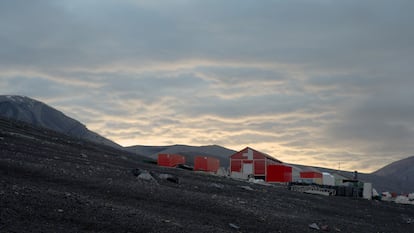
Spain has two bases in Antarctica, on two neighboring islands: the Juan Carlos I, managed by the CSIC, and the Gabriel de Castilla, run by the Spanish Army. The former, where alcohol is strictly prohibited, resembles a monastery dedicated to science. The latter, where wine and beer are available, has a more festive mood. In the almost always lively living room, hanging above a leg of jamón, there is a map of the Deception Island volcano with five evacuation routes depending on the potential eruption site.
Lieutenant Colonel Javier Moreno Amatriain, head of the base, explains that they are ready to get out at any moment. “We always have five boats on the beach to be able to evacuate all personnel,” he says. Two technicians from the National Geographic Institute, Violeta Rechcygier and Sergio Blanca, monitor the volcano’s movements in real time from a module at the base.
The island is a haven for scientists thanks to its extraordinary conditions. The high ground temperatures facilitate the establishment of immense penguin colonies, with more than 50,000 individuals. This past February, the biologists Josabel Belliure and Gabriel López, from the University of Alcalá, and Nacho Juárez, from Oxford, were investigating whether global warming is changing the penguins’ personalities, making them more timid, exploratory or aggressive. On a beach, the oceanographers Emma Huertas and Elena Rubio resemble the protagonists of Ghostbusters, except that instead of a proton pack to capture spectra, they are carrying a portable sensor on their backs to measure greenhouse gases. They walk on fumaroles at temperatures of over 100ºC (212ºF).
“The ocean’s role in mitigating climate change is essential, as it absorbs a large amount of heat and greenhouse gases from the atmosphere, which cushions global warming. Antarctica has sequestered 40% of anthropogenic CO₂ emissions,” explains Huertas, from the Institute of Marine Sciences of Andalusia. “The fact that Gabriel de Castilla Base is located in the caldera of an active volcano gives us the opportunity to study this volcano’s contribution to the greenhouse gas emissions that inevitably end up in the Southern Ocean,” adds the oceanographer, before boarding an Army Zodiac to return to Gabriel de Castilla Base.
Tonight there will be a party and cumbia music with the residents of the Argentine research station — the only other one on the island — but always with five boats ready for evacuation.
Sign up for our weekly newsletter to get more English-language news coverage from EL PAÍS USA Edition









































