
What should moderate right-wing parties do against the far-right surge?
Many of them seem trapped in an identity crisis. The dilemma is whether to embrace extreme positions or strive to maintain a centrist profile, like the Hungarian conservative Péter Magyar, who defeated Orbán with votes from the center and the moderate left
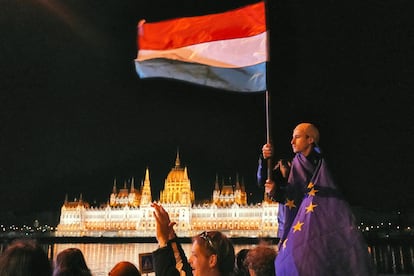

The rise of the far right is one of the great issues of our time: it is often cited as a threat to democracy and one of the building blocks of future dystopias. The left, as is its wont, reacts with a mixture of horror, discouragement, and calls for resistance. Caught in the middle, the traditional right seems to be indecisive, out of step with the times, torn between going all in with the risks that entails (the much-discussed preference for the original over the copy), or maintaining a responsible moderation.
In Spain, this indecision seems to have been dispelled by the pact between the mainstream conservative People’s Party (PP) and the hard-right Vox in the regional government of Extremadura. This deal hands over the family affairs department to the ultranationalist party and incorporates some of its proposals, notably some of its positions on immigration. In other countries, however, movements in the opposite direction are occurring. In Hungary, Viktor Orbán’s hegemony has been overthrown by the conservative, pro-European, and non-illiberal Péter Magyar, who has garnered cross-party support, transcending ideologies, from the center to the moderate left. In the United States, Donald Trump is beginning to generate resentment among his own party members due to his military adventures in Iran (or his famous messianic meme portraying him as something resembling Jesus Christ); and within the right itself, some are questioning his mental stability. Even the Italian president, Giorgia Meloni, with her post-fascist roots, seems to be moderating her position and breaking with Trump’s policies.
The answer to this question is therefore beginning to take shape: what can (or should) the traditional right do to deal with the far right?
The split between the two right-wing factions is not new: it occurred at the end of the Old Regime and the dawn of modernity. One embraced the new era and followed the winds of the Enlightenment: it sought to limit arbitrary power, separate political and religious power, promote individual liberties, and eventually embrace the market economy. The other fought to maintain hierarchies and traditions, old privileges, and the union of throne and altar in a world that was beginning to change at breakneck speed—a change that was soon perceived as decadence. The far right, fueled by the contemporary polycrisis, thrives at the expense of more centrist parties, elevating autocratic leaders, denying science, egalitarianism, and democracy, dominating the conversation on social media, and captivating a growing number of young men.
“The division on the right has always existed; now it’s turned on each other,” explains Armando Zerolo, a professor of political philosophy and law at San Pablo CEU University in Madrid. “It’s curious that the idea of both right-wing factions uniting is being considered, because they are conceptually incompatible,” he adds. He believes that nationalism has no place within the liberal right, which has encompassed a broad spectrum of sensibilities. And he is surprised that there isn’t a stronger reaction against the phenomenon of self-proclaimed patriots and leaders like Donald Trump or the now-disgraced Orbán.
While the center-right has traditionally sought to project an image of moderation and competence, often detached from ideology, the current far right makes no secret of its strong ideological content, which it displays in the culture wars, even while frequently attempting to disguise it as common sense. If the center-right has at times sought to resemble an aseptic technocracy, with calls for modernization and flexibility (hence the accusations of a “cowardly” or “insecure” right wing), the far right has a more revolutionary component.

This revolutionary and anti-establishment character, according to some analysts, is linked to the populist element. “Thus emerges a right wing that challenges the fundamental principles of the existing order, whereas classical conservatism tended to respect tradition and institutions,” explains Diego Garrocho, a professor of moral philosophy at the Autonomous University of Madrid. “Populism is a sign of our times.”
A common narrative about the split portrays it as a result of tensions within the liberal-conservative camp, when conservatives began to believe that liberalism had gone too far. From this perspective, the key to understanding the current situation is not the left-right divide, but rather the distinction between populists and those who defend the institutions. Some, like Zerolo, argue that the far right doesn’t even deserve the name “right,” which is something else entirely, differing not only quantitatively but also qualitatively. Even so, sectors of the traditional right have gotten lost down the rabbit hole of hard-right movements.
Antonella Marty’s personal journey illustrates this shift. This Argentine political scientist was a prominent participant in liberal think tanks until she detected the growing presence of authoritarian and ultra-religious movements, which she considered contrary to her principles. “In some areas, the traditional right has tended to move toward more extreme positions, partly due to electoral calculations and partly due to pressure from these new forces that set the agenda with violence and polarization, even pushing the center aside,” she explains. She cites as an example several key figures in Together for Change, Mauricio Macri’s former center-right party in Argentina. “A large portion of its leaders and voters shifted towards positions aligned with Javier Milei, to the point that key figures like Patricia Bullrich ended up joining his government, and numerous elected congressmembers switched to his party.” While initially the two political groups competed, ultimately one absorbed the other.

Another notable case is that of the Republican Party, in the U.S., a traditional representative of the American center-right, now in the hands of Trumpism. “The MAGA movement, which is not conservative but radical, has almost completely eliminated the center-right. The center-right Republicans, the followers of Reagan, who still exist, often fear expressing their opinions, or have changed their minds, or have withdrawn from politics,” explains the American analyst Anne Applebaum, Pulitzer Prize-winning author of essays such as Autocracy Inc.: The Dictators Who Want to Run the World, via email. For this thinker, the differences are both ideological and methodological: while Republicans have historically believed in free trade, the rule of law, and the idea that the United States should be the leader of the world’s democracies, “in contrast, the MAGA movement has supported tariffs, unprecedented state interference in markets and businesses, and corruption on an unprecedented scale. It challenges and undermines the Constitution and the rule of law; it does not believe that the United States should lead the democratic world and, instead, sees the country as a transactional and predatory state with no permanent allies.”
How to respond to the far right?
What can the traditional right do in the face of this far-right surge? The Hungarian case is an example: try to attract a broad electorate, not necessarily along the left-right axis. Something similar happened in Poland in 2023 when the moderate Donald Tusk managed to unseat the radical Law and Justice Party. Previously in Hungary, coalitions of parties of all stripes were formed against Orbán, but without success. In the case of Hungary, the campaign has focused on denouncing systemic corruption: “Hungarians have learned that the most important political divide is between authoritarians and kleptocrats, on the one hand, and those who believe in democracy, transparency, and the rule of law, on the other. Faced with an authoritarian threat, it is essential to create broad and ideologically diverse coalitions,” says Applebaum. The moderate right can also strive to offer less inflammatory responses to the issues on the far-right agenda. The formula would be a mix of clear boundaries, political effectiveness, and leadership.
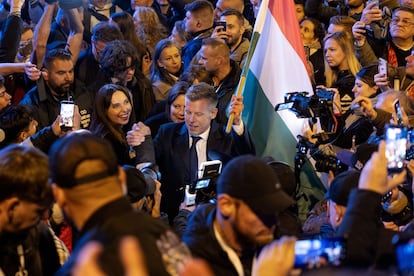
In Germany, traditional parties still maintain the far-right Alternative for Germany (AfD) in isolation, though not without criticism from the traditional right, which believes this isolation benefits the far right by presenting them as the only alternative to the system. The same is happening in France, even though Marine Le Pen has managed to “un-demonize” the National Front she inherited from her father, and has succeeded in attracting voters from the traditional right.
Another approach could be to denounce their rhetoric. “Continuing to call them extremists no longer serves as an alarm bell,” says Diego Garrocho, “it’s necessary to point out their contradictions, to show the specific inconsistencies in their platform, not to fight them solely through fear.” In the United States, the MAGA movement’s support and the silence of the traditional right seem to be fracturing due to Trump’s erratic policies, the consequences of the Iran war, and his messianic and apocalyptic rhetoric: “A whole civilization will die tonight,” the president wrote on social media. Not everyone wants to join him in these diatribes.
The traditional right can also engage in democratic activism, in the sense described by Anne Applebaum: for democracy to thrive, the mere existence of institutions is not enough; it cannot be taken for granted. We must get to work. We must combat apathy, defend the rules, denounce abuses and authoritarianism, and protect those institutions. Democracy does not defend itself.
“The liberal right must exist, remember its history, and shape it,” says the scholar Armando Zerolo. And in his genealogy of the new right, the researcher Franco Delle Donne, author of the book (and podcast) Ultra Epidemic, traces its origin to the idea of the decline of Western civilization, which stems from the work of the German philosopher Oswald Spengler and contributed to the rise of fascism in the 1930s. Defeated in World War II, the thread is picked up again in the French New Right of Alain de Benoist, who unexpectedly takes the Italian communist theorist Antonio Gramsci as a point of reference: the battle for hegemony had to be fought in the cultural arena. That inspiration has become hypertrophied in this apocalyptic and digital age. “When the right learns Gramscian methods from the left, that’s when the right’s defeat occurs,” Zerolo believes.
Sign up for our weekly newsletter to get more English-language news coverage from EL PAÍS USA Edition









































