
One month since the earthquake in Colombia: solidarity, government controversies and the titanic task of reconstruction
President Abelardo de la Espriella is focusing on four affected regions, where repairing the damage will cost 1.5% of GDP and take at least five years
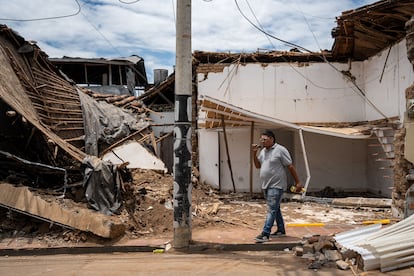

The 7.4-magnitude earthquake that left more than 300 dead and 4,500 injured in Colombia a month ago has marked a before and after in the recent history of the South American country. The government of Abelardo de la Espriella, which had been in office for barely three days, put the response to the natural disaster at the center of its agenda. During the first two weeks, it focused on rescuing people and distributing emergency aid, while a wave of citizen solidarity spread across the country. Now, Colombia is beginning to realize the enormous challenge ahead: rebuilding four regions, a task valued at more than 30 trillion pesos ($9.7 billion, or 1.5% of GDP), and which projections say could take up to five years. One month after the earthquake, the long-term impacts are beginning to emerge.
The government’s response has focused above all on the economic aspect, chiefly, on how to raise the huge sum required for reconstruction amid one of the most serious fiscal crises in recent years. De la Espriella has found the answer in the solidarity of Colombia’s wealthiest individuals. The president traveled this week with a group of them and with heads of major companies to Chocó, the department at the epicenter of the quake and one of the hardest hit. There, he promised to launch an ambitious ‘Marshall Plan’ to attract investment to a region historically neglected by politicians and the business community.
The private sector has become a central pillar of reconstruction in the face of insufficient state funds to respond to the catastrophe. In addition to receiving multimillion-dollar donations, De la Espriella has decreed an economic emergency to obtain the money needed to begin rebuilding. These very large sums will be administered through the so-called Fondo Milagro (Miracle Fund), a mechanism that will channel public and private resources and is modeled on the Forec fund that responded to the 1999 earthquake. The government has not yet formally created the new body, nor defined its structure or the sources that will finance it.
The humanity behind the tragedy
Meanwhile, the human dimension is probably what has most deeply moved Colombian society. Several stories received wide media attention and some names will remain in the collective memory — names like Ana María Saavedra, the 23-year-old triplet who survived the quake in Cali but saw her two sisters and parents die. Or Violeta, the seven-year-old girl who died clutching her grandmother in the same city. Or Daniela Largo, a 32-year-old woman rescued from the rubble in Pereira 36 hours after the quake. Her case was a small light of hope amid the tragedy, which was cut short by her death a few days later from her injuries.
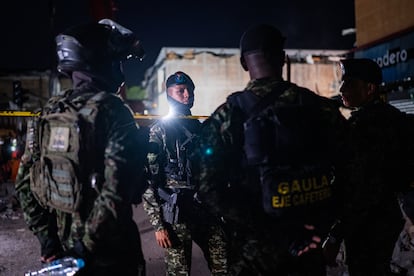
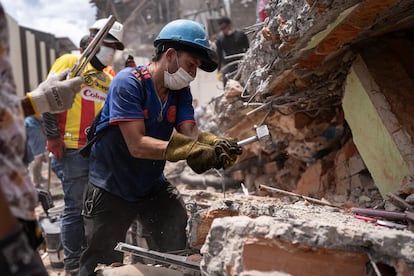
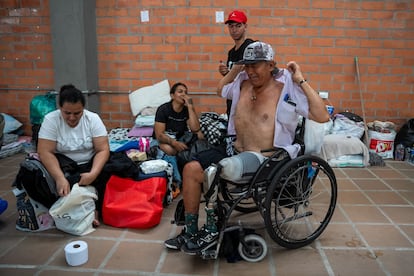
In the first days, the response concentrated on rescue operations. More than 300 people were pulled from the rubble, but about a hundred remain missing and are presumed dead. Citizen solidarity was a hallmark of this initial phase. Hundreds of campaigns in Colombia and around the world responded to the immediate needs of the displaced, who, according to official figures, number more than 400,000. For them, the government designed a package of assistance that includes temporary subsidies and reductions in basic utility bills.
However, one of the greatest challenges has been ensuring that aid arrives and is distributed equitably. Local authorities have denounced that assistance has been concentrated in large cities and does not reach the most rural municipalities. That was the case in Alto Baudó, a jungle area of Chocó where the mayor has told several media outlets that aid arrived in dribs and drabs.
Many vulnerable groups, such as displaced people and indigenous communities, also complain of unequal attention. Some continue living in shelters or makeshift houses. Another exposed group is minors. The Ministry of Education estimates that half a million children and adolescents had their access to education affected this month. According to Save the Children, more than 300,000 children were left unprotected.
Government controversies
While primary relief and initial aid was making its way to the territories, the government became embroiled in several controversies. There was a highly controversial decision by De la Espriella to limit acceptance of international rescuers to only three countries — the United States, Israel and Ecuador — whose governments are ideologically aligned with his. The presence of Israeli rescuers, many of whom are army reservists, provoked strong rejection from the left.
Another incident that generated great controversy was the leisure trip taken by Housing Minister Jaime Andrés Beltrán, who heads one of the ministries most central to the management of the quake’s effects: 200,000 damaged homes and another 36,000 completely destroyed. The official justified himself by saying he wanted to ‘spend a few hours’ with his wife and children, despite having been in the post for only a week at that time. De la Espriella also had missteps of his own: in Buenaventura he distributed soccer balls bearing political propaganda to children, who still await the full restoration of their education system.
Beyond the faux pas, another hallmark of this administration has been the constant travel of ministers, the vice president and De la Espriella himself to the regions. On his most recent trip, this Monday, when he traveled to Chocó with a group of billionaires, the president echoed a request that others have made: reconstruction goes beyond the earthquake. In the specific case of this department, Colombia’s poorest, the president wants it to become an investment hub. To that end he announced an infrastructure package valued at 1 billion pesos ($322 million), equivalent to the entire Chocó budget for 2026, for road upgrades and for renovating an airport near the Pacific Ocean.
‘We are not going to respond to the disaster with a handout program that distributes subsidies and then abandons the territory until the next emergency. True solidarity does not generate dependence: it emancipates, transforms and creates the conditions for a region to produce, grow and prosper,’ De la Espriella said, using a slogan that members of his cabinet have repeated in other parts of the country.
Demolition phase
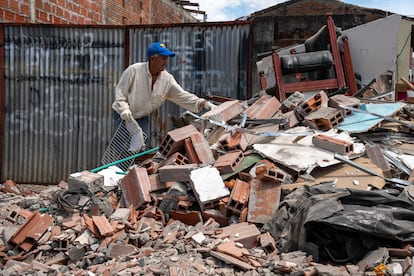
Now, paradoxically, reconstruction is focused on demolition. Cities such as Cali and Pereira have begun tearing down buildings at risk of collapse. The Fondo Milagro plans to allocate two trillion pesos ($644 million) for that task in the department of Risaralda, its appointed manager Jaime Uribe, a close collaborator of De la Espriella, said this week. Local authorities say this phase will take several months, as many structures must be brought down with heavy machinery and without explosives because of their proximity to other buildings.
The anthropologist Juan Carlos Orrego wrote in his most recent column published in this newspaper that reconstruction is not only economic. It also ‘redefines government agendas, creates expectations and exposes leaders to a permanent examination. In many cases, social urgency ends up forcing improvised institutional decisions and political pressure pushes quick fixes that can compromise the quality of the reconstruction.’
The recovery of western Colombia is a major test for De la Espriella. Figures close to the president have publicly expressed their ‘relief’ that he, and not former president and opposition leader Gustavo Petro, is the one responding to the emergency. Conversely, supporters of the left have sharply criticized the government’s response. One month later, Colombia remains shaken by the biggest natural disaster of this decade and by the economic and social challenges that are already coming to light.
Sign up for our weekly newsletter to get more English-language news coverage from EL PAÍS USA Edition









































