
Colombia’s government stumbles after the earthquake: A minister at the beach, political soccer balls and virtual classes without internet access
Lawmakers have called for a no-confidence vote against Jaime Beltrán after he took time off during the crisis, while residents criticize proposals that they say ignore local realities
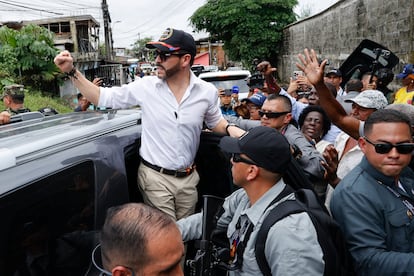

From the first day of Colombia’s humanitarian emergency following the magnitude 7.4 earthquake, President Abelardo de la Espriella ordered that all government communications about the crisis be channeled through him. He was the first to announce the death toll, and he personally led press conferences in the cities hardest hit by the quake. De la Espriella has sought to project the best possible image of his administration: a government working on the ground rather than issuing orders from a desk in Bogotá.
But his housing minister, the Christian pastor Jaime Beltrán, has tarnished that image. The minister was seen this Sunday relaxing on a beach on the Caribbean coast while thousands of people remain homeless, sleeping outdoors after losing their houses. Criticism of Beltrán’s apparent indifference came from across the political spectrum, adding to the backlash already facing the president over his conduct in the port city of Buenaventura.
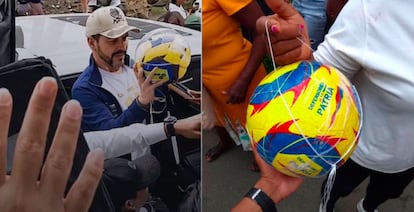
There, De la Espriella handed out soccer balls with the logo of his political movement, Defensores de la Patria (Defenders of the Homeland), to earthquake victims. After his visit to the Pacific port, several observers, including former culture minister Paula Moreno, argued that the government’s approach in a place like Buenaventura should take into account the perspectives of the communities it is trying to help.
The president’s biggest headache, however, has come from his housing minister. Pastor Jaime Beltrán, the former mayor of Bucaramanga, is one of De la Espriella’s closest allies and joined his presidential campaign at an early stage. But just a week after the earthquake, he chose to travel to the beaches of Santa Marta with his family, despite government reports showing more than 127,000 damaged homes, 26,000 destroyed homes and 197 collapsed buildings. More than 90% of homes in Colombia lack insurance coverage, meaning earthquake victims are anxiously awaiting for the minister to outline the reconstruction plan.
Beltrán defended himself against the criticism by saying he had traveled to Santa Marta only briefly to visit his family because he had not seen them during the week. “We must not forget that behind the minister there is a father, a husband, a son,” he said.
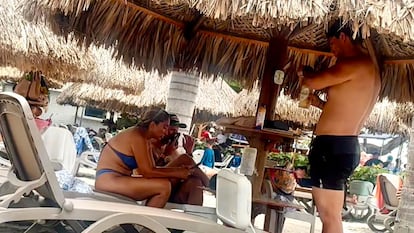
The controversy drew criticism not only from the left but also from members of the right who back the president. Senator Carol Borda, from National Salvation, the party that endorsed De la Espriella’s candidacy, sharply criticized the housing minister. “What a painful level of disconnect when thousands of families are living with the anguish of having their homes destroyed and not knowing where they will sleep,” she posted on social media.
Andrés Forero, a senator from the conservative Democratic Center party, the largest right-wing bloc in Congress, also condemned the minister’s behavior. “By remaining in office, he is forcing President Abelardo to deal with a problem that is not of his making and subjecting the government to premature and unnecessary political wear and tear,” he said.
Jota Pe Hernández, a senator from the Green Party who leans to the right and is an admirer of the president, also shared the hashtag #Indifferent alongside a photograph of the minister.
The House of Representatives has already requested that Beltrán appear for a no-confidence vote, in which the largest left-wing caucus is expected to seek his removal. The second-largest bloc, the Democratic Center, is also unhappy with the minister’s conduct. De la Espriella, however, has kept him in office, announcing that he will lead a “miracle plan” for reconstruction. He also sought to reassure those who lost their homes: “You have not been abandoned.”
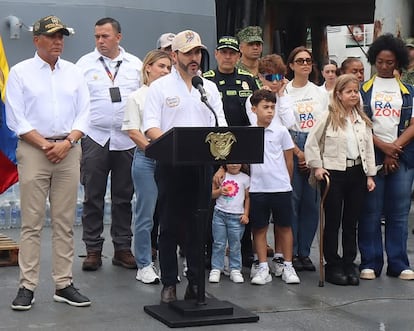
At the same time that the housing minister was spending Sunday at a beach in Santa Marta, the president traveled with his wife and members of his cabinet to the port city of Buenaventura, one of the areas hardest hit by the earthquake. More than 10,000 homes were damaged, over 400 people were injured and 27 people were killed. The city’s healthcare system has been overwhelmed, and De la Espriella held a press conference to announce the reopening of the hospital ship Benkos Biohó and the delivery of tons of medical aid to the Pacific port.
The controversy stemmed not from the press conference itself, but from what happened afterward. The president stopped on a street in Buenaventura to toss soccer balls — with the logo of his political movement — to children affected by the earthquake in the port city. A local activist filmed him throwing them into the crowd, and the outrage directed at the housing minister was soon joined by criticism of what many saw as political branding disguised as charity for vulnerable victims.
The image recalled a moment from Donald Trump’s first term in 2017, when he drew criticism from Puerto Rican officials for tossing paper towels to victims of Hurricane Maria.
“There’s nothing inherently wrong with handing out soccer balls, but it was a communications mistake. What people are left remembering is: ‘The president went to Buenaventura to hand out soccer balls,’ and the truly important aspects of the visit got lost,” says Jhon Jairo Caicedo, a columnist from the region.
For Leonard Rentería, a community leader in the port city, “the real issue isn’t the soccer balls.” Rather, he points to the fact that dozens of schools in the area have been damaged and that authorities have declared an “educational emergency.” Six schools have been completely destroyed.
Far less attention has been paid to another announcement made in Buenaventura by Interior Minister Rodrigo Lara Restrepo, who said the government hopes telecommunications companies will donate “data plans for children, and we will work to provide tablets so that we can have virtual education as soon as possible.”
Also in Buenaventura that Sunday was regional expert and former culture minister Paula Moreno, who heads the Manos Visibles foundation. Without mentioning either Lara or De la Espriella by name, she offered both a suggestion and a critique of how the response could be improved, especially for children who need far more than soccer balls.
“We need a team of professionals from the Pacific region within the national government who can speed up this [reconstruction] process, because we’re moving very slowly in understanding the reality on the ground and in proposing real solutions,” she said. “Virtual classes don’t work because the Pacific region lacks reliable internet access, and children there can’t afford cell phones. So virtual learning is not the answer for us.”
Moreno added that the priority should be restoring in-person classes, above all in safe and supportive environments, since young people are particularly vulnerable to recruitment by armed groups operating in the region. “And rental subsidies are of limited use because there simply aren’t many properties available to rent,” she said, referring to the government’s plan to provide assistance to tenants. It was a reminder from a region asking to be understood with greater sensitivity than was evident in the distribution of politically branded soccer balls.
On Monday night, De la Espriella once again said that all major communications related to the emergency would come through him, that his ministers were deployed across the country, and that they were working around the clock. But one of them did go to the beach, and while the president traveled to the affected regions, not every message landed the way he intended. In times of crisis, any appearance of indifference becomes a political liability.
Sign up for our weekly newsletter to get more English-language news coverage from EL PAÍS USA Edition









































