
Delsa Solórzano, Venezuelan opposition figure: ‘The person who must explain these oil agreements is Delcy Rodríguez, not Donald Trump’
The Citizens’ Movement leader warns that pacts with the United States will have to be reviewed in the future, while she envisages an electoral process within no more than 10 months
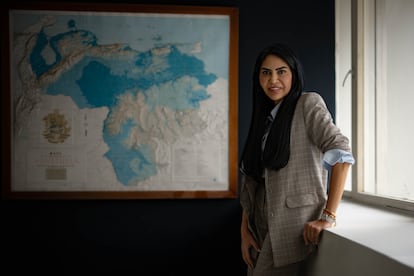
Opposition leader Delsa Solórzano (Caracas, 54) has a long record of defending human rights and the fate of political prisoners in Venezuela. She was active in several opposition organizations until she founded her own party, Citizens’ Movement, in 2018, which is part of the Unitary Platform. Solórzano ran in the opposition primary for president held in 2023 and was heavily involved in the 2024 presidential campaign. She took on logistical responsibilities to safeguard the vote in that failed ballot. After the wave of repression unleashed by Nicolás Maduro following the elections, she spent several months in hiding.
Solórzano values the role of the United States in efforts to return the country to democracy, but she is not satisfied with the oil agreements announced. She sums it up this way: “Economic success starts with trust. Trust is founded on legal certainty and that on the rule of law. As long as that does not exist in the country, no economic agreement will be stable.”
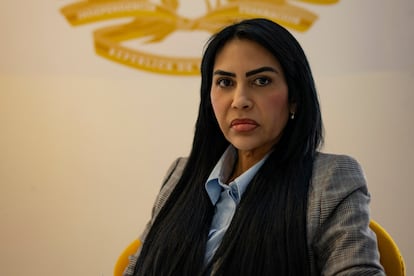
Question. Do you feel comfortable with the role the United States has played and with the stance Trump has taken toward Venezuela?
Answer. Over these past years we have made every effort to return the country to democracy, always seeking peaceful solutions and relying on the electoral route. I spent a year and a half in hiding, which, honestly, I wouldn’t wish on anyone. After January 3 [when the United States captured Maduro in Caracas], Venezuelans regained hope. Were it not for that day, we would not be speaking right now. One may have grievances or observations, but you can’t fail to appreciate what was fundamental.
Q. Many people in the country believe the United States has formed an alliance with the Chavista regime.
A. I don’t see it that way. I understand the concern — perhaps we expected things to move faster. But these processes don’t move at the speed we would like. I think we are on the path to democracy. I hope I’m not wrong.
Q. Do you agree with critics who say the oil agreements represent a loss of sovereignty?
A. On July 28, 2024, when they stole the presidential elections, the chavista regime kidnapped national sovereignty. The agreements of recent years with Russia, Cuba, and Iran are the clearest expression of the end of national sovereignty. Venezuela’s mining areas have been controlled by criminal groups for years. They have been illegally extracting our wealth there.
Q. Do you think these agreements with the United States will need to be reviewed in the future?
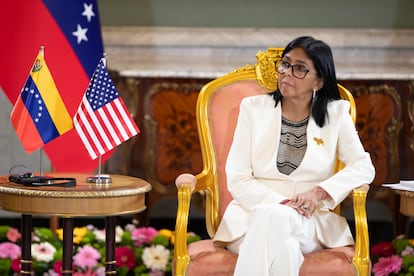
A. Yes, I believe they must be reviewed. Transparency as a principle must be part of the dynamics of political change. We need to know what those oil agreements entail: what was handed over, under what conditions, and the details. On this matter, as on others under discussion in the country, we often put responsibility in the wrong place. The person who must explain these agreements to Venezuelans in detail is Delcy Rodríguez, not Donald Trump.
Q. What do you think about Washington’s choice of the controversial businessman Alejandro Betancourt as the coordinator of the oil agreement?
A. It took us by surprise. They owe us a lot of explanations: we understood that this man had pending lawsuits against him. But, again: it is Delcy Rodríguez’s interim government that owes us these explanations.
Q. Aren’t you afraid mutual business deals have been imposed between the White House and Miraflores?
A. Very likely. Venezuela has long faced that problem as a country: the allure of its natural resources, its oil reserves, its fortunate geopolitical position. But defending Venezuela’s interests is our responsibility, not that of foreign governments.
Q. Chavismo and the opposition are approaching a second round of political negotiations next week. What are your expectations for that process?
A. I would have preferred a different negotiation process, but this is the one we have. No transition process has taken place without some form of negotiation beforehand. The position of the party, as well as that of almost the entire Unitary Platform, is to help in every way we can.
Q. In which areas has progress been made, and where has there been none?
A. I hope agreements on a new Supreme Court (TSJ) will meet the demands of the moment, with independent, honest judges. I hope the appointment of a new National Electoral Council (CNE) will be swift and that it will be a depoliticized, professional and honorable body. Several laws of the chavista repressive apparatus must be repealed: the Law against Hate, the Simón Bolívar Law, the law that restricts NGOs. Also the seizure of freedom of expression and the media.
Q. Don’t you consider a roadmap to renew authorities necessary?
A. Dinorah [Figuera, president of the exiled 2015 National Assembly who leads negotiations with Chavismo] has been announcing it. We are supposed to see some results in December: a new TSJ and a new CNE. I understand the urgency, but we cannot demand elections from this CNE, which was the body that facilitated the 2024 fraud.
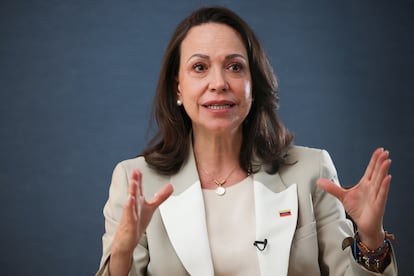
Q. Negotiations with Chavismo without María Corina Machado have caused rifts within the opposition. How are things inside the Unitary Platform?
A. The platform has the higher mandate to bring together all political actors — including María Corina, who is not part of the platform — within strategies that allow us to return to democracy. It is about consolidating a unity that goes beyond the platform’s eight political parties. This round of negotiations will end in December, and after that comes the hard part: setting an election date. That is what must happen: a re-legitimization of authorities.
Q. Should Machado not have been the one to lead that process, as approved in Panama?
A. The Unitary Platform received several proposals at the time to start dialogue with Chavismo. In that effort to coordinate, we consulted widely, starting with María Corina, who undoubtedly holds the opposition leadership given to her by the people’s vote. But Washington sought another mechanism and chose interlocutors directly. We then proposed a kind of political commission, a unitary coordination body. María Corina has refused, which I respect. We maintain permanent contact with her, and we think it was wise of her to say she would not obstruct the process.
Q. Does the opposition have room to steer the transition?
A. We must be clear that today we would be in a very different, much darker political situation had January 3 not occurred. For a long time many people in Venezuela had been calling for international community support in the face of the magnitude of the tragedy unfolding under the chavistas. Things have evolved favorably politically.
Q. Can you forecast an election date?
A. Political processes are not predictable. But if things go as they should according to the information coming from the negotiating table, I would say that in about eight to 10 months we should have an electoral process in the country.
Q. Donald Trump has said that Venezuela is not ready to organize elections at the moment.
A. I prefer to anchor myself in the three-step plan announced by Marco Rubio: stabilization, recovery, and transition. The roadmap we approved in the Unitary Platform is based on that interpretation.
Sign up for our weekly newsletter to get more English-language news coverage from EL PAÍS USA Edition









































