
Alejandro Betancourt, Trump’s new Latin American oligarch
The Venezuelan businessman, under investigation in Switzerland and Spain, is the key to the oil agreement with Delcy Rodríguez’s regime

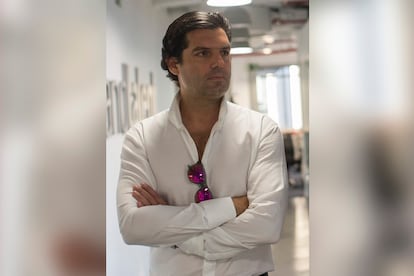
A 46-year-old businessman with a terrible reputation has just become Donald Trump’s oilman in Venezuela. After days of speculation, the White House finally released more details about the historic deal that will give him privileged access — for a century — to a quarter of Venezuela’s crude reserves. It is an unprecedented agreement, but the most surprising thing is who is behind it. Alejandro Betancourt, who remains under investigation in Switzerland and Spain for alleged money laundering and tax fraud, is the architect, the broker, and the main beneficiary of the contract that has whipped up a storm from Caracas to Washington. “No Betancourt, no energy-security deal,” a U.S. official told Axios.
The businessman has managed to get interim Venezuelan President Delcy Rodríguez to grant his company, North American Blue Energy Partners (NABEP), the rights to exploit 17 oil fields. He will be responsible for securing investment and getting the operations up and running, with the invaluable backing of the U.S. State and Defense departments, which have taken a 35% stake in the company. Washington thus secures the right to purchase 20% of the crude oil at cost. “No other oil executive can say they have the Pentagon on their side,” an official told Axios.
Overnight, the controversial businessman, under investigation by European authorities, has become one of the most powerful men in Venezuela — with political, economic, and military backing from Washington. “This is a proven operator… I’m not nominating anyone for sainthood here. What I am telling you is that this is a person that, in the past, has been helpful to the United States government,” a senior official in the Trump administration told several reporters on Tuesday.
Why Betancourt? Trump’s inner circle has made it clear that his legal troubles don’t bother them — provided he is not charged in the United States; what matters is his track record in oil fields and how NABEP had ramped up production in recent years. It’s realpolitik. “Geopolitics is often not a choice between the ideal and the imperfect. It is often, you’re trying to navigate what’s the best outcome, and you have to work with the factors that you have in place," the senior official explained.
“They say he’s shrewd and a very good negotiator,” a source in the sector says. “And it’s true he’s done well with his company, but also because the potential he had to exploit was high.” Other oilmen are far more skeptical: “Betancourt isn’t successful because he knows a lot about oil — he doesn’t — but because he knows how to move money.”
The path that gave Betancourt and the Pentagon control of NABEP left former partners by the wayside. Until August, a minority stake was held by Harry Sargeant III, a Florida oil magnate, Republican donor, and informal mediator between Washington and Caracas — who helped free U.S. hostages in 2025 — whom Nicolás Maduro affectionately nicknamed “El Abuelo” (grandfather). But with Maduro confined in New York, Sargeant apparently became inconvenient. In August, the U.S. Treasury froze the assets of the company through which he operated in Venezuela, and Sargeant faced pressure from multiple fronts — including from Venezuela against people close to him — to sell, according to sources familiar with the case. He ended up selling his stake for $300 million to an entity affiliated with Betancourt, leaving him as the sole shareholder of a company producing about 200,000 barrels a day.
Today, the businessman who became wealthy from energy contracts in the Hugo Chávez era — in a country where thousands still spend over 10 hours a day without electricity — is far more than Trump’s new oilman. Betancourt has more than a knack for deals: his tentacles have been in Caracas offices for over a decade, switching sides as the wind blows. “Maduro might still be in power if it weren’t for him,” Axios quotes the same official as saying.
U.S. media now report that he was crucial to the operation that ended with Maduro’s capture on January 3. That night, as special forces removed the autocrat and his wife, Cilia Flores, Betancourt played the good cop, calming Delcy Rodríguez, who initially thought her boss was dead. ‘I don’t speak with murderers!’ Rodríguez said later that night in a highly upset state, according to several sources who spoke to EL PAÍS about those conversations. Several interlocutors, including Betancourt, eventually persuaded her to speak with U.S. Secretary of State Marco Rubio about taking control of Venezuela. In those calls, according to The Washington Post, senior U.S. officials made clear to Rodríguez that Betancourt would be the key intermediary to reactivate the oil sector: for any related matter, she would have to coordinate through him.
The US hand in Switzerland
Betancourt’s name had been circulating in Caracas for weeks when, after the twin earthquakes of June 24, private jets from the United States began landing in Venezuela, as EL PAÍS revealed on August 16. It was a controversial development: Betancourt had been living in Europe for years, and the Swiss prosecutor’s case against him included an extradition order and the retention of his Italian and Venezuelan passports. Betancourt had been confined to his two mansions in the United Kingdom.
Two sources warned this newspaper then that his new freedom had the hand of the United States behind it. A Post investigation detailed how senior Trump administration officials — including Under Secretary of State Christopher Landau and then–Attorney General Pam Bondi — pressed Swiss authorities for information and favors for their associate. Betancourt’s extradition request to the UK was revoked in May 2026 due to “particularities of British extradition law,” the Zurich Prosecutor’s Office told EL PAÍS, but the investigation continues. “That is very unusual, and we expect Swiss authorities to make a statement explaining that contradiction,” said a spokesperson for Public Eye, a Swiss NGO known for its investigations into the oil sector’s financial opacity.
Betancourt is also a politically exposed person for Swiss authorities. Barely 48 hours after Maduro’s capture, the Swiss Federal Council ordered the freezing of assets belonging to dozens of people with ties to the autocrat — including members of Maduro’s immediate family, prominent chavista figures, Betancourt and several of his associates. Thanks to that order, 239 million Swiss francs (about $295 million) belonging to 21 of the 37 people on the list were frozen, Public Eye reports.
The organization has not been able to confirm to EL PAÍS what portion, if any, belonged to Betancourt, but warns: “As early as January 2026, a member of the U.S. embassy staff had asked us about this asset-freezing regulation.” Another piece of evidence of how closely the United States has followed Betancourt’s legal problems.
Betancourt’s ties to Washington date back to Trump’s first term, when the United States declared Maduro illegitimate and recognized Juan Guaidó in 2019. Trump’s circle has confirmed that Betancourt acted as a link between the opposition and senior Venezuelan military commanders to build internal support for a peaceful transition to a Guaidó government. Axios reports he even traveled to Moscow to hand-deliver a letter from Guaidó’s camp asking Russia to stop backing Maduro. That effort failed: Maduro endured, and Betancourt fell from favor.
“Guaidó’s financier”
It was then that the regime confiscated his stake in his oil company (Petrozamora), froze his assets in Venezuela and sent security forces to his properties. As the Post revealed recently, Betancourt financed the opposition to Maduro, which aligns with a direct attack at the time by the current president of the National Assembly, Jorge Rodríguez — Delcy’s brother. Rodríguez, then communications minister, alleged at a February 2020 press conference that there was “a corruption network between Alejandro Betancourt, Tamara Adrián [then a deputy] and [center-left opposition party] Voluntad Popular that hides the fortune used to attack Venezuela and finance terrorist acts.” The headline of that press release read: “Alejandro Betancourt López is the direct financier of Juan Guaidó.”
In 2023, the Post reported, it was Delcy Rodríguez herself, then vice president, who called Betancourt back to Caracas for a private meeting. She offered a deal: a return to public life in exchange for staying out of politics and resuming his businesses with security guarantees. Betancourt accepted, and NABEP was born from that rapprochement. That same year, the Venezuelan case against him was shelved.
Betancourt is the son of a musician and a jewelry designer, from a well-off family in Valencia, around 100 miles from Caracas. He was part of a group of young men from the Instituto Cumbres de Caracas, run by the Legionaries of Christ, and through a school friend he landed his first multimillion-dollar contract before turning 30. His first business challenge was to address the 2009 power crisis by buying several power plants — said to be secondhand — that barely solved the problem.
At that press conference, Rodríguez, who today applauds the deal with Washington and the businessman, herself claimed Betancourt became a multimillionaire thanks to that crisis. “With the approval of those contracts, Betancourt bought factories, industries and luxury residences in the U.S. state of Florida and in Spain,” she asserted.
Legal cases against Betancourt began more than a decade ago in Venezuela, continued to the United States and reached Switzerland and Spain, where he has invested hundreds of millions of dollars in companies and bought extremely valuable properties, including a castle he owns in Toledo (Spain). In Venezuela the case was dismissed; in the United States several of his partners were convicted, but he was never charged there, and in Europe the investigations remain at the instruction stage. These are not straightforward cases: investigators are trying to clarify the origin and destination of more than $4 billion allegedly diverted from the Venezuelan state oil company PDVSA with the connivance of bribed officials.
Through his prominent attorneys — who include Donald Trump’s personal lawyer, Rudy Giuliani — Betancourt has always denied any wrongdoing. His persona, however, provokes enormous rejection in Venezuela, from both sides of the political spectrum, within Chavismo and among supporters of opposition leader María Corina Machado. A hostility Betancourt attempts to smooth over across multiple web pages that extol his virtues and with an army of bots that praise him in every post attacking him. “Alejandro Betancourt, the people are with you,” they chant.
Sign up for our weekly newsletter to get more English-language news coverage from EL PAÍS USA Edition









































