
Oil, the most sensitive issue in Venezuelan politics
The agreement announced by Donald Trump has sparked widespread unease in a country with a deeply rooted sense of ownership over its natural resources
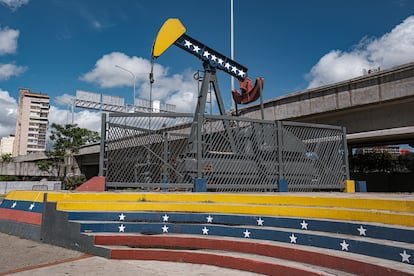
The oil agreements announced by U.S. President Donald Trump and Venezuela’s acting president, Delcy Rodríguez, of which only fragmentary details have so far emerged, have touched on some of the most sensitive areas of Venezuelan public debate: the relationship between oil, the state and citizens.
The existence of long-term agreements (at least 25 years), announced by a foreign president, with no verifiable details about their potential benefits and amid widespread suspicions about how the United States has used Venezuela’s national revenues in recent months, has sparked broad discontent. This unease has been only partly tempered by the instinct among certain local elites not to antagonize Washington, perhaps because they see Washington as the last remaining hope for a return to democracy. These agreements have not been submitted to Venezuela’s National Assembly, as required by the Constitution.
The debate over the exploitation and use of oil resources in Venezuela is more than a century old, dating back to the discovery of the country’s first oil fields. Over the decades, a powerful sense of ownership over oil wealth took root in Venezuelan society. In local political debate, commitment to national ownership of crude oil has long been regarded as a moral measure of political actors. Some of the most important works of Venezuelan political thought, such as Venezuela, Politics and Oil by Rómulo Betancourt (1956), place oil production and the strategy for developing it within a framework of national sovereignty at the center of their argument.
The dictatorship of Juan Vicente Gómez (1908-1935) has been judged harshly by Venezuelan historians for the lenient terms under which it negotiated the country’s first oil concessions with foreign companies, to the detriment of the national interest. Under Gómez, multinational oil firms established themselves in Venezuela and stayed for as long as possible.
Since then, each successive government has sought to strengthen national control over oil and its production, a longstanding goal of Venezuelan politics. The reform-minded and moderate administration of Isaías Medina Angarita (1941-1945) enacted the Hydrocarbons Law, which for the first time required multinational oil companies to operate under state regulations. The law set royalties payable to the state at 16% and imposed a 12% tax on profits from oil production.
In 1945, the new president, Rómulo Betancourt, levied an extraordinary tax on the profits of multinational oil companies. Shortly thereafter, under the government of Rómulo Gallegos, the so-called “fifty-fifty” rule was adopted, stipulating that the state could never receive less revenue than the oil companies earned in net profits. These measures were later repealed by the dictatorship of Marcos Pérez Jiménez, which in the 1950s opened the door to foreign capital with few restrictions.
In the 1960s, the first governments of the democratic Punto Fijo era (1958-1998) halted the granting of new oil concessions. The Venezuelan Petroleum Corporation (Corporación Venezolana de Petróleo) was established as a regulatory body for the industry, another step toward nationalization, while a new framework for dealings with multinational companies was introduced through service contracts.
The nationalization of the oil industry in 1976, under the social democratic government of Carlos Andrés Pérez, heightened public sensitivity to the industry’s relationship with foreign capital and solidified a broad consensus in favor of state ownership.
Contrary to what some had predicted, Petróleos de Venezuela (PDVSA), a state-owned company managed with considerable efficiency, became a highly successful model of public sector management. During years of extraordinary prosperity, it offered some of the highest salaries in the country. The company grew into a giant that controlled every stage of production, supplied international markets with crude oil and refined products, and became Latin America’s most powerful corporation, according to América Economía magazine. The nationalization of oil, gas and iron ranks among the most significant political milestones of 20th-century Venezuela.
In the 1990s, the Venezuelan state launched the so-called Oil Opening (Apertura Petrolera), an ambitious program aimed at attracting foreign investment and expanding access to international markets. The initiative was only partially implemented and was criticized by the far left as a sellout to foreign interests. At the time, with international oil prices depressed, royalties were extremely low, amounting to just 2%.
After taking office in 1999, Hugo Chávez shattered one of the most delicate understandings in Venezuelan politics by bringing PDVSA into the political arena, triggering a major crisis in 2002 that nearly cost him power.
After defeating the opposition, Chávez took political control of the company and intensified both oil nationalism and his anti-American rhetoric. From then on, he repeatedly accused both the Venezuelan opposition and the United States of seeking to seize the country’s oil wealth. Around 2007, he required multinational energy companies to operate through joint ventures in which PDVSA retained a majority stake. During a period of exceptionally high oil prices, royalties were set at 30% and income taxes on profits at 50%. The country received vast sums of money, fueling rampant corruption. Under Chavismo, PDVSA became an adversarial actor toward U.S. interests, and its operational and financial performance began to decline.
Oil and the culture surrounding it are deeply embedded in the Venezuelan imagination: in the visual arts, graphic design, public monuments, music and popular storytelling. In 1980, during the golden age of Venezuelan television, José Ignacio Cabrujas and Ibsen Martínez wrote the successful dystopian series El día que se acabó el petróleo (The Day Oil Ran Out).
The issue has also figured prominently in the work of major Venezuelan writers such as Arturo Uslar Pietri, Miguel Otero Silva and Ramón Díaz Sánchez. Uslar’s essay Sembrar el petróleo (Sowing the Oil) was required reading in Venezuelan schools for several decades.
Venezuelan ownership of the country’s oil resources is bound up with the nation’s very identity. Few proposals have struggled to gain traction in public debate as much as the privatization of Petróleos de Venezuela, despite the decline of Chavista oil nationalism and the collapse in oil production.
Sign up for our weekly newsletter to get more English-language news coverage from EL PAÍS USA Edition









































