
Security czar Omar García Harfuch helms Mexico’s 180-degree turn with the DEA
Broken during López Obrador’s era, the relationship with the US agency has entered a new phase of collaboration under Claudia Sheinbaum’s government

Few institutions embody with such clarity the spirit of the nation they represent, its ideals and interests, as the DEA, the United States’ anti-narcotics agency. One could argue that the transnational nature of organized crime justifies the agency’s presence in other countries in the Americas, but the line between duty and the familiar U.S. expansionist logic—well known to Latin Americans—is blurred, sometimes faint, sometimes explicit. In Mexico’s case, a partner and immediate neighbor of the U.S., the relationship with the agency enjoyed years of prosperity in cooperation (and a degree of tolerated interference) under PRI and PAN administrations. However, the arrival of the leftist party Morena and Andrés Manuel López Obrador to power lifted a wall. The former president left office having closed the door to the DEA. Until now, that is. Despite resistance from the hardest wing of the still-governing Morena, Mexico is reopening to cooperation with the U.S. agency.
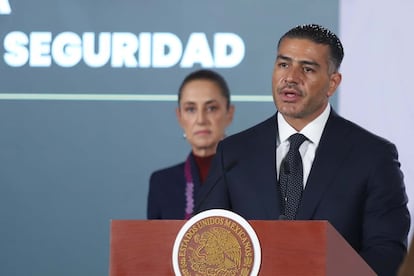
The 180-degree turnaround has put the spotlight on Omar García Harfuch, Mexico’s security cabinet coordinator, a career police officer and a trusted confidant of President Claudia Sheinbaum, with whom he had worked since the days she led the Mexico City government. García Harfuch has held two meetings this year in Washington with the head of the DEA, Terrance Cole. Cole, in turn, traveled to Mexico City for a discreet meeting with Sheinbaum’s security czar—an encounter that was not publicly disclosed: not when it took place, where, nor for what purpose. If there was any bilateral pact, the public does not know about it.
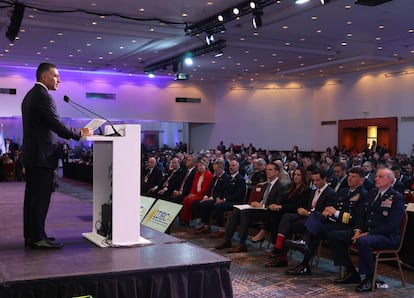
Mexico’s security secretary was in Argentina in August to attend the International Drug Enforcement Conference organized by the U.S. anti-narcotics agency. He spoke before dozens of officials from other countries about the results of Mexico’s security strategy against organized crime, much of which, he said, has been achieved thanks to unprecedented fluidity in information sharing with the DEA under Cole’s leadership. That immediacy has occurred “bypassing all the protocols that sometimes take a long time,” García Harfuch said, and has allowed Mexico to act promptly against criminals.
The good results are not due solely to collaboration with the DEA, but also with other U.S. agencies. In nearly two years of Sheinbaum’s administration, 63,000 suspected criminals have been arrested, 33,000 weapons seized, 2,700 drug labs destroyed and 518 tons of drugs confiscated. Mexico has also handed over 92 major criminals to Washington through a legal exception that bypasses the bureaucracy of ordinary extradition. Hard blows have been dealt to the cartels, exemplified by the death of Jalisco New Generation Cartel (CJNG) leader Nemesio Oseguera, aka El Mencho, in a military operation that relied crucially on U.S. intelligence cooperation. Fentanyl trafficking from Mexico has fallen by half, and the flow of migrants from South America across Mexico’s borders has collapsed by 96%. This Friday, the Security Cabinet reported the seizure of a 16-ton shipment of methamphetamine in Sinaloa, possibly the largest seizure to date. The DEA immediately sought part of the credit for the operation, saying it “would not have been possible without the investigative and intelligence work” of the agency.
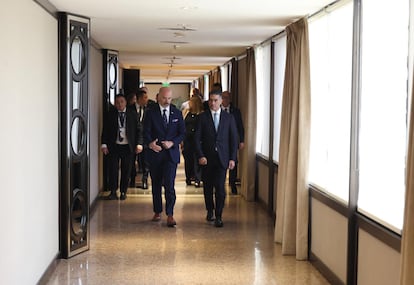
The summit in Argentina sealed the renewed rapprochement between the DEA and Mexico. Or at least that’s how Washington wanted it portrayed. That day, Cole praised the collaboration with García Harfuch and referred to him as “a trusted partner and a good friend of the United States.” The praise did not sit well in the ruling party’s political circles in Mexico, where closeness to the United States is viewed with suspicion, at a time when President Sheinbaum has called for unity against Washington’s “interventionism,” its threats to Mexico’s sovereignty and its attempts to meddle in domestic politics. The president said those back pats for García Harfuch were the typical U.S. way of trying to divide a government that does not bend to its interests.
Repairing the damage
Sheinbaum, in fact, said she did not want her security czar to travel to the DEA summit in South America, citing “the history of the DEA’s relationship with Mexico, especially in recent years.” Her remarks alluded to the six-year term of López Obrador (2018–2024), her predecessor, who ended up breaking with the U.S. agency after several clashes. The first of these, though not the most serious one, stemmed from the 2020 arrest of General Salvador Cienfuegos, defense minister during Enrique Peña Nieto’s administration (2012–2018), on alleged links to the drug trade. Although the general was not an ally of López Obrador by any means, the then-president was worried about the damage that DEA’s move did to the army’s reputation, one of the pillars of his administration.
The settling of scores came months later when López Obrador ordered the closure of a DEA intelligence unit that had operated for two decades in Mexico, specializing in the exchange of confidential information to combat drug trafficking, and one of whose major contributions had taken place during the first capture of Joaquín El Chapo Guzmán. López Obrador asserted that “the group was infiltrated by criminal elements” and accused it of “having fabricated crimes,” referring to the allegations against General Cienfuegos.
López Obrador tightened the screws further and sent Congress a reform to restrict the activities of foreign agents on national territory. During the second half of his term, the DEA published investigations documenting the expansion and strengthening of cartels in Mexico and the U.S., principally the CJNG and the Sinaloa Cartel—claims López Obrador rejected. The total break came in 2024, months before his administration ended, after a series of reports alleged that the drug trade had funded López Obrador’s first presidential campaign in 2006. The main source for those publications was a DEA report that never became a formal accusation.
The ruling party viewed that report as “revenge” by the agency, which gave Mexico’s opposition ammunition to speak of a “narco-government,” a “narco-party” (Morena) and a “narco-presidency,” slurs that persist to this day. Also lingering is the Sheinbaum government’s mistrust of the DEA; the tension between principles, the dignity so often invoked by morenismo, and the urgency to establish a cooperative relationship to confront a shared problem: drug trafficking and threats to the population. The ruling party has swallowed its pride and opened the door again; Washington has had to take a couple of steps back and accept the new conditions imposed by Mexico—demanding respect and reciprocity—to be allowed back in. The balance is as fragile as a spiderweb on the doorframe.
Sign up for our weekly newsletter to get more English-language news coverage from EL PAÍS USA Edition









































