
Young Chileans are turning away from the Church: Tarot, reiki and astrology fuel a new spirituality
Fifty-one percent of people aged 18 to 34 no longer identify with a religion. But more than half of those who do not belong to any church still believe in God
When Gabriela Strahalm was 18, in 2008, she turned to tarot cards for the first time. Her mother, she recalls, was struggling with alcohol abuse, and they had already spoken with a psychiatrist about admitting her to a treatment facility. Gabriela had to decide whether to stay in Santiago, the capital of Chile, or move in with her grandmother. She sought out her best friend’s aunt, who read tarot cards, and asked how her mother would fare if she left.
The reading, she remembers, helped her make up her mind, and Gabriela moved away. Three months later, her mother died. Over the years, she came to associate that first consultation with a different way of seeking guidance during difficult moments.
Since then, nearly two decades have passed, and religious affiliation in Chile has changed dramatically, especially among younger people. In 2006, 19% of people aged 18 to 34 said they had no religion; by 2025, that figure had risen to 51%, according to the UC Bicentennial Survey. Within the same age group, only one in three identifies as Catholic.
Zooming out, the picture is similar. In 2002, for example, 8.3% of people aged 15 and over said they did not profess any religion or creed. In the 2024 Census, that figure had climbed to 25.8%. Those without a religion are also, on average, nearly eight years younger than those who belong to one.
The 2024 survey by the Center for Public Studies (CEP) points to a divide between affiliation and belief. Among those who identify as having no religion, 55% still believe in God, and 67% say they have their own personal way of connecting with God.
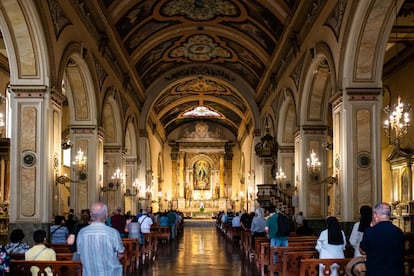
Maureen Neckelmann, a sociologist with the Interdisciplinary Program in Religious Studies at the Pontifical Catholic University, says that a traditional view of secularization argues that as religious influence waned, people would increasingly turn to science to explain the world. In her view, what is happening today goes beyond that framework.
“More than a process of secularization — in the sense of a replacement by scientific, rational views — people, especially young people, are increasingly cultivating individualized spiritual forms,” she says.
That individual approach to belief is also evident across the broader population. The same 2024 CEP survey reveals another striking finding: 76% of Chileans believe in God, while 74% say they relate to him without needing a church.
For Neckelmann, the shift is also about who holds authority over belief. What once came in the form of established doctrine can now become a path assembled by each individual according to their own preferences.
“What appears inconsistent actually has a coherence, but it is individual,” the sociologist says. “If you ask someone what their beliefs are, they will probably try to make a coherent case for why they believe in God and also believe in astrology, for example.”
A personal path
Before that first reading, Gabriela’s only exposure to spirituality had been through the Catholic Church: she made her First Communion. At 15, she became close friends with a schoolmate with whom she talked about UFOs, extraterrestrials, energy, reiki and chakras.
The biggest shift happened during the COVID-19 pandemic: a cousin told her he could communicate with her deceased mother and mentioned memories that helped her heal. That, she says, was her “spiritual awakening.”
Courses, gatherings and conferences have also sprung up around these kinds of spiritual pursuits. Majo Arévalo, a psychologist and event producer, for example, came to tarot through her own personal search and eventually began creating spaces for others.
Over time, that search converged with something she already knew how to do: produce events. She organized courses led by astrologers visiting Chile, as well as tarot and oracle gatherings. Out of that journey came the Chile Tarot Congress.
The congress also teaches participants how to practise professionally as tarot readers and charge for readings, presenting it as a potential career path.
“These therapies help you get to know yourself better. They place the power within you, whereas religion places the power outside you,” she says.
René Gallardo, a psychologist and academic at the Institute of Psychology of the Austral University of Chile, has observed this emphasis on new forms of spirituality. In one of his studies, researchers identified a search for fulfilment, empowerment and a reluctance to engage with formal institutions.
The authors link these traits to a neoliberal logic that places responsibility for wellbeing on the individual. They describe both a “spiritual consumer,” who selects practices according to personal needs, and a “spiritual entrepreneur,” focused on working on the self. As Gallardo puts it: “There is an imperative to ‘treat yourself, heal yourself, so that you can then heal others.’”
Healing and charging for it
Gallardo and Rodrigo Navarrete, also a psychologist and academic at the Institute of Psychology of the Austral University of Chile, have studied holistic therapists in the country’s south. They use the term “therapeutic spiritualities” to describe practices that combine a spiritual worldview with techniques that, according to their practitioners, are intended to relieve physical or emotional problems.
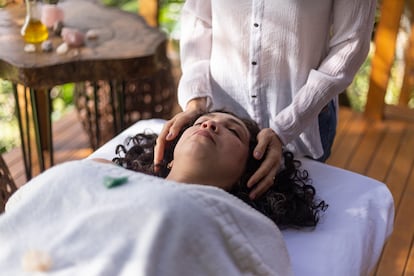
Wilma Flores came to these practices after a personal crisis led her to look beyond Catholicism. She discovered reiki, left her administrative job and now describes herself as a quantum healer, reiki practitioner and medium. She charges 70,000 Chilean pesos per session, about $76. “This is not a business for me. I do it because I understood that my purpose in life has to do with helping others,” she says.
This coexistence of personal conviction and financial livelihood also emerged in Gallardo and Navarrete’s interviews. Some therapists told them they earned more than psychologists. Many preferred to speak of “compensation” rather than payment, Navarrete adds.
Navarrete identified another tension: “There is no such thing as therapeutic failure. Instead, there is something the person is not doing, not developing, something they are failing to achieve.”
For the psychologist, that logic can end up being “quite perverse.”
Regulations
According to Chile’s Ministry of Health, the country has had regulations governing alternative medical practices since 2005. Reiki does not have official recognition as a healthcare profession and may be subject to oversight when offered in a health-related setting.
Arévalo believes tarot readers should abide by a code of ethics: avoiding predictions about death or health, refraining from using fear, and not interfering in clients’ decision-making. She also considers it reasonable that practitioners pay taxes.
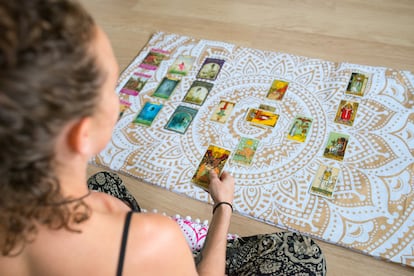
Gabriela first consulted the tarot and later wanted to learn how to interpret the cards herself. She trained in reiki, Egyptian tarot and astrology. In 2021, she began charging for readings. In the afternoons, after finishing her job as a journalist, and on weekends, she lays out a deck of cards on the same desk where she writes her articles. Clients contact her through WhatsApp; she photographs the cards and sends voice messages with her interpretations.
“It does generate income for me, and I’m very proud of that because it comes from something I enjoy. But the line is razor-thin and it can be very dangerous, because you’re dealing with people’s expectations,” she says.
She warns clients that the cards can be wrong and that her interpretation can be wrong too. She reminds them not to base their decisions solely on tarot and recommends psychotherapy or medical care when they are facing serious problems.
“If you don’t believe, then you don’t believe, and that’s the end of it. I’m not going to evangelize you,” Gabriela says.
Sign up for our weekly newsletter to get more English-language news coverage from EL PAÍS USA Edition









































