
Welcome to the post-religion era: The idea of Christianity as the absolute truth has become obsolete
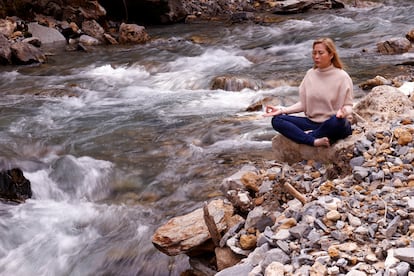
A new landscape of hybrid beliefs is taking shape, in which agnostics embrace Zen meditation and technology, or work on the body-mind-spirit connection

‘Tis the season to occupy oneself in eating and drinking like there’s no tomorrow, in the wonderful warmth of friends and family, remembering those who are no longer with us and locking eyes as we toast to the river of time and the year to come.
Some will go to Mass, many to buy presents, and almost none of us will think for even a moment of that unknown land between this world and the next. That Truth of the ancient, all-powerful God ceased long ago to be our only belief — but in this technological, post-post-modern 21st century, we still have faith, of a kind. The first survey of religion and beliefs by the Pluralism and Coexistence Foundation, attached to Spain’s Ministry of the Presidency, shows that 49% of respondents in Spain say they have religious beliefs — most of them Catholic — while 51% do not. Of this latter group, one in three believe in some kind of spirituality.
“Spanish society is post-secularizing,” explains political scientist, sociologist and doctor in ecclesiastical law, Eugenia Relaño, one of the study’s co-authors. “We are going through a very accelerated process of socioreligious change. And at the same time, hybrid forms of spirituality are emerging.”
The data show that new ways of relating to belief are emerging, outside (at least in part) of traditional religious institutions. It is a new religious-cultural landscape that some label as post-religion. Even Rosalía, in promoting her album Lux, references this concept, pointing to a spirituality beyond dogma, more earthly and free. In an interview with Billboard, she said she is very interested in “the concept of post-religion, that openness in which one can resonate with the ideas of Christianity” and other major religions. One of the inspirations for Lux is Simone Weil, who in Letter to a Priest wrote: “The jurisdiction of the Church in matters of faith is good in so far as it imposes on the intelligence a certain discipline of the attention.”
On this same search for meaning (paraphrasing the Viktor Frankl classic Man’s Search for Meaning), Relaño highlights that beyond the simple believer/non-believer divide, the religious landscape is undergoing a rich and complex transformation. Many Catholics do not consider themselves spiritual but experience religion as a cultural and social fact — a sign of belonging.
Relaño also notes that many agnostics are adopting heterodox spiritual beliefs: Zen meditation, holistic therapies — which seek the connection of body, mind, and spirit — digital transhumanism — the belief that technology will allow our lives to be much longer — Sufism — a mystical branch of Islam — or neopaganism — which revives rituals of worship of various gods, such as the Olympic deities that are being practiced again in Greece. It is an unprecedented landscape where “each person creates their own semantics of what they consider sacred and what they do not,” and where young people experience their beliefs naturally and freely.
French sociologist Corinne Valasik, who co-authored the book Religions en postmodernité (Religions in Post-Modernity) with theologist Xavier Gué, believes that we are being faced with an amalgam of actions and devotions in the image and likeness of today’s world: fragmented, multicultural, neoliberal, identity-based, globalized and localized, defined by the internet and also by the ecological crisis. Hence, the idea of the term post-religion. “It is not a question of saying that religion is no longer part of society, but that it takes different forms,” Valasik argues by email.
Her thesis is that the modern concept of religion, which arose during the Enlightenment and established Christianity as “the one truth,” has become obsolete, and that the new concept allows for other ways of believing, including dimensions sometimes overlooked, such as the relationship with ancestors, spirits, or new forms of re-enchantment with the world.
Another factor influencing these changes is geographic mobility. Today, millions of people maintain strong ties to their countries of origin through new technologies and social networks, giving rise to “the development of transnational identities that are profoundly reshaping religions,” according to Valasik.
On this new map of beliefs, the Earth — in the local, but also planetary sense — seems to be regaining its lost significance. According to Paolo Pecere, author of the Spanish-language book El sentido de la naturaleza (The Meaning of Nature), the new spirituality responds to a profound malaise in modern-day society, where outdoor life and closeness to other living beings are far more limited than in the past.
As a result, many are returning to rural settings and reconnecting with nature, seeking care and psychophysical well-being. According to Pecere, “We need sensorial and emotional involvement, which can be aroused in various ways, such as direct contact with the environment, with other animals, emotional connection with the landscape, and even forms of religion and spirituality.”
Other thinkers also point to the idea that spirituality is having a resurgence, and is opening up to other possibilities. “The human being is religious by nature, which is to say, they are not satisfied with the immanent or earthly dimension, but need the transcendent or spiritual. They need to reconnect [the word religion comes from the Latin religare, which literally means “to reconnect”] with something greater than themselves,” explains writer and priest Pablo d’Ors, author of the Spanish-language books Biografía del silencio (Biography of Silence), Los contemplativos (The Contemplatives) and Devoción (Devotion), in an email.
A similar opinion is held by the essayist Juan Arnau, for whom our culture magnifies the ego to stratospheric heights, while also granting physical and mathematical abstractions the status of reality. “Since the scientific revolution and the Enlightenment, a crude, physicalist and mechanical materialism has been prevalent,” he writes in his book La meditación soleada (Sunny Meditation).
In this new landscape of beliefs, some take advantage of human needs for connection and belonging to manipulate or make money. In the book Conspirituality: How New Age Conspiracy Theories Became a Health Threat (PublicAffairs, 2023), authors Derek Beres and Julian Walker warn against the rise of influencers who mix New Age spirituality and well-being with paranoid discourse, unleashing scams that proliferate across the internet, cheating those who seek relief in uncertain times.
The media reports that the number of people who describe themselves as “pagan” — believing in witches, shamans and Druids — is approaching 75,000 in the United Kingdom. There are U.S. evangelical meetings that herald the approaching Armageddon, and in Argentina, there are wildly expensive conferences on eternal youth. When it comes to living in this mysterious world, one must be careful not to be trolled. And, if possible, keep good company. In La meditación soleada, Arnau writes: “The only truth is not death. The only truth is that we are currently alive.” Let’s toast to that.
Sign up for our weekly newsletter to get more English-language news coverage from EL PAÍS USA Edition









































