

Rosalía: ‘I’ve been preparing for this all my life’
In ‘Lux,’ the singer and songwriter journeys toward spirituality through the lives of different women who inhabit the symbolic worlds of religions such as Catholicism and Islam. In this in-depth interview with EL PAÍS, she discusses her life at this point in time — as well as Palestine and ‘Euphoria’

It’s a few minutes past 10 a.m. on Saturday, October 18, 2025. Rosalía Vila Tobella, 33, sits on a sofa in one of the rooms of a photography studio north of Madrid. She’s tired, having slept little for days (and still with little sleep ahead). But she is eager to talk about her fourth album, Lux, which at this moment half the world is already theorizing about without having heard a single note — it will be (was) released on November 7. The level of speculation is overwhelming, sometimes revealing more about the theorist than the object itself. Rosalía isn’t just big — she’s important. And all that this entails in an era of events and hyperbole.
She sits, speaking softly and deliberately. When she gets excited or wants to emphasize a point, she shifts on the sofa or even makes a small jump, making you worry about the phone recording on her lap. Over the past two years, we’ve learned more about her from what the celebrity press (or the business press) chose to reveal than from what the singer herself has shared. That is about to change. It’s already changing.
Before sitting down with Rosalía, we had the chance to listen to the album twice at her label’s offices in Madrid. It’s 18 tracks (15 on the digital version, with three extra on the physical releases) in which orchestration takes center stage — imagine Spanish singer Concha Piquer entering Barcelona’s Liceu opera house dressed in McQueen — there are no loops, almost no electronic sounds (and when they do appear, it’s either very subtle or wildly intense). But there is God. Himself, and the idea of Himself that Rosalía has built like a temple from countless religious readings, especially of key female figures across the various faiths of the world.
Faith and the Almighty have always been present in her work, but never with this musical, ethical, and aesthetic centrality. In an effort not to limit the discourse to a single faith, while also highlighting the fact that the Spanish artist is a global figure as only one can be in the internet age, the album contains lyrics in up to 13 languages. There are arias, copla, rumba, lyrical singing, nods to contemporary sacred music, and even references to Kanye West’s Yeezus, an album on which Noah Goldstein — one of the two executive producers (the other being Dylan Wiggins) who have helped Rosalía complete this monumental work — participated more than 10 years ago.
The album was recorded in Barcelona, Seville, the Montserrat mountains of Catalonia, Paris, Los Angeles, New York, and Miami. Collaborators include Sílvia Pérez Cruz, Estrella Morente, Björk (with whom she had already teamed up on the 2023 single Oral), Yves Tumor, Yahritza, Carminho, the London Symphony Orchestra, the Montserrat Escolania choir, and the Orfeó Català choir.
If El mal querer brought flamenco into the world of 21st-century R&B, trap, and hip hop, inspiring an entire generation of artists, and Motomami pushed Latin and urban sounds to their creative extremes — almost flirting with joyous absurdity — Lux is an extremely personal orchestral venture that begins and ends with its creator, something rarely seen in mainstream music. It’s almost a cultural treasure.
In an era where products are increasingly homogenized, it may seem surprising that someone could command such centrality with this kind of artistic statement — but only if you ignore the fact that there’s a vast segment of the public that has grown up with omnivorous, open-minded musical consumption. For better or worse, free of any historical baggage, this breaks the cultural continuum but allows something like Lux — Latin for light — to have the potential to be truly universal.
Perhaps this audience doesn’t have David Bowie’s entire discography memorized, and thinks Maná is just as good — or as average — as The Clash. But they aren’t intimidated by a mix of aria and rumba, nor do they seem to mind if you produce a chorus once and then hide it forever. They even welcome — with open arms and DMs, and a huge desire to be part of the event du jour — a dark preview single sung in English, Spanish, and German from an album called Lux (Light), sounding like a cross between Emma Shapplin, Kate Bush and Diamanda Galás.
It opens like a thunderclap of almost Wagnerian martial grandeur — but above all with echoes of Vivaldi or Bach at his most sacred — and then disintegrates before your eyes and around your ears in two acts. The first track we had heard from Rosalía’s celestial album is a hell with the name of a Berlin techno club (Berghain), where, contrary to the reputation of Beelzebub’s abode, it’s hard to get in — but once inside, you never want to leave. Perhaps hell is simply the foundation of heaven. Perhaps, as Björk sings, we will only emerge from this through divine intervention.
(—La fem en català? [shall we do this in Catalan?]
—Com vulguis, per mi sí [as you wish, that’s fine with me] )
Question. How does an album like this come about?
Answer. I’ve tried to find an answer for when people ask me that question. But I don’t have one. Sometimes things just happen without you knowing it. I think in this kind of process, you’re not aware, and before you realize it, you’re already starting. I’ve always had a connection to spirituality and a curiosity about languages, and little by little I surrounded myself with specific readings, listened to more classical albums, even though when I was studying music I was already surrounded by classical musicians. The word lux has always been circling in my mind. Suddenly, I understood why I was thinking about it so much. And all of that was happening while the Motomami tour was going on. It was: now I’ll let myself feel this way, compose from this place, now is the moment.
Q. Was it the moment to look inward?
A. I felt that for many years I had been focused on doing things outwardly, and I was excited to go deeper, yes. Wow, it’s been a long time since I’ve allowed myself the space to read as much as I’d like and as I used to; wow, I’ve had this need for a while. Sometimes I structure projects around what I want to live and experience. I can tell you a year was spent only on the lyrics: reading and writing lyrics. Another year only for arrangements, production, recording. That year of reading and writing lyrics was a period of isolation, of staying at home and doing nothing else. Basically, simplifying my days to the maximum. Going to the gym in the morning, making breakfast, and literally lying down to write. I can’t write sitting up, only lying down. Lying down, head supported, laptop on my lap… like that all day.
Q. Does a process like that shape your character?
A. I’d say my personality is much more social than the way I live my life. I really enjoy being with my friends. But my path leads me the other way, my mission leads me in the opposite direction. So I spent a year away from where I was born, away from my family, away from my friends, isolated. Most of this album I made in Los Angeles. It’s as if I couldn’t do it any other way. Personally, I’d prefer to be able to write lyrics while going to the studio, hanging out with my friends at the studio. Because that would be a more enjoyable process, but in that way I wouldn’t be able to produce this. Over the years, I’ve understood how my process works.
Q. How do you make an album with verses in up to 13 languages?
A. I don’t speak them, and it’s not natural. I don’t speak perfect Hebrew, of course. At first, it’s about vomiting it out, then polishing it. Getting it out, writing, making sketches: what do I want to say, polishing it. Then I used Google Translate, or I sent it to a translator and said: “Listen, tell me the ways I can say these four phrases.” Then they gave me options, three or four, and I would say none of them worked, in terms of meter, phonetics, or musicality. And I’d redo it: okay, I can’t say it like this, I’ll say it this other way. Another method was sending them 20 word options and asking how to say that in their language. Okay, you have these. Okay, this works, but it doesn’t rhyme. Okay, I’ll change this phrase. Okay, let’s put it here. It was a puzzle, an endless puzzle, you know? And sometimes I also tried reading in other languages, poetry written by these saints who inhabit the album. Seeing their way of writing, trying to soak all this in. Some words would come, and I’d think: this word comes for a reason. Okay, maybe it has meaning, I need to do something because it has to say something.
Q. Does going through a process like this risk never being finished, never feeling complete?
A. When I write a song, there are spaces left blank. You pour out, and you don’t have a total sense of what the final result will be. You have to find what’s missing, fill the gaps, and if you leave it there a bit, maybe what’s needed will arrive. I think there’s always a crack. I know my work will be imperfect because it’s human, and I accept that from the start.
Q. Is it a spiritual album, and perhaps polytheistic? Or at least does it lean toward the idea that at this point in history, religion should be understood more as something you construct yourself from existing faiths? Or is this overanalyzing?
A. I really like the idea. I should study it. In fact, I would love to audit a theology class at a university, that would blow my mind. If I had enough time… I don’t know, maybe in a few years. I’m drawn to the idea of post-religion, that there could be a more inclusive and open way to understand faith and spirituality. For me, there are ideas in different religions that I resonate with. I resonate with Buddhism, Islam, Christianity, Hinduism. I think they all have things I connect with. They resonate with me. Putting your head to the ground is very powerful to me, also being more compassionate, more able to forgive. Diego Garrocho [who teaches moral philosophy at the Autonomous University of Madrid] says that worthwhile human relationships are crossed by the experience of forgiveness. Family is a space of forgiveness, friendship is a space of forgiveness, romantic relationships are a space of forgiveness. Desire is the basis of suffering. I think each religion gives you different things, and I’m equally interested in all of them.
Q. Can we fit all of this into 18 songs?
A. I wouldn’t dare put words to my relationship with God, but if I can dare to do that, it’s by making an album, composing songs. It’s an exercise that will always have imperfections. The love I feel and my connection to the spiritual… the best way I have to express it is by making songs. Religions are ultimately the contexts from which the stories of these saints come. The album is an album about love, inspired by the lives of these saints, by feminine mysticism. They are saints from all over the world, from different cultures and religions, and all of this has allowed me to learn, which was ultimately the thing I was most excited about: expanding my horizons and my idea of spirituality. I also think this is an album about the other, about understanding the other.
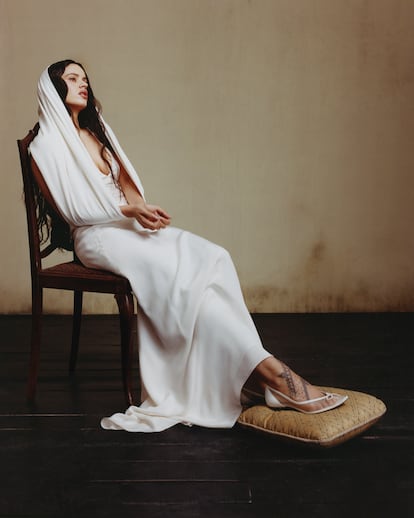
Q. Is there generosity in Lux?
A. I hope so. It’s about finding ways to understand the other, and even to speak to them in their own language. Every language in the world can’t fit into one album and I wish they could all fit in a natural way. But a record has the space that it has, and you have to play with musicality in an organic, honest way. My dream was to fit the whole world in here. If it could fit... When I sing “quepo en el mundo y el mundo cabe en mí” [I fit in the world, and the world fits in me] that’s how I feel. That line is inspired by Rabia al-Adawiyya, a Sufi mystic whose branch of Islam fascinates me. I love the idea of understanding God for God’s sake, and not out of fear or reward. To approach God for God’s sake. I feel that my sorrows are the same ones someone in Japan might feel, even if they describe them differently. Here we have the octosyllabic quatrain used in flamenco; there, they have haikus. So yes, I’m curious about the different ways we find to express what we feel, which is probably the same.
Q. Is curiosity still the main driver of your career?
A. Yes, yes…, 100%. Totally agreed.
Q. What role does darkness play in an album of light such as this one?
A. I think that in order to explain the light, there must probably be darkness. You have to leave some space to explain darkness. [The philosopher] Pau Luque, who blows my mind, says: “The artist who walks next to the devil, laying his hand on his shoulder, can expand our understanding of vileness.” Like Nick Cave, who lends a voice to the villain, I try to understand and feel empathy for the villain. I think I am able to feel empathy for the other, with the light and the darkness. From that point, I can create a more complete album and I can better explain the light. There are four movements on the album. The first one is about departure, leaving, exiting the pureness. The second one deals with gravity and being a friend of the world, of mundane things. The third one is about grace, being God’s friend. And the fourth one is about goodbyes, about returning home.
Q. You end up fantasizing about your own funeral. I wonder if you’re not a little young to be doing that…
A. It’s just a fantasy. What will it be like? I had that question, and I saw that in the lives of saints, very often there is a pattern of an unconventional life that is celebrated after death and sacrifice. I find it very interesting that sometimes you are only celebrated after [the end of] your life. Besides, death was very much present when I was reading these biographies of saints. I found it very inspirational to think about what my own burial would be like. What would I want for myself if I could choose? I would prefer for people to have a good time, to enjoy themselves. There is something more personal here, but throughout the album I am looking for the sweet spot, that balance or blurred line between the personal and the universal. And then there is the task of writing in the first person from the point of view of God. Since I know it’s absurd, I do it with a sense of humor.
Q. Is it important for Lux to loosen up a bit at certain moments?
A. Yes, because an album with this kind of subject matter could prove too dense. At all times, there is the hope that it won’t be that dense. At least, an attempt at it.
Q. There also seems to be a clear intention to avoid overusing beats and loops. There’s barely any electronics, nor too many percussion elements.
A. There is a definite intention to avoid all kinds of loops. There are no samples, just Patti Smith at the end of Yugular. There is one internal sample created by us in the studio. There is a very clear intention to do everything from a human perspective, very human, made by humans, touched by humans. If there is a more electronic element, it is only there as support, for texture. AI is non-existent on this album. At one point I had the thought: let’s take advantage of the fact that AI exists, let’s ask it to write a verse, and see how it goes. The result was terribly disappointing. AI is very interesting, but for now, this album is made by humans.
Q. It may sound like a silly question, but is this the most musical album you’ve ever recorded?
A. It is the album where there was the greatest intention to make it overflow with composition. There is a bigger effort at composition than anything else I’ve made in the past.
Q. Additionally, the structures are typically not very linear. Some songs are out there.
A. There is a desire within me to make pop structures, but my interests as a musician lead me to take apart, put together again, compose and recompose. There was an element that sought these pop structures, but everything I wanted to say, and the linguistic challenge, forced me to create very unconventional structures.
Q. How has the role of the piano evolved in your songwriting?
A. I think it’s the instrument with which I write the most music. My voice is my instrument, and the albums are built around my voice, but it’s the piano that allows me to write songs like Mio Cristo. It took me a year before I walked into the studio and said: “Guys, we have my aria.” The piano helps, because I am always looking to see where the harmony can coexist with the melody. I get very serious about it when I’m sitting at the piano.
Q. Is there any instrument you turn to just to relax?
A. The bass guitar. I play it for fun, I allow myself to enjoy it, it’s easy to do so. I don’t need to press very hard for the sounds to come out, I can just let the fingers slide. I don’t consider myself a bass player, but I do enjoy it.
Q. Have you rediscovered the joy of singing? Did you miss it?
A. I wanted to make an album like this one, pushing my voice to the limits. I’ve been preparing for this all my life. While I was making the record, I was remembering how, at the age of 18, I was with my singing teacher and she would teach me opera singing. I’ve been with Eric for six years and he teaches me to sing O mio babbino caro… And look, perhaps the songwriting method is here where I use my voice in this way. If you don’t, your voice won’t be used this way. I need to make this journey as a songwriter to be able to express myself as a singer.
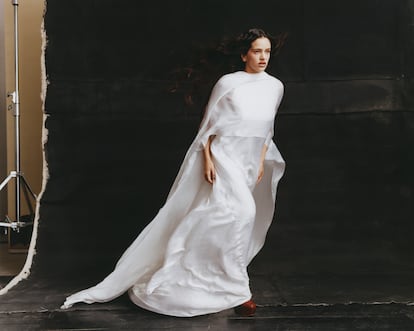
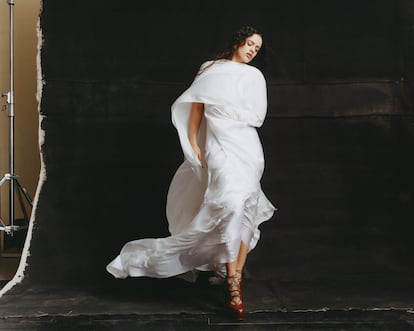
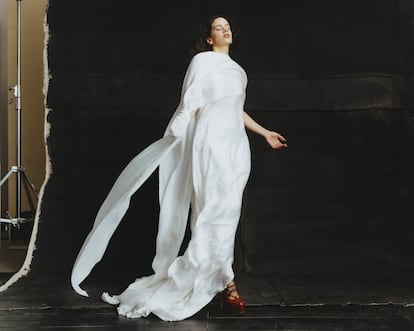
Q. How do you bring all this to the stage?
A. I have three notebooks with sketches and ideas. It’s the million-dollar question. A really big challenge.
Q. But…
A. I know, I know...we’ll have to see if it’s possible.
Q. What do you mean, if it’s possible?
A. I mean how it’s possible… Look, Motomami was minimalist and this is maximalist, even brutalist. How do you make this work in a live performance, how do you make it viable.
Q. The challenge is creative and...economic as well?
A. Oof, it was already a mindblowing challenge to make an album like this one, because of its scope… I don’t even know how we managed it, we were really struggling to make a thing like this work. Recording with the London Symphony Orchestra, two years at the L.A. studio… We really waded into these waters out of our love for music, why else?
Q. If anybody was able to perform when they finish building the Sagrada Familia [basilica in Barcelona, still unfinished after more than 140 years]…
A. Are they really going to finish it? For real?
Q. Next year they say there are going to complete the Tower of Jesus Christ, and there is an event planned for June 10.
A. Next year? Really? Hmmmm...
Q. Would a live performance of Lux require its own spaces, perhaps outside the regular circuit for concerts and festivals?
A. I think that a project like this one could take place is spaces where a lot of people could enjoy it. That gives me satisfaction. Perhaps it could be taken to a place that does concerts, but not like this… It is a project that just begs you to perform it in a place that is not the usual kind of place. Why are cathedrals so vertical?
Q. Now we’re starting to be on the same page…
A. It makes you think differently, and this is a project that requires that kind of verticality. But it’s complex. How do you ensure that you can execute the visuals?
Q. In the Lux era, is architecture as important as music videos or styling?
A. Yes, because it’s all conceived as a whole: the video clips, the outfits…, and now, also the architecture. As a musician, if you want to carry out a project of such scope, you need to find how to translate it across every element, and this is something you find during the process, not afterwards. The album lights the fuse of things from other disciplines.
Q. Is that why you need ever-longer periods between albums?
A. I don’t have a choice, it’s the periods of time that the projects demand of me. When I am explaining, I am not creating. And I like creating.
Q. How are you with deadlines?
A. I try, but I blow them right out of the water and then put them back in place, with all due love and respect. But I blow them right out of the water. I really believe in them, although I almost never make it.
Q. Were you expecting all this commotion in the weeks prior to the launch?
A. Tell me, tell me about it; I’ve been very caught up in things and I haven’t been paying enough attention. I was excited about the idea that if we shared a a musical score, there will be curiosity as to what it sounds like, that someone will pick it up and play it. There’s a lot of people out there who study music, and out of all these people, we thought, someone will want to…, and that makes me very happy. Very. I think it’s nice to slowly reveal the album. Not just “let me throw the whole thing in your face.” To give people clues. Why not? It’s a nice thing.
Just one week before the interview — writing this piece has meant breaking the space-time continuum more than once — an image of the singer emerged, showing her in Paris reading the score from Vissi d’arte, vissi d’amore, an aria from Puccini’s Tosca. A day later, she posted an image of the soprano Maria Callas smoking on Substack, the content creator platform that is reviving the blogger scene. The post began with this sentence: “I say that singing is the most beautiful exercise there is against gravity.”
On October 13, another post on Substack showed a picture of the musical score for a song called Berghain supposedly from her forthcoming fourth album, for which no release date had yet been announced. Shortly thereafter, social media was flooded with people playing the score on the piano, the violin, or even the accordeon.
Two days later, the Catalan artist uploaded to her Instagram account a few images taken in Warsaw during what was said to be the recording of the video clip for Berghain. In one of them she was wearing a top with the message “God complex” and holding a schnitzel in her hand. The next day she had a wonderful conversation on the podcast Radio Noia of Primavera Sound with Mar Vallverdú, on the bed of the latter’s bedroom in Barcelona. And soon after that, signs were put up announcing the album in Madrid’s Callao square and in New York’s Times Square. It might have been the cover for Lux. But it wasn’t. Not yet.
The morning after our interview, it emerged that on October 20, Rosalía would perform live for 90 minutes on TikTok. The event, which attracted up to four million followers, ended with the unveiling of the Lux cover on the screens of Callao square, triggering a new wave of theories regarding the new work by Rosalía.
There were memorable images of the singer smoking a cigarette as she drove a Nissan GTR across Madrid, a crucifix hanging from the rearview mirror, classical music blaring on the sound system. It was comparable only to the 1986 photograph of Julio Iglesias — the other great global music star to come out of Spain — inside a private jet with a tortilla de patatas, a bucket of KFC chicken and a bottle of Château Lafite Rothschild that would cost in the range of $10,000 at today’s prices.
During that whole week, Rosalía was subjected to a scrutiny that ranged from the new marketing strategies to the resurgence of the Catholic faith among the young, and the feminist reformulation through the empowerment of faith.
On October 27, at 5 p.m. Berghain, a song that Björk and Yves Tumor collaborated with, became available on streaming. The puzzle was starting to fit together, but the theories surrounding Lux reached new heights after the video was released. Directed by Nicolás Méndez — who was also behind the iconic clip for Malamente in 2018 — there was something about it that made one think of Lars von Trier.
And so, amid think pieces crediting Rosalía with the death of atheism and deep dives into the pawnshop scene of the video (one X account with barely 500 followers racked up 13,000 likes by Tuesday morning for its delirious thread dissecting it), the days went by until, at last, there was light.
Q. What is your relationship with social media these days?
A. I’m going to be honest with you, it’s an ambivalent relationship. If I didn’t do what I do, I don’t think I’d be on social media.
Q. Is it hard to know when to be there and when not to?
A. I feel more comfortable when the project is completed and it gets communicated and shared. When you do a project like that, you get away from all that, there is no other way. There is a lot of noise out there. And I don’t know up to what point I feel comfortable adding to the noise. I know we live in an era where everything is about the storytelling, the story… And I understand, but, and I repeat, I would rather be creating than explaining.
Q. And what about taking sides?
A. Sometimes, depending on the context, it’s as though artists were expected to take a stand, and yes, it makes sense, but sometimes, if you’re working on an album… Look, I really respect activism, the real kind. But if an artist is working on an album, they can’t also be doing activism that makes sense, and so just dropping a story on your social media accounts, well, I don’t know to what extent that is just frivolous. Sometimes, it feels like, ok, you’ve done a story [on Instagram], you can check the box for your conscience, you can feel good about that, the end. But there are issues that are so sensitive that I would not want to choose the wrong words. I don’t feel comfortable with the pseudoactivism on Instagram.
Q. But the things that you say resonate, that’s just the way it is.
A. Yes, but there is so much noise… will I add something? Will I help trigger action, which is the main thing? Or will I only end up contributing to more noise and chaos? I don’t think I have the answer, no matter how often I ask myself the question. But I do try to learn how to do better, because I know I have a responsibility. It hurts that silence can be interpreted as taking sides. Why does everything have to be so performative? Such a delicate subject as what is happening in Palestine… I obviously condemn genocide. As a person, I make a series of decisions in my life that maybe are not known in public and I don’t want to reduce them to something performative, because that’s what my social media accounts are, the artist and the performance. I feel bad that by not using words in a performative way on such a delicate and complex issue as this one, people might feel that I have taken a stand.
Q. Were you hurt by the controversy with the designer Miguel Adrover and the Gaza issue this past summer?
A. I have to say yes. But I learn every day and try to do better. I feel a lot more comfortable when I have a face-to-face conversation and talk at length, instead of posting a story. I feel more comfortable putting together a foundation. I understand that others may have other ways of doing it, but maybe in the long run… I just don’t know, this social media thing is quite a subject.
Q. Let’s end with something more fun: Euphoria, where you appear in the third season.
A. Very good! A big challenge. Sam Levinson blows my mind. It’s incredible to see how they work. I had to write my lines and improvise a lot at the same time. I also speak Spanish and Catalan. It’s my favorite series. I really like Succession and Severance, but I think my favorite is Euphoria.
Q. Are there things that were left out of the album?
A. There are tracks left out that I think could work for something in the future. I have hopes for that.
Sign up for our weekly newsletter to get more English-language news coverage from EL PAÍS USA Edition