
A children’s soccer league to prevent a return to war in Syria: ‘We want our children to live together again without religious or ethnic divisions’
The Hope League project brings together Kurdish, Arab, and Christian minors, including children of former Islamic State members, to rebuild coexistence after years of conflict
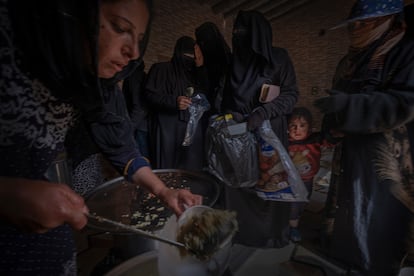
A woman covered entirely in black, wearing a niqab that reveals only her eyes, watches the soccer match while talking with other women, some with their long hair loose and others with colorful headscarves. Dozens of ruined buildings surround them and the Raqa municipal stadium, the facility that the Islamic State turned into a detention, torture, and extermination center between 2014 and 2017, when it declared this northern Syrian city one of the capitals of its self-proclaimed caliphate.
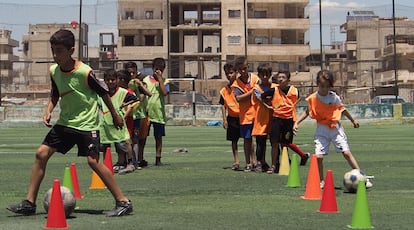
Now these women bring their boys and girls weekly to a nearby pitch so they can play together and not end up like them, divided by the nearly 14 years of war that shattered coexistence in Syria. The project is The Hope League, launched almost a year ago by the Catalan NGO NOVACT so Kurdish, Muslim, Christian, and other ethnically and religiously diverse children and parents who survived the war can learn to trust one another again.
Redab al-Hasan, the mother of two children who attend the project, says that although nearly a decade has passed since the Islamic State was expelled from Raqqa, fear remains. “Outside this environment, I would be afraid to approach the mothers of the Islamic State. But here we have relationships with them, and they are good. We have also become friends with Kurdish families; we go to their homes so the children can play and study together. My daughter is learning Kurdish words from her friend, with whom she exchanges songs. We want our children to live together again as Syrians, without religious or ethnic divisions,” she says.
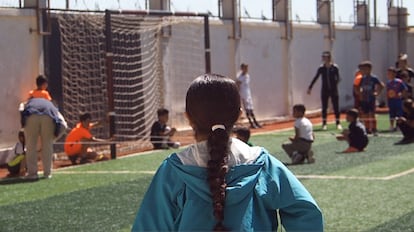
More than 1,300 children and over 150 parents take part in the activities The Hope League runs in four Syrian cities and in Erbil and Sulaymaniyah in Iraqi Kurdistan, through the Kurdish NGO Doz and NOVACT’s work in collaboration with the FC Barcelona Foundation and the La Caserna Football School.
Louai al-Qadban, one of the project’s coaches, says adults have found a place in the league where they know their children can play safely. “And because our methodology requires parents to get involved, they also form relationships with people they would hardly encounter outside this facility,” he adds.
Syria is one of the countries with the greatest ethnic, religious, and cultural diversity in the world. A richness that the regime of Bashar al-Assad, which fell in 2024, and the actors that turned the Syrian war into an international conflict exploited to pit the population against itself. Also in the northeast of the country, where, despite Kurdish forces declaring the Autonomous Administration of North and East Syria in 2012, Arabs, Kurds, and Christians were swept into war after centuries of coexistence. To rebuild ties between communities, The Hope League coaches received initial training from Oleguer Presas, a former FC Barcelona player, who taught them techniques to foster cooperation and conflict resolution through play.
“When we began activities, some parents did not want to send their daughters because our teams are mixed. But as they saw the work we do, they enrolled them. Also, women coming from the Al Hol detention camp did not want to relate to men and their children did not want to play with girls. But this year we have managed to get them to do both,” Al-Qadban says as about 50 children aged between eight and 15 run joyfully after the ball and their parents talk in the shade, sheltered from the summer sun.
Among them is Hanan (a pseudonym), who until a year ago lived in Al Hol, the detention camp where the Kurdish-Arab militias, supported by the United States, held the families of Islamic State fighters after defeating them. In 2019 the camp housed more than 73,000 women, boys, and girls. In February 2026, during the transfer of power from Kurdish forces to the government of Ahmed al-Sharaa, at least 16,000 inmates escaped. By then Hanan and her two children had already been free for months under an international reintegration program.
“When I entered Al Hol I had one son who was nine months old and the other was born there. When we left they did not know what a door or a car was. The first time Omar saw a tree, in Raqqa, he hugged it and said he was going to take it home. There was not a single blade of grass in Al Hol. The camp was hell,” Hanan says.
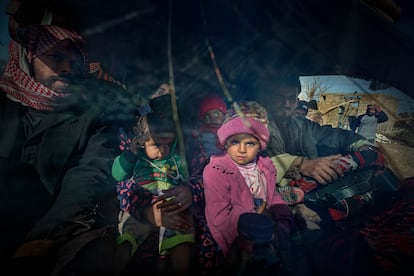
Both she and The Hope League coaches agree that children from Al Hol need strong support after surviving the extreme violence that dominated daily life in the camp, where jihadists imposed a kind of matriarchal caliphate in which executions — including of minors — were common, and rights were nonexistent: there were no schools, no protection resources, and the only permanent clinic was run by Doctors Without Borders.
“When we were freed I realized my children had a lot of aggression inside; they were always angry. They did not want to interact with other children. Now, thanks to the coaches they are calmer, trust others more and are learning to relate,” Hanan says; she returned to Raqqa because it is where her husband died and where her in-laws live. She survives by washing clothes in the room where she lives with her two children on the outskirts of Raqqa. “I have also found in this project a place where I feel safe. But outside of here, I know people are still afraid of me,” she laments.
Less than 100 meters from where the children now play carefree, the remnants of the reign of terror the Islamic State imposed in Syria are palpable. Through a hole opened in the side of Raqqa stadium, there is a basement with a long corridor giving access to dozens of cells where hundreds of men were mutilated, tortured, killed and disappeared. They had been accused by the militants of smoking, drinking alcohol, being homosexual or, simply, to remind those still free that their survival depended on total submission to their orders.
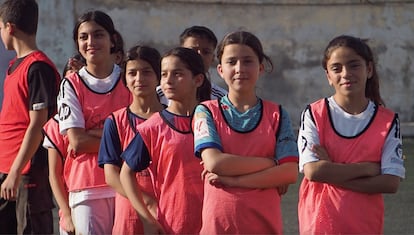
Laia al-Shamaly is 14 and, although what attracts her most to the project is playing her favorite sport, she does not miss its real purpose. “The coaches teach us to resolve misunderstandings, not to get angry, not to hurt other players and to understand that what matters are our personal relationships,” she explains. Al Muntaser Billah Fahmi, the father of another player, says that “before the war we grew up thinking ‘this one is Arab,’ ‘I’m Kurdish,’ ‘the other is Christian,’ ‘that one is an Islamist.’ With this project, we are determined that our children grow up believing in the unity of the Syrian people.”
President Al-Sharaa, a former leader of the Syrian branch of Al Qaeda who broke with the group in 2016, and of HTS, the coalition of Islamist militias that overthrew the Al-Assad regime in late 2024, has insisted in public statements that he will promote a country that respects its diversity and protects minority rights. However, he has still not adopted institutional reforms to guarantee their political integration and has not addressed responsibility for the massacres carried out by pro-government forces that left more than 1,000 Alawites and over 100 Druze dead in 2025, among other extrajudicial executions. Among the Kurdish population, fear of attacks by Islamist groups, especially Islamic State elements, is compounded by continued operations carried out by Turkey in border communities.
“During the war we were afraid of our neighbors. We locked ourselves in the house and could not sleep for fear they would come for us. And surely they feared we might do the same to them,” recounts Salma Ali, a Hope League coach in Tiperspiye, a town inhabited by Kurds, Assyrians, and Arabs.
“It’s common for children to fight over the ball and quickly shout things like ‘this Arab won’t pass me the ball!’ and vice versa. Our job is to build friendships in a society as diverse and fragmented as ours, and to create strategies so they join and eventually become part of the initiative. That’s why we created a girls’ team and now they relate to everyone,” says the art teacher, wearing sports clothes and a cap.
On the sidelines of the stadium Yasmine, a mother and aunt of several players, encourages them. She explains that, because of the war, her niece had begun to fear Arabs. For that reason, she adds, “we had to make her understand that not all of them are bad.” And although she tries to trust that they can live in peace, she acknowledges they know the war could return “at any moment.”
Psychological wounds
“After surviving the war against the Islamic State, Turkish bombardments destroyed our house and our car. My children still cry in their sleep; they tremble whenever they hear a loud bang. As a father I feel terrible because I cannot make them feel safe,” says Mohamed Mustafa, father of a 10-year-old. “We need psychological support because we have spent years hearing fighting, bombings and feeling we could die at any moment. Many of our children have post-traumatic syndrome. So this activity that brings Kurds and Arabs together is healing and the first step toward building peace and security,” he concludes on a small pitch on the outskirts of Kobane, where the Islamic State committed massacres against the Kurdish civilian population. In its cemetery the sight of almost 1,300 graves of Kurdish men and women killed during the fighting fades into the horizon. They are joined by the victims of Turkish attacks, which continue to besiege them with drones.
Farah Khaled Muhamad is 14 and recalls that during the war they were left without healthcare, electricity, water, medicine or education. Now she dreams of moving abroad to become a professional soccer player — and to feel safe. “I don’t sleep peacefully; I fear a drone attack at any moment,” she says. A few hundred meters away is Kobane’s market, covered with metal sheets since February 2025 after a bomb killed a dozen people and injured about 20 others.
Listening closely is Midia Ahmed Musleh, a coach. “My daughter asked me why we don’t die and stop suffering. She tells me that if she can’t go to school, play in the street with friends or visit relatives, what’s the point of living. It broke me. I told her that one day the war would end, but she said no, that I am always scared they will kill us. It’s not just the bombs destroying our children. It’s also the psychological war,” says this former teacher, grateful to be able to work now helping Syrian children to coexist because, she insists, “it’s the only thing that helps them keep hope.”
Sign up for our weekly newsletter to get more English-language news coverage from EL PAÍS USA Edition









































