
Lyhanna rape case makes sexual abuse against minors a ‘priority’ in France
The Justice Minister asked for the review of around 70,000 archived complaints after detecting negligence in the rape and murder case of an 11-year-old schoolgirl
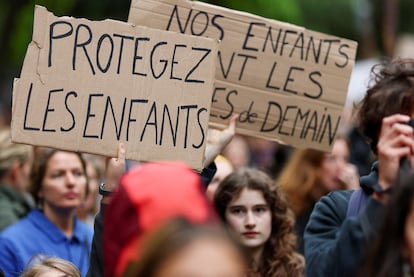

The murder of Lyhanna, the 11-year-old schoolgirl who was abducted and allegedly raped by a man already accused of sexual assault, has sparked massive protests in France. The case has exposed the chronic problems in France’s justice system regarding the handling of reports of sexual violence. Under a deluge of calls for his resignation, Justice Minister Gérald Darmanin asked prosecutors to review 70,000 reports of abuse concerning minors that had not been followed up. He set a deadline: July 14. In five weeks, magistrates have reopened 1,350 investigations and ordered 675 people to be taken into custody on suspicion of child abuse.
The Lyhanna scandal was huge. The accused, a 41-year-old father of two children who went to school with the victim, had been reported for abuse up to five times. But the charges were dropped in a chain of negligence that has unleashed a wave of public outrage culminating in rallies in front of the country’s major courts and the Ministry of Justice.
Darmanin promised an investigation and commissioned a report on police and judicial action. The resulting document revealed that there were police and judicial rulings that allowed the accused, Jérôme Barella, to be released, despite the fact that in August 2025 the mother of a 10-year-old girl had accused him of raping her daughter. Earlier, other parents of minors had also filed allegations, on top of which Barella had been sacked from the high school where he worked after complaints of harassment.
Still, this latest allegation “was not treated as a priority matter” and there was “an accumulation of delays and a lack of follow-up by the gendarmerie and the prosecutor’s office,” Stéphane Noël, inspector general of the National Gendarmerie told a press conference.
Darmanin gave the courts until July 14 to review cases in which there had been no follow-up. Now, over 1,000 files concerning crimes of pedophilia have been identified as “priority,” namely, those in which the perpetrators have been identified, have a judicial record, and the victims are still minors, Darmanin stated on Wednesday, July 15.
Around 1,350 judicial investigations have been opened since June 8, approximately four times more than in the same period last year, the minister added during the National Assembly’s question session.
In total, 69,626 files have been reviewed across the country and prosecutors have registered 85,047 allegations. “Of the procedures reviewed, 61.5% correspond to lesser offenses and 38.5% to more serious crimes. Also, 83.5% of the alleged perpetrators have been identified, while 16.5% remain unidentified,” the Ministry of Justice said in a statement.
In the days after Lyhanna’s body was discovered, Darmanin declared that “there was no lack of means or laws.” The problem lay in the lack of “prioritizing cases involving the rape of minors.” The opposition has, however, accused Darmanin of giving that priority to issues such as drug trafficking. But the problem goes way back.
French rape victims wait more than 10 months until their allegation is investigated, according to the Women’s Foundation, which adds that 94% are then archived. The European Court of Human Rights condemned France in April 2025 for failing to protect three women who reported rapes when they were 13, 14 and 15 and subsequently alleged that the French authorities had failed to protect them.
The figures are scandalous when it comes to sexual crimes against minors. About 160,000 children are raped every year in France, according to estimates compiled by the Independent Commission on Incest and Sexual Violence Against Children. Every three minutes a minor is sexually assaulted, raped or is the victim of incest, according to Ciivise, the association against incest, which cites official data.
It is equivalent to three children in each school class. The problem also lies in the lack of resources, according to a second report, commissioned in the wake of Lyhanna’s death and quoted by the French media on July 16.
The victim’s mother went to the police in October 2022 to report a rape that took place two years earlier in the French region of Gers, allegedly committed by Barella. “Although the investigation was carried out quickly, the victim’s statement was not made in accordance with ministerial recommendations due to the lack of resources at the Béthune police station at the time,” says the General Inspectorate of Justice (IGJ) in the report published by the French media.
The inspectors also point out that “the victim’s psychological evaluation was entrusted to a psychologist who was not on the official list of experts,” while “both the magistrates and the investigators noted a shortage of experts in the jurisdiction of Béthune.” The inspectors also point out that the subsequent report, “due to its methodology and lacking a date and signature, more closely resembles an evaluation of the credibility of the minor, a prohibited practice.” The psychologist flagged up alleged inconsistencies in the girl’s story, which weakened the case, making it no longer a “priority”.
The negligence appears to be widespread in France. A year ago, the country went into shock over the trial of surgeon Joël Le Scouarnec, sentenced to 20 years in prison for abusing or raping more than 300 young people, most of them minors, in consultations or operating theaters over three decades. He was arrested in 2017, despite the fact that he had already been convicted in 2005 for possessing pedophilic images. He was not struck off the medical register and continued to deal with children and adolescents.
Sign up for our weekly newsletter to get more English-language news coverage from EL PAÍS USA Edition









































