
Jean-Luc Mélenchon: ‘The right no longer has anything to offer except fear’
The leader of the far-left party La France Insoumise, who launched his campaign last Sunday in the Paris suburb of Saint-Denis, is the only clear candidate right now for the 2027 French presidential election
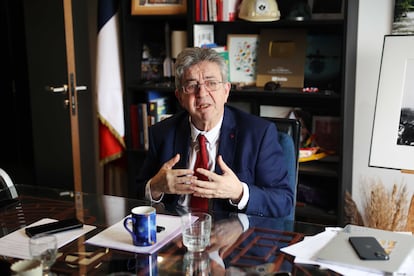

Jean-Luc Mélenchon, 74, electrified the streets on Sunday at the launch of his campaign. It was in Saint-Denis, land of kings, a Paris suburb turned epicenter of immigration and multiculturalism. But also where he gets the narrative material that weaves the idea of the New France that the leader of the far-left party La France Insoumise (LFI, or France Unbowed) has put forward to win over the suburbs in the presidential election of spring 2027. And, incidentally, to capture the roughly 400,000 votes that were missing last time to reach the runoff.
Mélenchon, a devotee of Hispanic culture who speaks perfect Spanish and has praised the policies of the Pedro Sánchez administration in Spain, met EL PAÍS and three other journalists from the Lena group of European newspapers on Tuesday afternoon. He seemed pleased. Everything was going well. Until a few questions startled him. His figure remains extremely divisive. Even on the left. But today he is the only clear candidate in a section of the ideological spectrum where chaos and internecine fights have reigned among several candidates. The center and center-right are in the same situation, vying in the polls for the chance to compete in the first round to stop the far right in the runoff. Mélenchon remains calm. The more chaos, the better. He is confident he will be there in the final battle.
Q. Is the idea of the New France a narrative meant to counter the far right’s Great Replacement theory?
A. De Gaulle, Jospin and Valérie Pécresse had already used this concept. But it became explosive because in 2024, when the far right was favored to win the legislative elections, we observed a reality: today one in three French people has a foreign ancestor. In my time it was one in 10. The New France is that: the real, concrete France. And when I saw that whole crowd on Sunday, I cried. We are the only ones building an inclusive narrative against the far right’s narrative. We talk about women, young people, the elderly, everybody. The New France is the France of today.
Q. This is your fourth presidential campaign. Why would you be able to reach the second round this time?
A. France has been destroyed by 40 years of neoliberalism. I always thought the crisis would end up pitting two principles against each other: each person for themselves or all together. In the end, the dispute will be between the fascists and us. I have organized my entire strategy around that division.
Q. There is more of a left out there than just you.
A. European social democracy, by accepting the Lisbon Treaty and neoliberal rules, gave up on writing a true program of rupture. The socialists, the center-left and the moderates all took that path. Everywhere their coalitions ended up clearing the way for the far right. We saw it in Italy before Meloni and we see it elsewhere in Europe. In Germany it could end particularly badly.
Q. How will you advance from the first to the second round?
A. I don’t believe the forecast that the far right is already installed at 33 or 35%. Polls are working less and less well in a society where social categories no longer correspond to a certain way to vote. In the 2022 presidential election, polls placed me 20 points behind Marine Le Pen at the start of the campaign. In the end there were only 400,000 votes between us. By one point, we would have left her out of the second round. Nothing proves that France has become more racist or more fascist since then, except that anger at Macron’s government is immense.
Q. Do the moderate right and left no longer exist?
A. The world has changed. Even the U.S. has buried neoliberalism, with tariffs and the end of free trade as we knew it. The right no longer has anything to offer except fear of Muslims, Arabs and Black people. That is not a project. De Gaulle invoked France’s greatness. Giscard enacted reforms, like the vote at age 18 and the right to abortion. After that there was nothing, apart from Sarkozy and the bling-bling. When the right empties itself of content, it slides toward the easy option: pointing to scapegoats.
Q. How will you bring the left together?
A. We already did it in the 2022 presidential election. We obtained 22% of the vote and the Socialist Party got 1.67%. In France everyone wants to be a presidential candidate in order to exist. That makes noise at first, but not necessarily in the end. True unity will occur on the ground. I don’t think it is useful to seek agreements with political leaderships that define themselves above all as “anti-Mélenchon.” They have sown hatred and mistrust among the electorates.
Q. But you will need all left-wing voters in a hypothetical second round...
A. Yes, but it will happen by itself. Whoever comes first will organically attract the others. It’s a bet on human beings. I also would never have imagined myself voting for Chirac in 2002.
Q. Your program demands a lot of spending. But paying the debt has become the largest item in the French budget.
A. That must change. Those who should pay will pay. The company Total hasn’t paid taxes in the last four years because we are told it makes no profit in France. They must stop treating us like fools. And then there are those who have become billionaires and escape taxes. It’s the Ancien Régime — we are in 1788. France has a large debt, but those who can pay don’t want to. We are going to reverse that situation.
Q. Do you fear episodes of violence during the presidential campaign?
A. Yes, because far-right actors have become very aggressive and very audacious. But there is also, in my opinion, a risk of foreign interference. French intelligence services have warned us about Israeli interference in Marseille and Toulouse, through an influence campaign organized by an agency linked to Netanyahu’s government.
Q. Do you regret some phrases that have been described as antisemitic?
A. I have been suffering that slander since 2009. Some of my opponents, unable to find another line of attack, began to call me antisemitic and racist, without taking into account my life or all I have done. This does not start with one recent phrase. It is an old political construction meant to discredit me. By repeating it, they end up manufacturing evidence. It is like those who now repeat that I would be “the most hated figure” according to the polls. It is a lie. I am the man with the most support across the entire left.
Q. Your opponents claim that your position and strategy in the banlieue are part of a communitarian electoral strategy. How do you respond to that?
A. That is a racist argument. My worldview is universalist. I am an ultra-traditional left-wing man. I do not divide the people into electoral communities. When we choose Saint-Denis, when we talk about the New France, creolization or mixing, it is not to lock people into an origin. It is to say that France is that as well. The idea that a working-class neighborhood equals Muslim and that Muslim equals antisemitic is odious.
Q. Can the French election become a turning point for Europe and the world?
A. A far-right victory is not inevitable. If the French left can defeat it, then it can also happen elsewhere. Although, of course, the situation remains very volatile.
Q. Can the Trump cycle be closed?
A. Trumpism was born from the end of liberalism and the collapse of social democracy. It is a form of supremacism. A kind of social pseudodarwinism, although Darwin was on the left. But in Europe the rise of Trumpism comes at a particular moment. Elections are going to take place virtually one after another in several countries. If we win, we can reverse the cycle.
Q. If you were president, what would you do in the EU?
A. We have never said we would leave the euro; I don’t see how something like that could be done given the current disorder. What could be said 10 or 15 years ago no longer makes the same sense today. Likewise, we will not leave the EU. But we will say clearly that the economic model is obsolete.
Q. What should be done?
A. Propose something else. And this time we have an opportunity. When we talk to the Germans, perhaps they will take a different tone. When they have crashed with their grand-coalition governments and the fascists are knocking at their door, the Germans will be like any other people. They will not want to find themselves in the middle of a general blaze. Then they will listen to us.
Q. Is Spain a model to follow?
A. People said you had lost your way, but the Spanish government’s curse turned into its blessing. From the moment they approved the first budget, there was no longer a majority to approve another. So each year they have extended the same one: a redistributive budget. Does Spain grow at 3.8% because it grows more tomatoes? Because it has attracted more tourism? No. It is because it has a redistributive budget. I am not saying Spain is a paradise on Earth. But it has shown that this method works, while other countries do not even reach 1% growth. Germany has been in recession for three consecutive years. Where are the model students, the ones who shone and said we should imitate them?
Q. Is Spain a political example for the European left?
A. It is very interesting. First, because there is a social-democratic party that was not afraid to ally itself with the radical left. Sánchez has pushed a redistributive budget, and he also constitutes an example in foreign policy and in rejecting alignment with the United States. If we come to power, we will build a kind of non-aligned pole within Europe.
Q. Could you work with Meloni?
A. Meloni is a far-right leader, there is no doubt about it. But if one begins to choose allies, friends or partners only among those who think exactly the same as you, not much will be left. France must speak with progressive governments in Latin America, but that is not enough. It must also build a front with Latin Europe. That is certain.
Q. What would you do on European defense?
A. Everyone has decided to arm themselves to the teeth. For what? To confront the Russian threat? Who is really convinced that Russia plans to invade Germany, France or Belgium?
Q. The Baltics, the Poles and the Finns do fear that invasion...
A. Fine, let us admit that theory. We are bound by a defense clause in the European Union treaty. Our position is clear: France has been invaded four times by a neighboring country. That is why we have always been against invasion, as in the case of Ukraine. We welcome Russian refugees. But we assert that the only path is negotiation to bring the war to an end.
Q. If elected president, would you resume dialogue with Putin?
A. After four years, maybe Putin will be more willing to talk about peace. Discussion is necessary, but on clear bases. First: any change of borders must be accompanied by consultation of the affected populations. Second: the Russians must offer security guarantees to Ukrainians and to Europeans. And vice versa. Who protects the nuclear plants? Who clears mines from the Black Sea? What guarantees exist regarding borders? What guarantees will there be about medium-range missiles? Those are the bases to resume concrete dialogue.
Q. Do you think you would be better received in Moscow than Macron?
A. My policy is different. It is non-alignment and independence. And it is also more coherent than Macron’s, who even spoke of sending troops. Therefore, they would trust us more, not for romantic reasons, but out of realism. Our common interest is to end the war.
Q. And do you really believe that is in Putin’s interest?
A. His interest is for tension to decrease, not to increase. I could be wrong, but that is my bet.
Sign up for our weekly newsletter to get more English-language news coverage from EL PAÍS USA Edition









































