
Drug traffickers defy the French state
The justice and interior ministers traveled to Marseille after the killing of the brother of an anti-drug politician and activist, comparing the threat of these organizations to terrorism
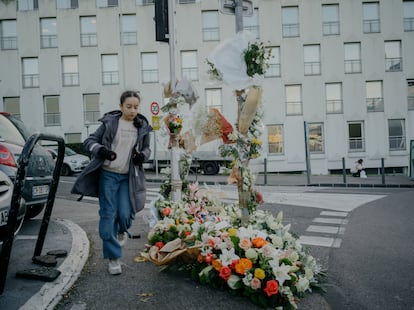

Marseille is France’s second-largest city but has long been considered its capital of drug trafficking and organized crime. It made headlines again this week after the murder of Mehdi Kessaci, the brother of a young politician and anti-drug activist.
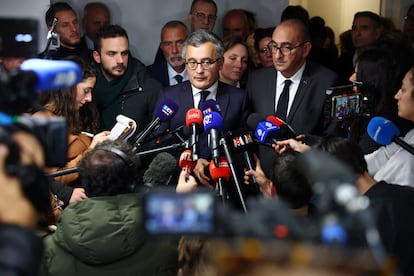
This intimidation killing marks a turning point and demonstrates the power that has been amassed by these criminal organizations, which are now capable of challenging the state. “What happened in Marseille is a crime meant to instill fear, a crime aimed at the Republic and the state. That is why, starting January 1, we will implement a system similar to the one we use against terrorism,” Interior Minister Laurent Nuñez announced on Thursday, during a visit to the city, where he was accompanied by Justice Minister Gérald Darmanin.
France has long been aware of the seriousness of the problem. In April 2025, a new anti-drug law was passed that will come into effect on January 1. Inspired by Italian legislation enacted during the era of Judge Giovanni Falcone, the law provides for a special prosecutor’s office for these crimes, high-security prisons for isolating such inmates, and significantly harsher penalties. Speaking in a small room crowded with journalists at the Bouches-du-Rhône police prefecture, which he once headed, Nuñez described a chilling situation.
The interior minister also promised to visit Marseille once a month to ensure the new measures are properly implemented. French Prime Minister Sébastien Lecornu added that there would be a debate on the issue in the National Assembly.
Drug trafficking is an entrenched problem in France. The crisis has gripped the outskirts of cities such as Grenoble, Nîmes, Béziers, and Toulouse. In the first six months of 2025, authorities seized 37.5 tons of cocaine, 45% more than in the same period in 2024 — a record figure, as is the number of deaths; in 2024 alone, there were 367 murders or attempted murders related to the trade.
Around 200,000 people in France make a living from drug trafficking, which generates an estimated annual turnover of €5.5 billion ($6.3 billion) and supplies cocaine to 1.1 million users, according to 2023 data from the French Observatory of Drugs and Addictive Behaviors (OFDT). That is why President Emmanuel Macron raised the stakes in his analysis last Wednesday, pointing the finger at “the bourgeois in city centers who consume and finance it.”
The murder of Mehdi Kessaci is extraordinary because it had nothing to do with drug trafficking, and he was not an accidental victim of a settling of scores. The 20-year-old was the brother of Amine Kessaci, an environmental and anti-drug activist who had recently entered politics. Amine, founder of the association Conscience, had been under police protection since last August. Authorities learned that criminal organizations — likely the DZ Mafia, the dominant gang controlling much of the drug trade in southern France — had planned to kill him. Given the difficulty posed by the security around Amine, they decided to kill his brother instead.
The police believe the murder was meant to scare activists: to impose a code of silence. And in part, they have succeeded. “His death shows the failure of our state and of Europe to protect its citizens. Amine, beyond being an activist in civil society, was a politician, someone highly visible. That’s why many of us no longer want to appear publicly with our names. It’s over,” says an activist, speaking anonymously for the first time.
Police investigations and the criminal logic of Marseille point to the DZ Mafia (DZ refers to Algeria in Arabic and Berber languages) as the organization behind the killing. This horizontal organization grew after decimating the rival Yoda clan, and now controls the drug trade.
“It’s a widespread phenomenon,” explained Philippe Frizon, head of Marseille’s judicial police, to EL PAÍS a few months ago. “Under that name operate many traffickers who are in prison, on French territory, or abroad. It’s a brand, a form of publicity to consolidate actions, partly in Marseille, but also in other parts of the region and neighboring areas. We are now investigating their links with foreign organizations.”
Investigations, according to Le Parisien, are now focusing on Amine O., one of the gang’s leaders, who has been imprisoned since last Tuesday in a high-security facility in Villefranche-sur-Saône. Amine O. is also known as “Mamine” or “Jalisco” — a reference to Mexican cartels because of the extreme level of violence he employs. Police believe he has continued organizing murders from prison and that last summer he planned to kill Amine Kessaci (hence the police protection). This inmate is also accused of a triple murder in late 2020. The target then was Amine’s older brother, Brahim, who was involved in drug trafficking. His body and that of an associate were riddled with bullets in a vehicle that was later found burned near Marseille. The mutilated body of a third victim was also discovered in the trunk of another car.

Mamine is set to stand trial for these murders in 2026. Amine Kessaci has been summoned as a witness in the case. The activist was involved in that investigation, and it is suspected that the animosity also has a personal dimension.
Arrests have increased, and the homicide rate has fallen to less than half of what it was in 2023 — partly because the conflict between the DZ Mafia and the rival Yoda clan ended with the DZ Mafia’s victory.
The justice minister praised the fact on Thursday that 27 of the 30 current leaders of the DZ Mafia are now in prison. The problem, however, is that they continue to operate normally from behind bars and order killings, as has happened on previous occasions — one year ago, they burned a 14-year-old boy alive in a dumpster — and all signs suggest they were also behind the murder of Mehdi Kessaci.
Sign up for our weekly newsletter to get more English-language news coverage from EL PAÍS USA Edition









































