
Colombia’s left seeks to find the right tone for its opposition to De la Espriella
While outgoing president Gustavo Petro denies the legitimacy of the incoming leader’s victory at the polls, and his candidate Iván Cepeda talks of civil disobedience, the administrative transition moves forward smoothly

“Abelardo did not win the election,” wrote Colombia’s outgoing president, Gustavo Petro, about the winner of the recent presidential election, the far-right Abelardo de la Espriella. The message, shared on Monday morning, reiterated the leftist Petro’s theory of an electronic voting fraud against his party’s candidate, Iván Cepeda. “The president of Colombia, according to the decision of Colombians, is the philosopher Iván Cepeda,” he insisted. However, in that same message Petro referred to De la Espriella and his team as the “incoming government,” an implicit acknowledgment that the transition is already underway and that there will be a normal administrative handover of power.
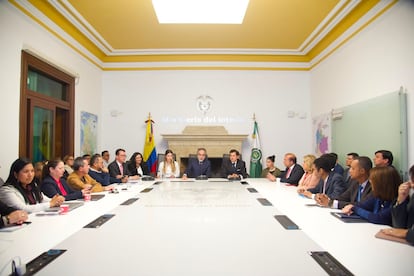
In fact, just a few hours later, members of the transition teams from the outgoing leftist administration, whose four-year term ends on August 7, and the far-right government that begins on that same date were meeting in different offices. Photographs of Armando Benedetti, the current interior minister and a traditional politician who was once on the right but has become a key ally of Petro, and of former congressman Rodrigo Lara, appointed to the same post by De la Espriella, present a stark contrast with the statements of a president who insists that the left did not truly suffer defeat at the polls.
Between those two poles lies uncertain terrain, in which a political left that has developed largely as an opposition force in Colombia—it was a minority for decades, and even banned—now seeks to recover that spirit for the new period that begins in a month. The left will go back to being out of power and to questioning and criticizing the government, this time one on the far right, but this time carrying the wounds and lessons of having governed for the first time in decades.
The Historic Pact, the unity party born from the left’s effort to present a single candidate in the recent presidential election, will hold the largest blocs in the Senate and the Chamber of Representatives, but neither is even close to a majority. At the local level, which in Colombia also changes every four years but with a lag of nearly a year and a half behind the presidential cycle, the left has few mayoralties and governorships but a presence in every department. Its greatest strength lies in a diverse and vigorous social movement that includes Indigenous organizations, Afro-Colombian platforms, students, unions and other groups that were central to the successful opposition to the right-wing president who preceded Petro, Iván Duque.
Indeed, the outgoing president has mixed his statements that deny De la Espriella’s legitimacy with a call for social mobilization on July 20, the day the new Congress is sworn in and one of the country’s two national holidays. It is a call he repeated over four years at different moments of political tension, such as when the legislature rejected some of his social reform proposals. But that mobilization never achieved the force of the protests and marches that left Duque on the ropes and boosted Petro’s presidential bid, driven at the time by unpopular tax decisions by the right-wing government, by police violence that Duque failed to control and by the social and economic crisis left by the pandemic.
Petro appears inclined toward that style of opposition—the one he chose in 2018 after losing the presidential race and taking a seat in the Senate. But he now adds a legal offensive that has also served the left, especially sectors rooted in human-rights litigation of the 1970s and 1980s. Senator Cepeda gained considerable standing in recent years thanks to the criminal case in which he acted as complainant and victim against former president Álvaro Uribe, the major leader of the Colombian right until De la Espriella’s emergence in the recent elections. Although Uribe was later cleared on appeal of an initial charge that led to house confinement, the case propelled Cepeda among the left’s base—where anti-Uribismo is a foundational sentiment—helping him win an internal primary in October 2025 and come within 0.96% of De la Espriella in the presidential vote.
In fact, Luis Guillermo Pérez, a lawyer close to Petro who once served as superintendent of Family Subsidy, announced on Monday that he intends to file an annulment action against De la Espriella’s election victory. Although he has not yet submitted it, he said it will be based on the president-elect’s U.S. nationality (he is a dual citizen), the public backing of De la Espriella by Donald Trump, and what the lawyer calls the far-right candidate’s intimidation rhetoric and alleged irregularities in the vote count at 100 of the 122,020 polling stations. It is another example of the same logic, of that other spirit of the left—one that leans toward legal activism and the use of judicial tools, so characteristic of a legalistic country like Colombia.
Many signals remain to be read. The elections took place two weeks ago, and there are not yet legal reforms to debate in Congress, oversight inquiries into ministers or administrative decisions that could generate new banners of opposition. More than that tactical level of detail, what is at stake right now is how far Petro’s most incendiary rhetoric will go.
The balance is delicate. On one hand, the leftist government is beginning a calm, peaceful transfer of power that allows it to present itself as institutionalist, far from the guerrilla stereotypes that marked Colombia’s history in the second half of the 20th century. On the other hand, it seeks to be a vigorous opposition to a far-right government and to maintain a repertoire of struggle that Petro strove never to extinguish and that have sustained him among his grassroots supporters. It is also the tension between a left that defends institutions, respects democracy and is willing to hand over power when defeated, and a left that cannot fully accept that defeat.
There is one month left before Abelardo de la Espriella is inaugurated, and in those 31 days it will likely become clearer which of those two spirits gains more strength in the opposition already being proclaimed to the future president.
Sign up for our weekly newsletter to get more English-language news coverage from EL PAÍS USA Edition









































