
World Cup celebrations reinforce decline in homicides in Mexico
On the day of the opening game and this Tuesday, the country recorded two of the days with the fewest intentional homicides in the past decade, a trend that has become established over the past year


The World Cup celebrations reflect the decline in homicidal violence in Mexico — a scourge that has persistently plagued the country over the past 20 years and the tip of a gigantic iceberg: criminal governance, the source of the country’s major unresolved problem. The news is good and is shining brightly on the global stage. On the opening day of the tournament, June 11, Mexico recorded 30 homicides, according to preliminary figures from the Secretariat of Security and Citizen Protection (SSPC), a record low. This Tuesday, with the latest data added to the platform, the figure hit a new low of 27.
Taken out of context, the figures can appear shocking because of how high they are, but it is important to consider where the North American country is coming from: counts of above 70 murders a day at the start of Claudia Sheinbaum’s term, just a year and a half ago. It was even worse before that. In the year of the Qatar World Cup in 2022, Mexico recorded 33,287 murders, an average of more than 90 a day, and earlier, during the 2018 World Cup in Russia, the number rose to 36,685 — the second-highest in the country’s history, according to the National Institute of Statistics. Pending the agency’s final figures, 2025, Sheinbaum’s first full year in office, could show a considerable decline at close to 20,000 fewer murders.
Wrapped in problems of all kinds — teachers’ protests, demonstrations by families of the disappeared, and constant threats from Washington over drug cartels — Sheinbaum’s executive branch is boasting about its major success, a claim often challenged with the argument that the figures hide a more complex reality in which organized crime still calls the shots, whether it is killing people or not. The numbers also raise eyebrows among activists and analysts, who note that the number of people missing in the country — a range from 40,000 to over 130,000 — is linked to the decline in homicides, a hypothesis that has not been proven.
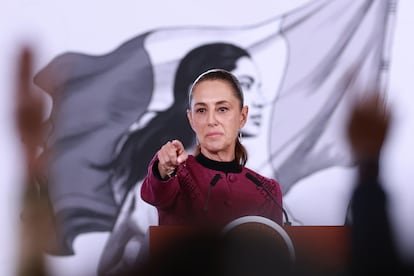
The figures are what they are, and Sheinbaum and her team gleefully brandish spreadsheets and statistical tables. This Tuesday, in one of his two monthly press briefings alongside Sheinbaum, Security Cabinet spokesman Omar García Harfuch closed his remarks by citing the data. “There has been a 46% decrease in the national daily average of intentional homicides,” he said, using the start of the president’s term as a reference point. “This represents 39 fewer homicides each day. This May is the lowest since May 2015,” he added.
The road has been complicated and the future looks as challenging as the past few months. The blow against crime has been significant, but it remains large and powerful. When Andrés Manuel López Obrador left the presidency at the end of September 2024, the situation was dire. Mexico was recording more than 80 murders a day, with peaks over 90. Large criminal conglomerates reigned over different territories, notably the Jalisco New Generation Cartel (CJNG), particularly in the country’s central-east. The word “reigned” is not used lightly: crime acted as a manager of both legal and illegal economies, poisoning public life and bending it to its methods.
Battles between criminal groups, part of the landscape in previous years, intensified. In Guerrero, Colima, Zacatecas, Baja California, and Guanajuato, among other states, criminal networks flexed their muscle in countless battles, blows that reached into the political establishment, which was linked to them by force, necessity, or ambition. This wasn’t a new phenomenon that emerged under López Obrador’s watch. Previous administrations had their share of responsibility, but the veteran politician from Tabasco — wary of the excesses committed by security forces in previous six-year terms — took a step back. With their eyes always on the playing field, the cartels advanced.
It is not that the situation has radically changed now. Criminal rule continues in many parts of the country, but Sheinbaum’s government, pushed strongly from the north with Donald Trump back in the White House, has stepped forward. Aware of the war between factions of the Sinaloa Cartel, a conflict that began in September 2024, the Security Cabinet practically dismantled the main faction, Los Chapitos, responsible for criminal governance in Sinaloa according to a U.S. indictment against politicians in the state — including the governor, of the ruling Morena party like Sheinbaum, and the former security secretary, a retired general.
The focus then turned to Jalisco, the CJNG stronghold — the group that had grown the most over the last 10 years. In barely two months, authorities killed its absolute leader, Nemesio Oseguera, “El Mencho,” who until then had seemed untouchable, and arrested its number three, Audias Flores, “El Jardinero.” The crisis of disappearances in that state and neighboring areas, and evidence that the group was forcibly recruiting young people, forced the authorities to act. The Security Cabinet has also tried to strike at networks of political-criminal complicity with Operation Enjambre in the State of Mexico, Jalisco, and Morelos, with dozens of local officials detained.
The question now is whether Sheinbaum and her team will continue to untangle the criminal web — the knot tightly bound by decades of impunity and laissez-faire, the basic condition that allowed crime and violence to advance. With the mafias contained — or at least warned that murder and extortion will not be tolerated — the Security Cabinet knows the only path forward is to deepen Operation Enjambre and disentangle the exercise of public service from cartel ambition once and for all. Otherwise, any reduction in homicide rates could become anecdotal, reversible at the first sign of official hesitation.
Sign up for our weekly newsletter to get more English-language news coverage from EL PAÍS USA Edition









































