
End of war in Iran sidelines Benjamin Netanyahu
The deal between Washington and Tehran fails to meet any of Israel’s objectives and leaves the prime minister alienated from Trump and with no achievements to sell four months before the elections
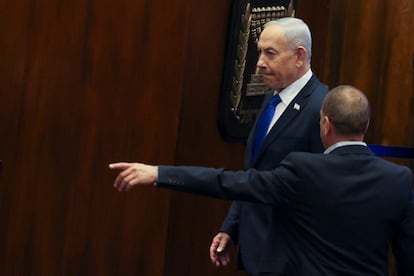

The war on Iran is headed for an end without victors, but the ceasefire agreement does have a clear loser: Benjamin Netanyahu. The strategic failure of the campaign he launched in February, alongside the United States, is scarcely matched in Israel’s history. With an added dimension: for Netanyahu (who has spent nearly 19 of the 78 years Israel has existed in power), attacking the Islamic Republic was not only a “dream” for four decades (in his own words) for which he lacked a willing partner in the White House. Had it succeeded, it would have been a kind of personal and political redemption for the other enormous security fiasco of his tenure: Hamas’s October 2023 attack. Israel’s powerful intelligence services did not foresee the surprise operation and Palestinian militants had hours to kill nearly 1,200 people before reinforcements arrived.
Netanyahu is the only leader, political or military, from that day who has neither resigned nor apologized, and he has obstructed an independent state inquiry into the episode. Victory over Iran would have crowned his attempt to reframe the narrative about that day: from the deadliest attack in Israel’s history to the dawn of a new Middle East.
Four months before an election in which polls place him a long way from revalidating his current governing coalition, Netanyahu tried on Monday, in his first press conference in three months, to present himself to Israelis as their savior and persuade them the military campaign was a success. “It did not go wrong at all. I defined the goals and the cabinet defined the goals” he said in his customary defensive tone. “Israel on October 7 and Israel today — how can one compare them?” He insisted the operation’s main achievement was that it saved Israelis from “an existential danger” because Iran was “a regime racing toward nuclear weapons.”
Netanyahu will have to twist language a lot from here — or pull one of his finest rabbits out of his hat — because the deal between Tehran and Washington fails to meet a single one of the objectives for which Israel pursued the war and has turned the sometimes embarrassing honeymoon between Netanyahu and Trump into weekly orders and insults.
“Israel is now paying the price for the round of confrontations with Iran in which it involved Trump. The man who promised total victory and said the regime would fall, the man who thought it would be a walk in the park in which Israeli-American military, air, and operational superiority over Iran would produce a crushing, absolute result, is now picking up the pieces of his own arrogance and hoping to survive,” wrote Ben Caspit, a well-known commentator for the Israeli newspaper Maariv, on Monday.
On Monday morning, the media was merciless toward Netanyahu. After the previous war on Iran, in June 2025, he spoke of “a historic victory that will endure for generations,” and of “eliminating two existential threats:” nuclear weapons and 20,000 ballistic missiles.
Yet eight months later he launched another campaign that is now ending to his chagrin. “The aim of the operation is to put an end to the threat from the Ayatollah regime in Iran,” he said at the time. “If we do not stop them now, they will become invulnerable. To this end, their representatives in negotiations are trying to buy time, attempting to gain time in fruitless and deceitful negotiations with our American friends.” In those heady days a building in Tel Aviv displayed a banner aimed at dissenters, with a photo of Trump and Netanyahu and the Hebrew slogan: “Commentators talk. Leaders lead.”
Promises
One of the representatives of that same Iranian regime will shake Trump’s hand this Friday in Geneva when the deal is sealed. The regime withstood the assassination of its supreme leader, Ali Khamenei, and weeks of bombardment by two of the world’s most powerful militaries. Promises of mass demonstrations in Iranian streets, of a Kurdish advance from Iraq, or of a military operation to seize enriched uranium amounted to nothing.
Netanyahu has not one significant achievement to sell, not even on his signature issue: Iran’s nuclear program. For years he has presented the country as a threat to humanity on the verge of building a nuclear bomb, contrary to assessments by experts and his own intelligence services.
In the end, the deal leaves the matter pending negotiation over the next 60 days. The program will not stop and it is unclear how material enriched above 60% will be diluted. Trump said on Sunday that they will “take it by force” at “the appropriate time, when everything is calm.” A bitter pill for the Israeli prime minister, who scandalized Holocaust scholars by justifying the offensive by saying otherwise the names of the nuclear facilities at Natanz, Fordow, Isfahan, and Parchin “would have been remembered forever in infamy, just like Auschwitz, Treblinka, Majdanek, and Sobibor.”
Two months of war and another two of ceasefire have served only to return to something that looks very much like Barack Obama’s nuclear agreement — the very deal Trump abandoned in his first term and which Netanyahu maneuvered against, even using the Republican control of the U.S. House of Representatives to give a speech urging them to abandon it. All at a daily cost to Israel’s coffers of one billion shekels (about $350 million) in military spending alone.
Future
Amos Harel, the defense affairs commentator for Haaretz, wrote on Monday that, “after the failure of this war,” it is hard “to imagine any future U.S. president — probably also less friendly to Israel — backing an Israeli prime minister in a future war with Iran, in the quite plausible scenario that the regime one day decides to build a nuclear bomb.”
Before the war, Netanyahu also spoke — and at length — about two other issues: Tehran’s ballistic missile program and its support for allied militias across the Middle East. In December, a reporter asked Trump if he would support Israel attacking Iran solely over its missile program, not its nuclear one. He replied: “Absolutely.”
Months later, those two issues were already so absent from negotiations with Tehran that even Netanyahu had stopped mentioning them. They do not even appear in the text of the memorandum of understanding to be signed in Geneva, according to points released by the Iranian Mehr news agency. The text has not yet been published.
The war has also meant the collapse of Netanyahu’s relationship with Trump. The Israeli prime minister knew how to flatter him in impeccable English and feed his ego: he suggested he was the best of the 45 U.S. presidents and even nominated him for the Nobel Peace Prize. The praise was mutual. Just six months ago, Trump called Netanyahu a “hero” and pressured Israel’s president, Isaac Herzog, to grant him a pardon for the three corruption cases in which he is indicted. But when their interests in Iran diverged, Trump threw him under the bus and began insulting him. Over the past eight days the Republican has called Netanyahu a “fucking lunatic” and “a very complicated guy” without “a fucking shred of judgment.”
Thus, as of this Monday, the new Middle East Netanyahu promised nearly three years ago looks like this: Hamas remains in power in part of Gaza; Hezbollah is fighting Israeli troops in southern Lebanon; and the Tehran regime has emerged vindicated, emboldened, and with its strangled economy poised to receive billions of dollars from the unfreezing of its funds in banks around the world. In the meantime, Netanyahu’s Israel has killed nearly 80,000 people in Gaza, Lebanon, Syria and the West Bank; it occupies more territory than at any time since 1982 (“indefinitely” in Lebanon and Syria, Defense Minister Israel Katz stressed on Monday); and it faces a genocide complaint at The Hague while Netanyahu is under an arrest warrant as a suspect for war crimes and crimes against humanity in Gaza.
Sign up for our weekly newsletter to get more English-language news coverage from EL PAÍS USA Edition









































