
Lendrick Street, a snapshot that explains violence against immigrants in Belfast
Residents at the epicenter of the xenophobic unrest express their fear: ‘I think they’re trying to make everyone racist’
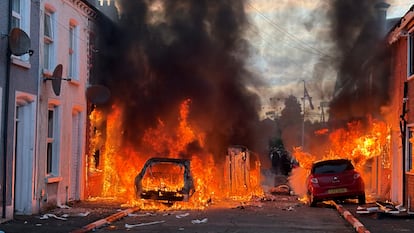

As with so many stories, the outbreak of violence this week in Belfast can be told through the lens of a single street. Lendrick Street is in the east of the Northern Irish city. A straight line of barely 200 meters. Modest two-story brick houses, aligned in that Georgian style where only the door and windows mark the different homes that occupy the continuous walls on both sides of the road.
East Belfast houses the faded pride of generations of workers from the Harland & Wolff shipyards, where the Titanic was built, and the nostalgic frustration of a Protestant population left disoriented and disadvantaged by the peace process in Northern Ireland, as the war-themed graffiti covering the neighborhood shows.
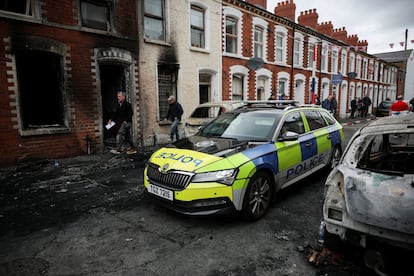
On a rainy, dreary Thursday morning, reporters and cameras prowl the street. Three burned-out vehicles, like the skeletons of three beasts, are a reminder that 48 hours earlier Lendrick Street had been the scene of the closest thing to a pogrom the city has seen in decades. Protesters, egged on by social media, unleashed terror on the street. They set fire to two homes, and the immigrant families who lived there had to flee for their lives with only the clothes on their backs.
“On Tuesday we evacuated 12 families across Belfast because their homes and cars were set on fire. We helped them escape and placed them with friends, in some hotels and in neighbors’ homes who offered to host them [...] After a new hit list was posted on social media the next day, all those people whose addresses had been published asked us for help. We now have 200 families accommodated,” Twasul Mohammed tells EL PAÍS. Mohammed is a Sudanese-born activist who arrived in Northern Ireland as a refugee and now heads the Human Rights section of Participation and Practice of Rights, an organization focused on helping asylum seekers.
“When I arrived in 2016, I thought we were better off here than people of color in England or Scotland,” he says wryly, “because Protestants and Catholics were too busy fighting each other. Today we see a dangerous alliance of paramilitaries and the domestic far right,” Mohammed says.
Joshua and Kaleb, two 20-year-olds born in the United Kingdom to Nigerian parents, have come to see a Portuguese friend who lives on Lendrick Street. Unlike many others who avoid the press, they want to express their anger.
“I think they’re trying to make everyone racist. It’s crazy,” says Kaleb, the more talkative of the two. “One guy tries to kill another and, suddenly, they label all Black people as if they were that person, without thinking that each person is an individual,” he says, referring to last Monday’s attempted decapitation by a man of Sudanese origin, who attacked a neighbor with a knife. “I’ve never imagined in my life fighting someone and trying to cut their throat, and now they want people to believe all Black people are like that. I think they’ve been racist all their lives, and now they’re showing their true colors,” Kaleb adds.
The street has a constant flow of public workers who have come to carry out initial clean-up tasks, gas company workers checking the safety of the lines and curious onlookers coming to see the battlefield. Some come on foot. Others drive slowly down Lendrick Street and film the damage with their phones.
The ‘love’ for flames
“We love the flames, we love to stoke them. It’s something that provokes fear and provides an excuse to keep paramilitarism alive. It gives them a reason to stay active. And all of it stirred up by social media, which didn’t exist when we had 30 years of the Troubles [the sectarian violence that scarred Northern Ireland, pitting Protestants against Catholics]. Imagine what this must be like now,” says Martin Craigs, a 70-year-old Englishman who came to Belfast as a child, traveled the world while working in the aerospace and tourism industries, and returned to retire in what is now his city.
He had just dropped two friends from Bali at the airport and had been unable to explain to them the reason for so much violence. Though he is clear about its origins. “They’re the remnants of the paramilitaries, the remnants of a group that has never had a job in their life, and who think that taking the kids out to throw stones and petrol bombs, and then ending up in the pub, helps them get through life,” he says.
The Police Service of Northern Ireland does not go that far. It has not wanted to link the recent violence to the unionist paramilitary organizations that remain active. But an organization and its members are different things. Northern Irish human rights groups are less hesitant.
“We are witnessing the manipulation and exploitation of a horrific crime to find a collective scapegoat and target ethnic groups and communities that have nothing to do with what happened,” says Daniel Holder, director of the Committee on the Administration of Justice, Northern Ireland’s branch of the International Federation for Human Rights. “Racist intimidation in Northern Ireland is especially dangerous because elements of loyalist paramilitary groups have become involved. This has been building in recent years, with a far right that is anti-immigrant and Islamophobic and whose voice is amplified online and in public spaces.”
Protestant residents on Lendrick Street who peek out from their doorways to watch the street’s activity flee in panic when a journalist approaches. But with a bit of cajoling and half-smiles it is possible to extract some impressions. One resident, a proud member of one of the lodges that march every year to commemorate Protestant King William of Orange’s victory over the Catholic James II at the Battle of the Boyne in 1690, protests the damage on his street but says he shares the anti-immigration rhetoric amplified on social media and at the demonstrations. “They rent the homes to them for a ridiculous amount paid by the government, and I have to spend a large part of my salary on mine,” he says.
His voice, however, is not that of most Belfast residents, who are still waking from the nightmare of seeing parts of their city once again engulfed in the flames of violence. “It was completely unnecessary and disgusting. Pure, hard racism, to be honest. Recently we’ve also had horrific crimes committed by white people, and I haven’t seen anyone protest in the street. What happened this week was terrible, no doubt, but the response has been racist,” says Chip, a musician who has played Irish folk music for decades and lives a few blocks from Lendrick Street.
The immigrants who fled in terror on Tuesday night now live in shelters improvised by the authorities and charities, at addresses that remain secret for obvious security reasons. They have left Lendrick Street. The burned vehicles and homes, and the wary glances of some neighbors from behind curtains, are the legacy of a week of pointless violence.
Sign up for our weekly newsletter to get more English-language news coverage from EL PAÍS USA Edition









































