
University demands against Argentina’s Milei escalate with student protests and faculty strikes
Teachers’ unions stage walkouts all week and students occupy University of Buenos Aires buildings in protest against budget and salary cuts
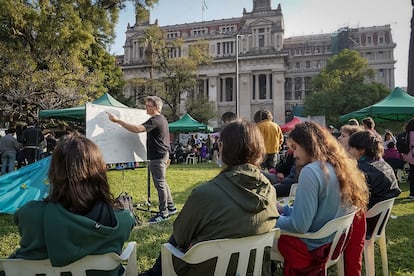

The demand over funding and salaries at public universities in Argentina shows no signs of abating. Protests and strikes resumed this week to demand that the government of Javier Milei respect the university financing law, while the academic community awaits a ruling from the Supreme Court of Justice on the government’s noncompliance. Since Tuesday, schools affiliated with the country’s largest university, the University of Buenos Aires (UBA), have been occupied by students. And faculty unions are staging strikes across the country all week.
“The government is engaged in a flagrant act of unconstitutionality. It has an obligation to comply with the existing law,” said Clara Chevalier, a teacher and leader of the union Conadu. “We have shown that sustaining a public, high-quality university is a point of agreement for Argentine society,” she added. She was referring to the massive demonstrations 15 days earlier in different cities by students, professors and academic authorities, which enjoyed broad public support.
To the strikes and other protests that professors have been carrying out since March, student-organized occupations of schools have now been added. For the moment the measure affects the secondary schools that are part of the UBA: Escuela Carlos Pellegrini and Colegio Nacional de Buenos Aires. Student assemblies decided to occupy both institutions for an indefinite period, although the occupation is being reviewed day to day.
“The idea is to make the conflict visible, to inform society about what is happening because it is truly very serious. The situation is at a breaking point,” said Francisco Pitrola, president of the student center at Nacional Buenos Aires. “The university financing law was passed by Congress, the president chose to veto it and Congress ratified it. The government is not complying with the law; that is undemocratic. Beyond the universities, democracy itself is at stake,” he summed up in remarks to local media.
State universities are suffering especially from the fiscal austerity imposed by Milei. According to estimates from the National Interuniversity Council (CIN), transfers of resources to higher-education institutions show “a cumulative real decline of 45.6% between 2023 and 2026.” Faculty members and other university workers’ wages have suffered “a loss of purchasing power on the order of 37.13%.”
The university financing law was approved last year by Congress with the aim of updating budgets and salaries in line with cumulative inflation since Milei took office. But the executive refuses to implement it, arguing it lacks sufficient funds. The current annual budget for the 64 national universities, where more than 2.1 million students are enrolled, is 4.8 trillion pesos (about $3.4 billion). Implementing the law would require adding between 2.5 and 3.1 trillion pesos. The CIN says the fiscal impact would be 0.36% of GDP, an amount far smaller than various tax exemptions granted by the government.
The matter is now in the hands of the judiciary. Two rulings, one in the appeals circuit, ordered a precautionary measure requiring the executive to begin paying the salaries provided for by the law while the courts decide the statute’s validity. Milei appealed to the Supreme Court and the high court has not yet ruled.
Demanding a prompt judicial decision, professors and students from several universities voiced their complaints in front of the Palacio de Tribunales, the seat of the Supreme Court, in downtown Buenos Aires. There, on Plaza Lavalle, they held public classes, assemblies and debates on Tuesday. “Help: the government does not comply with the law,” read one of the huge signs they placed on the grass among chairs, umbrellas, tents and makeshift blackboards. “The people have already ruled: enforce the law. Do not betray us,” read another. A third added: “Judges, we are waiting for you.”
Sign up for our weekly newsletter to get more English-language news coverage from EL PAÍS USA Edition









































