
Power of Siberia-2, the gas pipeline the Kremlin craves and that brings Xi and Putin together
Russia and China are moving closer to linking the Arctic Circle to Shanghai but the urgency is on Moscow’s side
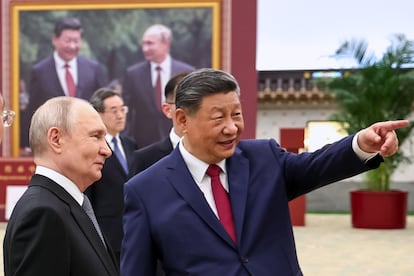

Poised to become the king of pipelines, with a total route of more than 2,600 kilometers (1,615 miles), Power of Siberia-2 is set to change two things forever: global natural gas flows and the already solid alliance between China and Russia. A few loose ends remain before it becomes reality, but after Tuesday’s meeting between Xi Jinping and Vladimir Putin, the road appears paved for the pipeline that will link the Yamal Peninsula ― one of the world’s largest gas fields ― with Beijing and Shanghai to come to fruition.
The promise that comes with the soaring name Power of Siberia-2 is twofold. For China, it offers a way to lower its future bill by supplying one-eighth of its domestic needs for a fuel key to its industry and reducing its need to turn to the highly contested global liquefied natural gas market (LNG, which is shipped by tanker). For Russia, which faces a domestic economic situation that is anything but reassuring, it is the only viable outlet to move the volumes it used to sell to the European Union before the invasion of Ukraine.

What it is. The project’s aim is to connect Russia’s main gas extraction point, deep inside the Arctic Circle, with some of China’s main economic hubs. In short, it will complement Power of Siberia-1, active since 2019 and already carrying 38 billion cubic meters (bcm) of gas a year — the equivalent of the demand of a country like Spain. When ready, its bigger sibling will be able to transport nearly 50 bcm, almost as much as Italy consumes in a year. Together, the two pipelines will cover one-fifth of China’s demand.
The idea for Power of Siberia-2 goes back two decades, when another official visit by Putin to Beijing ― he has made 25, by one count ― planted the project’s first seed. After years of dormancy, the stigma attached to Russian gas in the West following the invasion of Ukraine ― the EU has banned overland deliveries ― accelerated plans. Moscow needs new routes to export its vast fossil fuel reserves, the cornerstone of its economy, before it is too late.
Although both sides are interested, the party with the greatest stake in seeing the project completed is the Kremlin. In particular, the state gas giant Gazprom, which has for years been feeling firsthand the collapse of sales to Europe. Urgency is on its side.
Where it stands. After Tuesday’s summit between Xi and Putin, Kremlin spokesman Dmitry Peskov announced a “shared understanding on the main parameters of Power of Siberia-2: the route and how it will be built.” Some “details,” he conceded, remain unresolved, and the timeline for carrying it out has not been set. But from his words — and despite Chinese authorities opting not to comment — progress can be inferred.
The route ― which will cross almost all of northeastern Mongolia before entering Chinese territory ― has already been decided. Its cost, however, remains uncertain, though the most conservative estimates place it above $11.5 billion. And rising.
In September last year, Putin said the system that will determine the fuel’s future price had been finalised: it will, he said, be a formula similar to the one that once governed flows sent to the EU via the ill-fated Nord Stream pipeline, until it was hit by sabotage. Those prices were rock-bottom compared with what is paid today for LNG, the main and almost sole crutch the EU has been able to rely on to weather the crisis. Nevertheless, given the growing imbalance of bargaining power, China will likely have more room to push the gas price down.
Why now. The timing is most propitious. Russia, with the European route closed sine die, urgently needs foreign currency in exchange for one of its most coveted commodities. For China, the recent closure of the Strait of Hormuz has deprived it of two of its main suppliers (Qatar and the United Arab Emirates), making diversification more important than ever.
Economically — although in the early years of operation the cost of pipeline deliveries is higher — over the long term gas delivered by pipeline is typically noticeably cheaper than gas transported by ship. With an estimated lifespan of about 30 years, both countries will have ample time to extract value from it before natural gas fades. The research center of the Chinese energy giant CNPC projects an average demand increase of 5% through 2030.
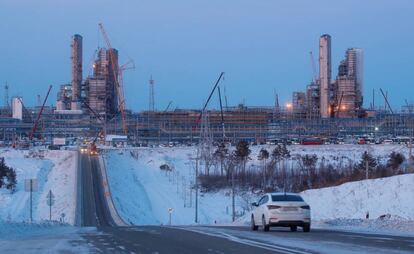
What it means for the rest of the world. In the short term, nothing: China itself estimates that once both parties give final approval, construction will last at least five years. Another near-five-year period will then pass before it can operate at full capacity.
In the long run, however, it will represent a major twist in global energy flows. By receiving more gas from Russia, China will be much less pressured to turn to the competitive global LNG market — supplied in large part by the United States since the Strait of Hormuz was closed — freeing up space so that the EU, Japan, or India, to name the most obvious cases, can satisfy their import demand.
Sign up for our weekly newsletter to get more English-language news coverage from EL PAÍS USA Edition









































