
Venezuela’s longest-serving political prisoners released after 23 years behind bars
Héctor Rovaín, Luis Molina, and Erasmo Bolívar were convicted, without evidence, over deaths that occurred in 2002 during protests in which Hugo Chávez was briefly ousted
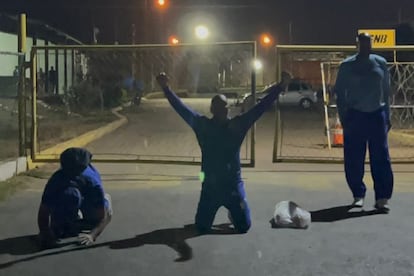
Héctor Rovaín was 34 when he went to prison and his parents were still alive. He left at 57 without having been able to bury them. Luis Molina left his daughter as a three‑year‑old and will now meet a married woman and a grandchild he has yet to know. Like the other two, Erasmo Bolívar spent 23 Christmases without embracing his family. All three were officers of the Metropolitan Police (PM), a force that operated in Caracas and which no longer exists. They were accused, without evidence, along with six other officers, of two of the 19 deaths that occurred on April 11, 2002, when an opposition‑called protest tried to reach the Miraflores presidential palace and demonstrators were repelled by gunfire. There remain doubts about where those bullets came from. That same day, Hugo Chávez was toppled in a coup d’état, though he returned to power 48 hours later.
The three Metropolitan Police officers were until now Venezuela’s longest‑serving political prisoners. Their case marked the start of the Bolivarian revolution’s repressive tally. Their release on humanitarian grounds was ordered Tuesday night and announced in advance by the president of the National Assembly, Jorge Rodríguez, who said around 300 more people would also be released this week by the same means.
In the case of these three officers, amnesty had been denied twice: in 2007, under Chávez, and in 2026, under Delcy Rodríguez. The measure was announced amid outrage over recent deaths in prison and reports of political detainees disappearing, such as Víctor Quero, whom his mother, Carmen Navas, had searched for for more than a year before she died.
The release was recorded on video, showing the three kneeling and kissing the ground at the entrance of the penitentiary in Lara state, wearing prison uniforms and carrying a bag with their few belongings. Much of their sentence was served in a military facility, but five years ago they were transferred to that prison, over 185 miles from their homes — they are from Caracas and La Guaira — a decision that hindered family visits and access to care.
“I lack the words to express everything we lived through in there, but the most important thing is to thank all those people who followed our case and never forgot us,” Erasmo Bolívar said upon leaving.
This Thursday, the three must appear before the court to learn the conditions of their release. The controversial case was filed in Aragua state, although the events occurred in Caracas, one of the first irregularities in a process riddled with them. “Their lives changed after 23 years in prison,” says lawyer and activist Yajaira Forero, wife of Lázaro Forero, another Metropolitan Police officer who was imprisoned and granted conditional release on health grounds more than a decade ago. Forero has been the main spokesperson for the cause and on Wednesday, at a protest calling for the release of more than 500 political prisoners who remain detained, she did not hide her emotion. “They are the political prisoners who have spent the longest uninterrupted period in detention in Venezuela. They had spent years in cells, in prisons far from their homes, without seeing their families. We have been fighting for them for years, and every time their release was denied, it was a source of pain.”
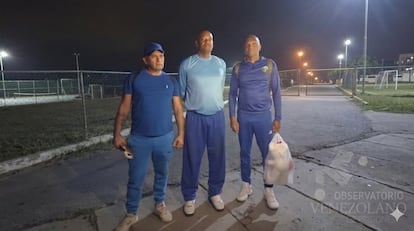
Molina, Bolívar, and Rovaín belonged to the now-defunct PM, a force replaced by the Bolivarian National Police in 2009. They were arrested after the events of April 11, 2002, the first major political storm between Chavismo and the opposition, and the episode that institutionalized polarization in Venezuela.
Hugo Chávez, elected in 1999, had used his legislative majority to obtain special powers through an enabling law and governed by decree across wide areas of administration, bypassing parliamentary checks. In that context, as the opposition began to fear the president’s authoritarian intentions, a wave of protests erupted, behind which a military conspiracy to depose him was concealed.
On April 11, a mass demonstration called by opposition parties marched toward the Miraflores Palace to demand Chávez’s resignation. A group of pro‑Chávez activists stationed nearby fired on the march, triggering a firefight with the police units responsible for public order. The toll was 19 dead and more than 100 injured. Chávez was ousted that night but regained power two days later.
When his government regained control, it moved to open judicial cases against those it held responsible for the crisis. Politicians, businessmen, and union leaders were charged; over time many were amnestied or went into exile. The courts went after Iván Simonovis, chief of the Caracas municipal police, and commissioners Henry Vivas, Lázaro Forero, and Julio Rodríguez, as well as officers Molina, Bolívar, and Rovaín. They were all accused of breaking the police cordon to allow the march to advance and of firing at the pro‑Chávez gunmen who were waiting armed for the crowd. They were sentenced to 30 years in prison.
Simonovis served 15 years, the last few under house arrest, before fleeing the country. The commissioners received humanitarian measures for health reasons more than a decade ago: two suffer from cancer. Marco Hurtado and Arube Pérez were released in 2020 and 2022 after serving their sentences plus extra time due to delays in executing their releases. Molina, Bolívar, and Rovaín, 23 years later, are the last to be freed from the April 11 story.
“The international community began demanding explanations for the dead and injured that day, and the scapegoats were the PM officers, not the snipers and gunmen surrounding Miraflores. But history will vindicate us and justice will be done,” says Yajaira Forero. The police officers were held responsible for two of the 19 deaths, without any evidence. The rest remain completely unpunished.
The case will be reviewed by the Inter‑American Court of Human Rights. “A narrative was built around the PM to obscure the concrete responsibilities of those who killed 19 people that day,” says Alfredo Romero, director of Foro Penal, an organization that defended several of the accused and took the case to international bodies, “where some truth about April 11, 2002, will begin to be determined.”
For Romero, the case is a milestone in the dismantling of Venezuela’s justice system and in Chavismo’s authoritarian drift: what happened that day served as a pretext to intervene in the judiciary and reform the foundations of the Supreme Court of Justice. “The essential basis supporting this regime has been control of the judiciary, presenting actions as supposedly legal but with a political control objective,” he says. “That is closely linked to what is happening now in this attempt to recomposition judicial actors.”
Sign up for our weekly newsletter to get more English-language news coverage from EL PAÍS USA Edition









































