
The Caracas Marriott, the hotel where the future of Venezuela is being decided
The five-star pile is a daily showcase of American tutelage in the country

At 8 a.m., the 20 Marines staying at the JW Marriott in Caracas go down for breakfast. It is a unique spectacle. They are between 30 and 40 years old and almost all of them sport a chevron mustache, Freddie-Mercury-style. The tattoos reach the elbow, sometimes the knees. Caps, shorts and T-shirts are emblazoned with slogans that sit oddly in Donald Trump’s war-mongering era. “No war team,” read one of them last week.
An elite fast-action corps, the Marines don’t miss a day at the gym, stick to schedules, and are never without their walkie-talkies. They are the most recognizable Americans, but at the rest of the tables sit CIA agents and personnel from the U.S. State Department and Embassy. All of them are part of this new political moment in Venezuela that started January 3, when the U.S. captured president Nicolás Maduro. It’s a new moment in which, having partly subdued Chavismo, the United States has more power than ever in Venezuela and operates out of a five-star hotel in a financial district of Caracas.
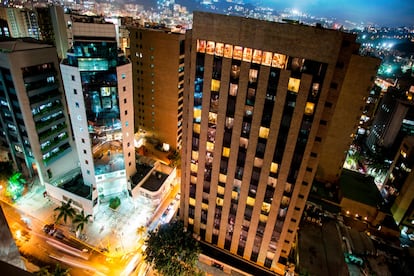
The JW Marriott — JW is Marriott’s premium line — is a 17-story brick building that doesn’t particularly stand out. It has about 300 rooms that, by haggling, can be obtained for $200 without breakfast. There’s an outdoor pool, gym, a restaurant where a snack and a drink can cost about $50, a bar with cocktails, and more than a thousand square meters of rooms for events and meetings. There’s also a bridal shop and another selling suits.
It is not the kind of place where one would expect the future of a country to be forged. And yet, since U.S. special forces executed the operation that culminated in the capture of Maduro, the JW Marriott has been the informal headquarters of the U.S. presence in Venezuela.
The JW Marriott was initially used as an embassy, since the actual embassy was closed for seven years following the diplomatic rupture in 2019. Abandoned during that time, the embassy building was beset by damp and mold and needed a full renovation before the U.S. flag could be raised again. Meanwhile, the diplomats, State Department agents, agents from the various security and intelligence agencies, and the Marines who arrived in Caracas in the days and weeks following January 3, needed a place to set up camp. The JW Marriott was large, low-key, and had enough space for closed-door meetings.
The Embassy formally reopened on March 30, 86 days after the U.S. operation. But the hotel continues to act as a base for operations. “It is not a hotel, it is the place where the oversight of Venezuela is being decided,” says one individual attending one of the many meetings that are held there every day.
Some of the most relevant players in Venezuelan politics and business have sat in its halls together with U.S. interlocutors. Major decisions in the first 90 days after Maduro’s removal have been discussed and carried out not only in Washington, but also at those tables. Oil and mining policy, changes required of Delcy Rodríguez’s government, economic initiatives, security... “I don’t know what precedent there is for an American tutelage that is coordinated from a hotel,” says the aforementioned individual.
What makes the Marriott peculiar is that it’s open to other guests and visitors as a hotel. It is not a military installation or a diplomatic headquarters, although there are eyes and ears everywhere. All kinds of people come and go through its reception area: soccer teams, Venezuelan and foreign businessmen, journalists, passing officials, fortune hunters, and occasional tourists who still do not understand what is happening in the country.
Venezuelans who take some of these guests out to eat joke that they suffer from cabin fever — the term for the psychological claustrophobia that comes from spending weeks confined in the same space, unable to go out, with almost no contact with the outside world. They go from the Marriott to work — almost always the Embassy — and from work back to the Marriott. They speak to no one outside their circle. At most, they cast a curious glance. They oversee Caracas without stepping into Caracas. And as the days go by, it’s not entirely clear what the plan is.
Sign up for our weekly newsletter to get more English-language news coverage from EL PAÍS USA Edition









































