
Díaz-Canel: ‘There is no negotiation’ with US other than on Cuban terms
The Cuban president has asserted that regime change is not in his government’s plans. ‘Imposing conditions does not allow for negotiation’
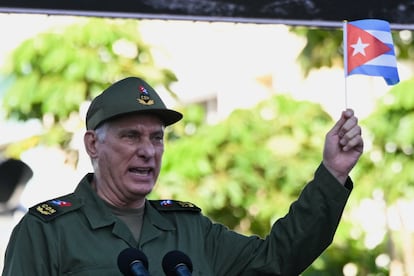

Cuban President Miguel Díaz-Canel issued a new challenge to the United States on Wednesday amid ongoing negotiations between the two countries, which are marked by escalating tensions. The president, who also heads the long-established Communist Party of Cuba, asserted that dialogue with Washington can only proceed if the northern power respects Cuban conditions. “There is no negotiation,” if the United States does not agree to discussions on Cuban terms, Díaz-Canel declared in a televised address recorded at Havana’s iconic Palace of the Revolution.
The communist leader has made his position clear, stating that “our internal issues are not on the table for conversation with the United States or for negotiation.” These statements come two days after it was revealed that the U.S. government issued a two-week ultimatum to Havana in a secret meeting, demanding the release of high-profile political prisoners. Washington specifically pressured for the release of artist Luis Manuel Otero Alcántara and rapper Maykel Osorbo. Díaz-Canel confirmed in mid-March that officials from his government had begun talks with representatives of the Trump administration, amid the economic crisis gripping the island.
The negotiations are being conducted in secrecy, although the Cuban regime has admitted to engaging in dialogue with Washington following a series of rumors and speculations about a rapprochement. Díaz-Canel, however, attempted on Tuesday to demonstrate that Havana holds all the cards in these “dialogues,” asserting that negotiations are only possible if the U.S. accepts the terms set by the government of an island mired in an energy and economic crisis that is severely impacting its population, pushing them toward mere survival.
The Cuban president stated: “A negotiation must be built. First, there must be dialogue. First, we must identify areas where we can work together, and after that, we must demonstrate a willingness to do so constructively. If one of the parties does not support that dialogue, does not support that conversation, wants to impose, it breaks the conversation, it breaks the negotiation.”
The Cuban has advocated for what he calls “a level playing field” at the negotiating table. “We have always started from that premise,” he said in an interview with the Brazilian program 20 Minutos. “Respect for our political system, our sovereignty, and our independence, under the principle of reciprocity and respecting international law.”
USA Today published a report a week ago about the imminence of an economic pact between the two countries, which, the newspaper suggested, hinged on removing Díaz-Canel from the equation. Trump reacted to the confirmation of negotiations with the Cuban side without his usual inflammatory rhetoric: “Cuba confirms talks with Trump officials, raising hopes for U.S. deal,” the Republican wrote on his social media platform, Truth.
In addition to economic considerations, the release of hundreds of political prisoners held by the Cuban regime is crucial for Washington. The White House has pressured for the release of Otero and Osorbo, but on Wednesday, Cuba’s Supreme People’s Court (TSP) rejected Otero Alcántara’s appeal for early release. According to EFE, the court rejected the appeal filed by the artist, who was sentenced in 2022 to five years in prison for the crimes of “contempt, public disorder, and repeated insults to the symbols of the nation.”
Díaz-Canel asserted that Cuba would not accept regime change in negotiations with the United States and stated that talks must be conducted with respect for the island’s political system. “Cuba has always been willing to engage in dialogue with the United States government, provided it is based on respect for our political system, our sovereignty, and our independence, without preconditions and on equal terms, because imposing conditions is not dialogue,” he affirmed. “Imposing conditions does not allow for negotiation.”
Sign up for our weekly newsletter to get more English-language news coverage from EL PAÍS USA Edition









































