
Trump announces 10-day ceasefire between Israel and Lebanon
Neither country has confirmed the ceasefire, even as the Israeli army pushes eastward and bombs the last remaining bridge over the Litani River
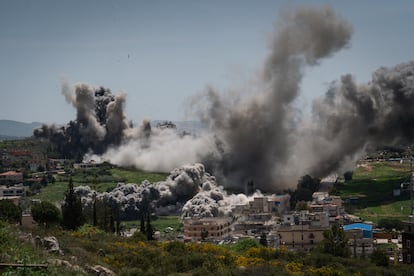
U.S. President Donald Trump has announced a 10‑day ceasefire in Lebanon that will take effect this Thursday at 5 p.m. Eastern Standard Time (midnight in Israel and Lebanon). According to Trump, Lebanese President Joseph Aoun and Israeli Prime Minister Benjamin Netanyahu have agreed to halt hostilities, though he offered no further details. Neither country has yet confirmed the announcement.
From early in the day, talks toward a ceasefire in Lebanon had taken center stage, as Israeli forces held a strip of the south and advanced while demolishing villages. Iran insisted on a ceasefire as a condition for progress in its talks with the United States, and Pakistan — acting as mediator — had included Lebanon in a broader 15‑day global ceasefire set to end next Wednesday. But Israel continued its bombardments, with Trump’s approval, complicating negotiations with Tehran and forcing the U.S. president to shift course.
After announcing the ceasefire, Trump added that he would invite Netanyahu and Aoun to the White House for “meaningful talks.” “Both sides want to see PEACE, and I believe that will happen, quickly,” he said in a post on Truth Social.
These are the “leaders” of Israel and Lebanon whom Trump had predicted would speak on Thursday, in what he described as a historic moment. A similar claim was made by one of Netanyahu’s ministers, Gila Gamliel, before the ceasefire announcement. But the conversation never happened. With Israel killing dozens of Lebanese civilians each day — including paramedics — and Hezbollah accusing the government of betrayal for negotiating directly with a historic enemy without securing concessions, Aoun refused to take part in the hastily announced call.
Instead, he spoke with U.S. Secretary of State Marco Rubio and reiterated that Israel must halt its hostilities in Lebanon if it wants direct negotiations, which began Tuesday in Washington with contact between ambassadors. That condition has now been met, even if only for 10 days. The Lebanese president described the ceasefire as “the natural entry point for direct negotiations” between the two countries and affirmed his commitment to “stopping the Israeli escalation” and curbing “attacks on innocent civilians, including men, women, and children, as well as the destruction of homes.” Israeli strikes have caused another 29 deaths in Lebanon in the past 24 hours, according to health authorities on Thursday.
From early in the day, signs were mounting that a ceasefire in Lebanon was imminent, even as the Israeli army destroyed the last bridge over the Litani River, moved toward the Syrian Golan, and pushed to seize Bint Jbeil, a town of symbolic importance for Hezbollah.
Netanyahu did not want this ceasefire. He made no mention of it in a video address the night before, speaking instead of military gains and advances, as if negotiations for a ceasefire were not already widely known. The decision is, on its face, unpopular in an election year, coming just a month after he vowed — once again — to deliver Hezbollah’s definitive defeat, a promise never fulfilled. On Israeli television, the mood is now one of irritation and skepticism.
The ceasefire, in any case, is temporary. And in Israel, the expectation is that it will hold without a withdrawal of troops from southern Lebanon. After the 2024 war, Israel carried out near‑daily strikes across the country, killing more than 400 people, even though the Shiite militia did not fire a single rocket. Netanyahu’s government accused Hezbollah of violating the ceasefire by secretly reinforcing its positions.
On March 2, the militia launched its first projectiles at Israel since 2024, citing previous violations and the killing of Ali Khamenei — Iran’s supreme leader and its key ideological and military patron. Netanyahu responded with airstrikes across Lebanon and a ground invasion of the south, where troops have advanced by expelling residents and blowing up homes, factories, and bridges, a pattern reminiscent of Gaza. The comparison was made by Israel’s own defense minister, Israel Katz.
Credit
The talk of a possible halt to hostilities has sparked a dispute in Lebanon between the government and Hezbollah over who deserves credit for it. The Lebanese cabinet links the breakthrough to its own decision — politically risky and unpopular among many citizens — to initiate the first high‑level contact with Israel in decades. Iran and its ally Hezbollah, by contrast, argue that the ceasefire is the result of pressure on the United States during negotiations for a broader regional ceasefire, Tehran’s blockade of the Strait of Hormuz, and Hezbollah’s armed response to the Israeli advance in southern Lebanon, in which it killed 13 soldiers.
That is how Ibrahim Moussawi, a Hezbollah lawmaker, put it in comments to Reuters. Similar claims were made by Nabih Berri, the speaker of Lebanon’s parliament and leader of the Shiite Amal movement, which is allied with Hezbollah, as well as by Mohamad Bagher Ghalibaf, the Iranian official overseeing negotiations with Washington.
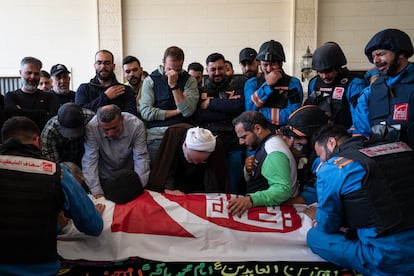
Israeli authorities announced weeks ago that they intend to control a border strip extending at least 10 kilometers (six miles) into Lebanese territory, and they say they will remain there indefinitely, regardless of any ceasefire.
With that objective in mind, Israeli military commanders submitted three requests to the political leadership handling the negotiations, according to reporting on Thursday by Yediot Aharonot. The first is the creation of a “buffer zone” in southern Lebanon reaching as far as the Litani River — potentially up to 30 kilometers (18.6 miles) from the border. This would not necessarily require a permanent troop presence, since it could be enforced through electronic means, but it would entail large‑scale displacement and destruction reminiscent of Gaza, at least in the first miles north of the frontier, where Israel has already wiped several villages off the map.
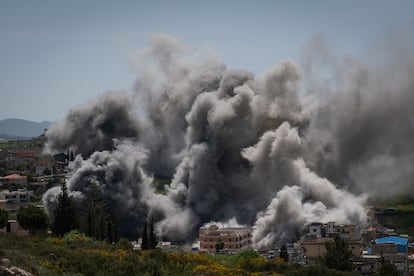
The other two demands involve launching a long‑term process to disarm Hezbollah under a U.S.‑supervised mechanism, and granting the Israeli army freedom to “eliminate threats, even north of the Litani River.”
That is essentially what Israel had been doing since 2024, in violation of the previous ceasefire. At the time, it secured from the White House broad latitude to strike anything it deemed a threat — a freedom it now wants to preserve. That carte blanche left residents of southern Lebanon feeling that the war had never really ended. It also allowed Israel to keep a border strip largely emptied of civilians, an area it has now reoccupied and where a group of U.N. human‑rights experts reported on Wednesday signs of ethnic cleansing against the Shiite Muslim population, Hezbollah’s main base of support.
In recent hours, the Israeli military has sharply intensified its operations in southern Lebanon. Troops have bombed the Qasmiyeh bridge — the only functioning crossing over the Litani — cutting off the south from the rest of the country. It is the third time Israel has struck the bridge since early March, when it began demolishing crossings. Israel presents the attacks as a military effort to prevent Hezbollah forces from moving toward the occupied border zone, but humanitarian groups warn of a looming catastrophe for civilians in the south, where the U.N. estimates more than 100,000 people remain.
Videos of controlled explosions targeting civilian infrastructure have also multiplied — acts that constitute war crimes. Some of the footage has been shared by soldiers themselves.
Israeli troops are also fighting Hezbollah militants for control of Dibbine, a town along the route Netanyahu has set for the army. On Tuesday, the Israeli prime minister ordered forces to expand the occupation toward the foothills of Mount Hermon, in the direction of Syrian territory that Israel seized first during the 1967 Six‑Day War and again in 2024, taking advantage of the turmoil following the collapse of Bashar al‑Assad’s government.
As often happens in the hours before a ceasefire takes effect, heavy fighting is expected. All the more so given that, for now, the pause is set to last only ten days.
Sign up for our weekly newsletter to get more English-language news coverage from EL PAÍS USA Edition









































