
One day at a time: How Mexico’s Sheinbaum dealt with a year of Trump
The president has managed to contain the whirlwind of threats from the tycoon, whose return to the White House forced Mexico to shift its priorities

Donald Trump’s return upended all the assumptions of a government that was only beginning to outline its National Development Plan. Since January 20, 2025, the volatility of the U.S. president has put the Mexican government to the test. Trump’s explosiveness has become the main challenge for President Claudia Sheinbaum, who is known for her meticulous planning and discipline. One year after Trump took up residence in the Oval Office, the president herself summed up her strategy for dealing with him in a single phrase: “It’s not just a matter of today.”
She explained this on Monday, January 12, just minutes after concluding her most recent phone call with the U.S. president, in which the main topic was his remarks about a possible incursion by U.S. troops into Mexican territory. “We must seek dialogue in these tense moments; it is the best time for dialogue,” said Sheinbaum, summarizing the strategy she has followed in the face of the worst specter of her administration: Trump and mass deportations; Trump and tariffs; Trump and fentanyl; Trump and the review of the USMCA trade agreement; Trump and the invasion of Venezuela; Trump and the threat of a military intervention on Mexican soil.
The magnate’s return to the White House a year ago forced Sheinbaum to rethink her governing plan, redefine her priorities, and align security strategy, economic policy, and domestic policy with the bilateral relationship — the only one that stands out in an otherwise blurred foreign policy. It is an uncomfortable but unavoidable relationship, built day by day, one that cannot be resolved through hours of work between governments, 15 phone calls between leaders, or a single meeting, no matter how cordial it may have been.
This is ongoing. We have been working with President Trump for almost a year now, and there have been moments... it’s not just a matter of today, it’s ongoing communication, coordination, defending the people of Mexico here and there.
“This is ongoing,” Sheinbaum explained at her January 12 morning press conference. “We have been working with President Trump for almost a year now, and there have been moments... it’s not just a matter of today, it’s ongoing communication, coordination, defending the people of Mexico here and there [in the U.S.]”

After a year of bilateral relations, Sheinbaum has refined her strategy and rhetoric around four pillars: respect for sovereignty and territorial integrity; shared but differentiated responsibility; mutual respect and trust; and cooperation without subordination.
The reality is that today everything is filtered through Trump’s actions. From the design of the Plan México (a strategy for investment and the development of the domestic market), to the ongoing extradition of cartel leaders sought by U.S. justice, a long chain of drug seizures, the deployment of National Guard troops along the southern border, the establishment of migrant shelters on the northern border, and even the organization of the FIFA World Cup.
Calm, patience, and a cool head
Since November 6, 2024 — the day after Trump won the U.S. presidential election for the second time — Sheinbaum has had to address the issue of Trump, striking a cautionary tone.
“To all Mexicans: there is no reason to worry,” she said at the beginning of her morning press conference that day, the 26th of her administration. “To our fellow citizens, to their families, to Mexican business owners: there is absolutely no reason to worry. Mexico always pulls through; we are a free, independent, sovereign country, and there will be a good relationship with the United States, I am convinced of it,” she insisted, adopting a line of rhetoric that would become a constant —one that she herself compared to the tactic of Kalimán, the popular Mexican adventurer superhero who always appealed to “calm and patience.”
Two days after Trump’s election victory, Sheinbaum called him to congratulate him. He appreciated the gesture, but did not soften the anti-immigrant and anti-Mexican tone that had characterized his campaign — the same one that carried him to the White House for a second time. As Inauguration Day, scheduled for January 20, 2025, drew closer, the Republican became increasingly radical, focusing on his three main issues: immigration, Mexican cartels, and the free trade agreement.
Eight days before Trump’s inauguration, President Sheinbaum led a massive rally marking her first 100 days in office. The packed Zócalo square served to demonstrate popular support for the government in the face of Trump’s return to the White House and his explicit threat to deport thousands of immigrants. Flanked by members of her cabinet, governors, and lawmakers from the ruling coalition, Sheinbaum mounted a firm defense of Mexican migrants and their contribution to the economies of both countries. From that rally came another of the phrases that has become a banner in her relationship with the U.S. president: “We will always hold our heads high. Mexico is a free, independent, and sovereign country. We coordinate, we collaborate, but we do not subordinate ourselves.”
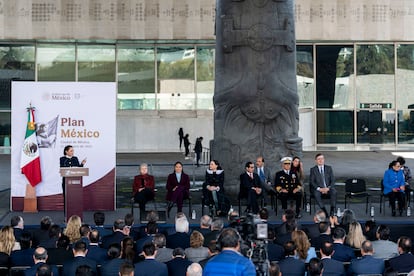
The following day, Sheinbaum gathered business leaders at the Museum of Anthropology to present Plan México, which, she announced, included a portfolio of domestic and foreign investments totaling $277 billion. A week later, with Trump just installed in the Oval Office, he began acting on his warnings, signing and publishing a series of decrees that seriously affected Mexico: the declaration of an emergency at the border, the reinstatement of the “Remain in Mexico” program, the imposition of tariffs, and the designation of drug cartels as terrorist organizations. “It is important to keep a cool head,” Sheinbaum responded on January 21.
Trump’s threats loomed over Mexico’s economy and politics for two weeks, during which Sheinbaum had to respond to dozens of questions about how she planned to handle them. “A cool head, calm, and patience,” she repeated several times. On February 2, Sheinbaum and Trump had one of their most important calls. It lasted 45 minutes, during which they reached a first agreement to postpone the implementation of tariffs on Mexican products until April.
In March, the government and Sheinbaum’s party Morena called for a new popular mobilization in the Zócalo, in anticipation of the imminent implementation of the tariffs. But another call with Trump defused the alert, and on March 9, in front of thousands of supporters, Sheinbaum recalled: “As you know, this assembly was convened in case we did not reach an agreement, with the purpose of announcing a strategy and actions we had prepared months in advance. Fortunately, dialogue has prevailed, and above all, respect between our nations… and the tariffs that were being applied to products we export to our neighboring country have been lifted.”
‘The cartels control Mexico’
Since then, the calls have followed one after another: April 17, May 1, May 22, June 17, July 31, October 25… Almost all were requested by President Sheinbaum through Ambassador Ronald Johnson, and always to address an emergency arising from a statement or action by the U.S. president — like the one in June, after Trump returned from a G-7 summit in Canada, where he was meant to have his first in-person meeting with the Mexican president.
The slight at the G-7 was resolved with another phone call, a couple of social media messages, and Trump’s apparent cordiality toward Sheinbaum, whom he has praised extensively, highlighting her intelligence, kindness, and character. These compliments are always accompanied by criticism, threats, and the assertion that the Mexican government fears the cartels. “She’s a good woman, but the cartels control Mexico. She doesn’t control Mexico,” he has said dozens of times.
Paradoxically, Sheinbaum’s government has found in Trump the perfect nemesis to rally her supporters and boost her popularity. In addition to the January and March gatherings, the U.S. relationship featured prominently in her October speeches, when she celebrated one year in office, and in December, when Morena once again filled the Zócalo to mark seven years of the Fourth Transformation. According to an Enkoll and EL PAÍS survey, Sheinbaum’s handling of the relationship with Trump is one of the policies most supported by the public. Sheinbaum’s approval rating has remained above 74% throughout her term, reaching 83% in May after she succeeded in postponing the implementation of tariffs.

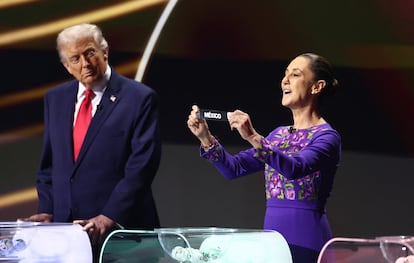
It wasn’t until December 5th that Sheinbaum and Trump finally met face-to-face, at the draw for the 2026 FIFA World Cup held in Washington, D.C. Before the eyes of millions of television viewers around the world, Sheinbaum and Trump — with Canadian Prime Minister Mark Carney as a witness — spoke directly for several minutes while the tournament groups were being drawn. Both described the meeting as cordial and friendly. “He was very kind; there was no rudeness at any point,” said Sheinbaum. Afterward, they had a private meeting, in which the three leaders agreed to stay in touch regarding the review of the USMCA, scheduled for 2026.
A month later, Trump decided to attack Venezuela to capture president Nicolás Maduro, and relations became strained once again. Mexico condemned the military intervention, and Sheinbaum defended the principles of national self-determination and the peaceful resolution of disputes. The attack on Venezuela set the stage for new threats from Trump, this time including the possibility of a U.S. incursion into Mexican territory.
After 10 days of statements and warnings, Sheinbaum requested another call with Trump, which took place on January 12. “We requested the call because he had brought up the issue three times in one week, and the worst thing one can do is say, ‘Well, we only communicate through what we say publicly, in the morning press conferences, at rallies, at assemblies.’ No, we must always seek dialogue, communication, so that the position and the joint work being done are clear,” she explained that day, after the call.
Hours later, despite the call, new warnings came from U.S. Secretary of State Marco Rubio, a key figure in the Trump administration. And there were new responses from Sheinbaum, including announcements of seizures, criminal arrests, and the dismantling of laboratories. Nearly one year into Trump’s return to the White House, Sheinbaum has also proposed a final measure: a popular mobilization, which is already being discussed in Morena circles. “If it’s necessary to call a mobilization, to do something, we will do it,” the president has said.
Sign up for our weekly newsletter to get more English-language news coverage from EL PAÍS USA Edition









































