
Mexico’s Sheinbaum relies on the power and influence of business leaders to boost investment
Faced with a stagnant economy, the president is promoting an agreement with high-profile entrepreneurs like Carlos Slim and Bernardo Gómez
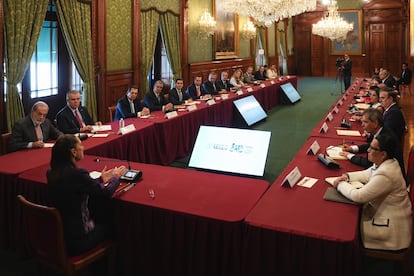

Mexican President Claudia Sheinbaum met on Wednesday with a dozen business leaders at the National Palace to discuss the creation of a private sector council to promote investment. The group was headed by the magnate Carlos Slim, president of the conglomerate Grupo Carso (which includes telecom giant Telmex), and Bernardo Gómez, president of Grupo Televisa. Faced with the stagnation of the Mexican economy — which contracted 0.3% in the third quarter of the year — the president outlined a national agreement with business leaders from across the country to explore and accelerate investments that can pull Mexico out of its economic slump.
Altagracia Gómez, head of the Business Advisory Council and president of Grupo Minsa, announced that the meeting with the 15 business leaders served to launch this new council. “It’s to monitor investments, how we can accelerate them, what can be improved in joint ventures, infrastructure, energy, and certain services. The idea is that this new forum will foster greater collaboration, allowing us to connect with more business leaders and gain broader perspectives. The goal is to continue expanding communication with business people from different regions of the country,” she stated after the meeting concluded.
A large part of the Cabinet sat down at the table with the presidents of banking groups, energy companies, steel companies, and major service firms. Sheinbaum posted a photo of the meeting on social media, which also included the president of the Business Coordinating Council (CCE), Francisco Cervantes, as well as the president of Grupo Televisa, Bernardo Gómez; the president of Grupo Bal, Alejandro Baillères Gual; the president of Grupo FEMSA, José Antonio Fernández Garza; and the son and right-hand man of the president of Banamex, Felipe Chico Hernández.
“At the National Palace, we welcomed businesswomen and businessmen; we agreed to meet periodically through a council for the promotion of investments oriented toward Plan Mexico,” wrote the president in the message accompanying the photograph.
The Mexican economy in 2025 has narrowly avoided recession, and the main estimates suggest that GDP will not quite reach 1% growth by the end of the year. The decline in the third quarter is attributed to a slowdown in the industrial sector, mainly in manufacturing, construction, mining, and energy. These are the areas that Sheinbaum intends to address through this new council.
On Wednesday, the National Institute of Statistics and Geography (INEGI) revealed that gross fixed investment in the country fell by 6.7% at an annual rate, reflecting a decline in spending on infrastructure, technology, and machinery to kick-start industry and services. Finance Secretary Edgar Amador argued that the country’s economic weakness is “focused on the industrial sector” and that Mexico has solid macroeconomic fundamentals to withstand, for example, external shocks.
Sensitivity to the future of Mexico’s economy is tied to the future of the free trade agreement with the United States and Canada (USMCA). Expectations for the agreement’s review, scheduled for July 2026, have created uncertainty regarding investments in the region. Foreign Direct Investment (FDI) peaked in the third quarter of 2025 at $41 billion, which has been interpreted as a sign of support for the treaty’s continuation.
However, threats by U.S. President Donald Trump to withdraw from the USMCA altogether have caused some sectors to question whether to go ahead with their plans. On Wednesday, hearings began in Washington at the Office of the U.S. Trade Representative (USTR) to hear the views of various sectors on the future of the agreement. The first of three meetings showed support for the three countries remaining in the trade bloc.
Sheinbaum has focused on strengthening relations with business leaders through Plan Mexico and by guaranteeing that their investments will be secure. Relations between the private sector and the Mexican government were distant during the administration of Andrés Manuel López Obrador (2018-2024), so in her first year in office, the Mexican president has dedicated herself to reestablishing ties between the private and public sectors.
One of the proposals that Sheinbaum is outlining for the coming weeks is the creation of an Infrastructure Investment for Welfare Law, which would form the basis for collaboration between the state and private initiative. Business leaders are finalizing the details with lawmakers from the governing Morena party, who plan to have it approved by Congress before December 15.
The future of the new relationship between business leaders and the government also depends on the expectations that the private sector has placed on the renewed bond. Private initiative has pointed to the legal security of its investments — which faltered with the renewal of the judiciary by popular vote — as one of the most sensitive issues for investment growth.
In addition, they have highlighted the efficiency of procedures with the public administration and realistic financial models as other points to consider. Carlos Martínez, director of Government Banking at Grupo Financiero Banorte, indicates in a report released by the entity that the design of investment strategies at this time will yield results over the next two or three years. “It greatly helps bankability and attracts foreign investors, companies, and even national funding.”
Sign up for our weekly newsletter to get more English-language news coverage from EL PAÍS USA Edition









































