
Differences over the USMCA deepen between the United States and Mexico
With less than six months to go before the review of the trade agreement, Trump has called it ‘irrelevant,’ while Sheinbaum has defended North American integration
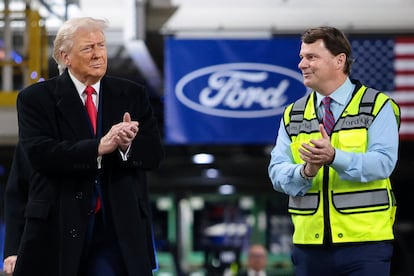

At the Ford plant in Detroit, surrounded by assembly lines and American workers, U.S. President Donald Trump once again cast doubt on the future of the USMCA. The Republican called the trade agreement with Mexico and Canada “irrelevant”: “The problem is, we don’t need their product. You know, we don’t need cars made in Canada. We don’t need cars made in Mexico. We want to take them here. And that’s what’s happening,” the president declared on Tuesday.
Following Trump’s controversial statements, Mexican President Claudia Sheinbaum defended the existence and continuation of the North American trade agreement: “Those who most strongly defend the treaty are American businesspeople, because there is a very high level of integration,” she declared at the National Palace the day after Trump dismissed the agreement, which was renegotiated during his first term.
The U.S. jab at the USMCA came just one day after a brief phone call between the two leaders. The exchange focused solely on security issues. Sheinbaum herself acknowledged her frustration at not having had enough time to address trade matters, which were left unresolved and are expected to be discussed in a future — and uncertain — call.
Trump’s comments in Detroit make clear that he still views the cancellation of the USMCA as a viable scenario, an idea he raised during the campaign. By contrast, Mexico is racing against the clock to extend the life of the trade agreement, which underpins annual bilateral trade worth $800 billion. From Mexico’s perspective, the deal brings more benefits than drawbacks for all three signatories. “It is far better for us to remain as North America to compete with China than for the United States to stand alone. The trade agreement is very important for the U.S.,” Sheinbaum said on Wednesday at the National Palace.
Support for the USMCA is one of the few points of agreement between the Mexican government and the opposition. “For Mexico, [the treaty] is not only not irrelevant — for the Mexican economy it is a matter of life or death,” said Senator Ricardo Anaya, leader of the National Action Party (PAN) in the upper chamber. The lawmaker recalled that 85% of Mexican exports are destined for U.S. regions and that some 12 million jobs in the country depend on the agreement. This week, the U.S. Embassy in Mexico also announced it will allocate $23.4 million to continue supporting the consolidation of Mexico’s Labor Justice System, as part of the commitments assumed under the treaty.
Despite Trump’s threats against the USMCA and his administration’s imposition of sector-specific tariffs on Mexico, the Latin American country remains the United States’ top trading partner, ahead of China and Canada. This is due to shipments totaling nearly $448 billion during the first 10 months of 2025. Exports that comply with the USMCA are exempt from the 25% tariffs imposed by Trump. According to Mexican authorities, more than 80% of shipments to the U.S. meet this requirement. On the import side, Mexico has become one of the main destinations for U.S. exports, purchasing more than $283 billion worth of goods.
Although the formal review of the USMCA has not yet begun, trade experts expect it to become a powerful bargaining chip for the United States in negotiations with both Mexico and Canada on other fronts. Álvaro Vértiz, head of Latin America at DGA Group, says the agreement will cease to be viewed solely as a framework for economic integration and will increasingly become a tool of U.S. policy, encompassing Washington’s priorities on migration and security as well. From his perspective, although the agreement will survive the 2026 review, it will do so with adjustments and after intense negotiations. The most contentious issues for Mexico will include rules of origin, non-tariff barriers, dispute resolution mechanisms, and labor matters.
Vértiz adds that these trade tensions, the reconfiguration of supply chains, and the approaching USMCA review will force the Mexican government to rethink its strategy toward Washington and its internal dynamics. “Mexico’s role as an ally of U.S. companies operating in the country becomes just as important as developing agendas that highlight the relevance of the USMCA at both the national and state levels in the United States. This involves underscoring Mexico’s role as a reliable partner that offers regulatory stability, a skilled workforce, and geographic proximity,” he said.
As tensions mount, and in an effort to preserve regional integration, the Sheinbaum administration imposed tariffs of up to 50% this year on imports from China and from countries with which Mexico has no existing trade agreements. The measure seeks to curb the advance of Asian products in key domestic sectors such as steel, textiles, footwear, toys, and the automotive industry, while also signaling alignment with Washington’s trade policy toward the Asian giant.
Saving the USMCA is one of the Sheinbaum government’s top economic priorities. Mexico has made the agreement a cornerstone of its industrial development strategy. The deal — formerly NAFTA — has delivered substantial gains for the Mexican economy, including record export figures and unprecedented inflows of foreign direct investment, to name just a few. However, the balance sheet also presents future challenges, particularly in labor issues and the development of higher value-added manufacturing. Mexico has less than six months to craft a solid strategy in the face of a U.S. administration that is increasingly skeptical about keeping North America’s trade ties intact through the USMCA.
Sign up for our weekly newsletter to get more English-language news coverage from EL PAÍS USA Edition









































