
Venezuela announces release of ‘significant number’ of prisoners as ‘unilateral peace gesture’
The head of the National Assembly, Jorge Rodríguez, says that the number of releases will be known in the coming hours. It is unclear whether these imply full freedom or whether restrictions will be applied
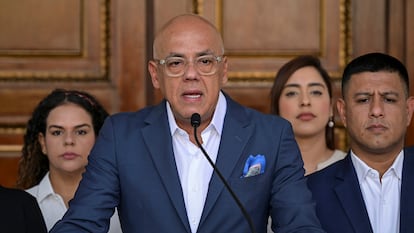
The head of Venezuela’s National Assembly, Jorge Rodríguez, announced on Thursday the release of a “significant number” of prisoners, including both Venezuelan citizens and foreigners. Rodríguez, who avoided referring to these individuals as political prisoners, described the move as “a unilateral gesture to reinforce our unwavering decision to consolidate peace in the republic and peaceful coexistence among all, regardless of political, religious, economic, or social differences.”
The Chavista government has presented the releases as a decision unrelated to the extraordinary pressure it has been receiving from the United States since the capture, in the early hours of January 3, of President Nicolás Maduro, who is now imprisoned in a New York jail. “Consider this gesture as the contribution that we all must make to ensure that our republic continues its peaceful life and its pursuit of prosperity,” Rodríguez declared at a press conference.
The head of the National Assembly, who is the brother of acting president Delcy Rodríguez, thanked the former prime minister of Spain, José Luis Rodríguez Zapatero; the president of Brazil, Lula Da Silva, and the government of Qatar for their mediation in the Venezuelan crisis.
In Venezuela, there are currently some 820 political prisoners, the highest number in the entire hemisphere, according to the NGO Foro Penal, which specializes in the issue. Of these, 89 are foreigners (including Venezuelans with dual nationality). Other organizations, such as Justice, Encounter, and Forgiveness, claim that the number of detainees exceeds 1,000, many of whom were arrested following protests that challenged Maduro’s claims of victory in the 2024 presidential elections. Last December, the government authorized the release of 180 prisoners.
It remains unclear whether these releases imply the full freedom of political prisoners, or whether restrictions will be applied, such as periodic court appearances or a travel ban, as has been the case in almost all previous releases. In any event, civil society organizations dedicated to human rights are demanding a general amnesty for what they consider “arbitrary and unjustified” arrests.
Although former president Hugo Chávez had political prisoners, such as Commissioner Iván Simonovis—exiled after escaping house arrest—or Judge Lourdes Afiuni, Venezuelan prisons have been filling up with political prisoners in the last decade, the one with the greatest political friction during the Maduro government.
Sign up for our weekly newsletter to get more English-language news coverage from EL PAÍS USA Edition









































