
Cuba is the country with the most convictions for arbitrary detention in the world, according to the UN
The United Nations declared the imprisonment of dozens of political prisoners ‘illegal’ at its last session
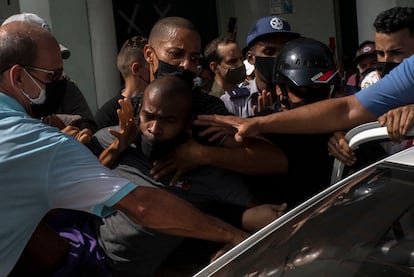

The United Nations Working Group on Arbitrary Detention (WGAD) concluded that 49 participants in the unprecedented protests that took place in Cuba on July 11, 2021 — which automatically made them political prisoners — suffered arbitrary detention, enforced disappearance, unfair trials and convictions, torture, isolation, and discrimination on political and religious grounds.
Four years after the demonstration, which resulted in the imprisonment of more than 1,500 people, Cubans and international organizations continue to demand justice. “It has been a long road, but any just conviction is positive, however small a part it may represent of the reality that Cubans experience,” Javier Larrondo, director of Prisoners Defenders, the NGO that documented and presented the cases to the Working Group, told EL PAÍS.
The findings of the United Nations body, presented during its 103rd session, show that some of those detained were not informed of the reasons for their arrest, were not shown arrest warrants, and were not made aware of their legal rights. They also show that detainees were not brought before a judge to challenge their detention within 48 hours of their initial arrest, and that some, after their arrest, were held incommunicado for several days and weeks, without being allowed to contact their families. Furthermore, several detainees did not have access to legal counsel or were not brought before a judge “to ensure the legality of the proceedings.”
“Given the context in which these arrests occurred, the cases described in the communication demonstrate a systematic violation of multiple rights established in the Universal Declaration of Human Rights, especially Article 18, which guarantees freedom of thought, conscience, and religion,” the Working Group ruled. It also insisted that the criminal charges against the protesters “are intended to coerce them for their opinions and political participation, as well as to discourage further protests in this area.”
Prisoners Defenders, along with a team of more than 10 lawyers, undertook the task of collecting and analyzing thousands of documents related to the cases of 520 detainees, out of a total of more than 1,180 political prisoners in Cuba. “However, the Working Group’s limited resources and regulations made it difficult to address all the cases, and they asked us to proceed in phases. Therefore, of those 520 cases, 17 were addressed in 2024, and 49 in 2025,” explains Larrondo. “For a dictatorial regime, it is very easy to detain, disappear, imprison, and torture thousands of people. Proving the innocence of each one of them is a Herculean task. The U.N. Working Group has demonstrated its high level of professionalism in its mission, despite having barely enough resources to address even a tiny fraction of the thousands of cases that occur each year in Cuba.”
The WGAD’s conclusions place Cuba as the world’s leading country in the number of convictions for arbitrary detention since 2019, making this a “historic condemnation” by the U.N., according to Larrondo. “These indicators are important for ensuring that the debate regarding Cuba in Europe and the democratic world is the right one. We must leave behind the fantasies; Cuba is not a left-wing regime, it is a totalitarian, criminal, and fascist dictatorship,” he maintains.
The U.N. body not only declared the Cuban government’s actions “illegal,” as widely denounced by activists, independent media, and the families and detainees themselves; it also urged the Havana government to release and compensate the 49 political prisoners who cases were reviewed, and to grant them “other forms of reparation, in accordance with international law.” It further urged the Cuban government to conduct a “thorough and independent” investigation into the cases presented and to “take appropriate measures against those responsible for the violation of their rights.”
On March 7, 2015, the Working Group communicated its allegations to the Cuban government and requested a response by May 6, asking for detailed information on the situation of some of the detainees. However, to date, Havana has not sent “any response within the allotted time, nor has it requested an extension.” “The Working Group regrets that the government has not responded to its request within the stipulated timeframe,” the organization stated. Larrondo, for his part, insists that Prisoners Defenders will continue to report abuses, regardless of whether “politicians take action or not to stop the massacre of freedoms taking place in Cuba.”
Sign up for our weekly newsletter to get more English-language news coverage from EL PAÍS USA Edition









































