
Albert Ramdin, secretary general of the OAS: ‘Latin America is more polarized than it has been in the last 30 years’
The veteran diplomat is calling for ‘a new legislative framework’ that provides ‘more freedom’ to combat drug cartels
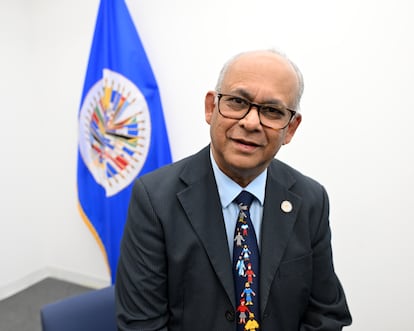

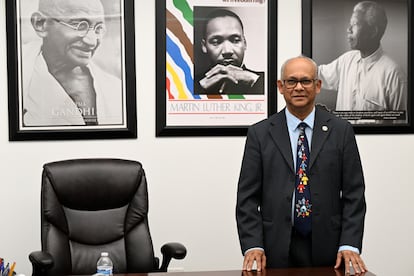
Behind his desk in his office, the secretary general of the Organization of American States (OAS), Albert Ramdin, 67, has three portraits hanging like guardians: Mahatma Gandhi, champion of nonviolence; Martin Luther King Jr., fighter for civil rights; and Nelson Mandela, advocate of dialogue with one’s enemies. Their example inspires this former Surinamese foreign minister, who has spent most of his career in this multilateral organization. Last May, he succeeded Luis Almagro as the head of the OAS. Ramdin has taken charge of the Pan-American institution at an especially challenging time for the world, for the Americas, and for the OAS itself.
The United States is deploying its largest concentration of warships in the Caribbean and attacking alleged drug-running boats amid speculation that it might strike targets inside Venezuela. The OAS is trying to advance a roadmap for Haiti. It has just sent a special mission to Guatemala ahead of a Supreme Court election process. Elections are approaching in several countries that could prove vital for their democracies. Yet deep divisions among governments in the region led the Dominican Republic to postpone the triennial Summit of the Americas, originally scheduled for December, citing the impossibility of holding a “productive dialogue.” It is now scheduled to take place next year.
“Latin America is more polarized than it has been in the last 30 years,” says the veteran diplomat, who weighs each word as if it were a precious jewel. But he also says he is optimistic: “We are all in the same boat. The only way forward is by working together, reaching agreements, and if not, at least having the courtesy to listen to one another.”
Question. Let’s talk about one of the major hot topics in the hemisphere: the deployment of U.S. warships in the Caribbean. These forces have launched at least 16 attacks against suspected drug boats, killing nearly 70 people, and many experts consider this missile-firing campaign illegal.
Answer. U.S. naval assets remain in international waters, so no one can have a problem with that. It’s not any country’s territory. And I don’t think any country can object to the formal reason the United States has given, and which is the one we have to work with: that it’s fighting international organized crime. I haven’t heard any country say that’s not a good thing, because drug trafficking is one of the great scourges we suffer in this hemisphere.
Q. But even if we accept that narrative, and agree that it is necessary to combat drug trafficking, the end doesn’t justify the means, right?
A. No. And this is something we’re going to have to discuss at some point. To be completely honest: how do we combat international criminal organizations? They do whatever they want; they don’t obey the law or abide by any kind of social convention. They can kill without scruples. At the same time, we expect our governments to combat this kind of crime— which is inhumane, against human rights, and against due process — and to do so while respecting the law to the letter. Of course, I stand for human rights and due process, but we’re fighting an unequal battle if we do it this way. And that’s a discussion we’ve just begun with some member states: we need a legislative framework that gives governments the opportunity to combat these organizations effectively.
Q. What should that framework look like?
A. I don’t know exactly. It must include more freedom to fight, but at the same time it must defend human rights. Although, in my opinion, we would be naive to think that we can fight these criminal organizations, which have absolutely no scruples, in the same way that we deal with everyday crime on our streets. It’s impossible.
Q. The Venezuelan government, and many other groups and individuals, believe that the real objective of the United States is not the fight against drug trafficking, but to achieve regime change.
A. Yes. That’s why I say I have to base my opinion on official statements. I know there are very strong feelings that this might be a different objective. I’ll leave that to the analysts, who are free to say what they think. I’m not. I have to keep in mind that I represent the member states of the OAS.
Q. So then...
A. Let’s put it this way: Venezuela has a problem beyond organized crime. The political climate in Venezuela is one in which there are issues that need clarification. One of them is the outcome of the July 2023 elections. Several regional governments have asked Caracas for proof of its claim that it won. It hasn’t provided any. In contrast, the opposition has presented documentation proving their victory. And that presents a problem: is this government legitimate or not? It’s not for me to judge. But if there is a problem, it’s my duty to ensure that we find ways to resolve it, and that we do so peacefully, diplomatically, and through negotiation. There is a problem in Venezuela regarding governance and legitimacy. No one can doubt that. So let’s talk about it. Let’s try to find a solution. That isn’t fully happening yet. There are different ways to apply diplomacy, and we only learn about some of them later, through historical records.
Q. Differences over Venezuela, and other issues, have postponed the Summit of the Americas. The president of the Dominican Republic, Luis Abinader, has said that it would be difficult to achieve a productive dialogue, given the level of disagreement. Is this the same perception you have within the OAS?
A. I think it’s prudent for the Dominican Republic to say that perhaps now isn’t the time to hold that summit. We have a very complex environment. We have leaders who don’t share the same vision. Agendas that do not fully align. The positions of the countries have changed. We’re witnessing a transformation of the political landscape.
The Summit of the Americas should be a historic moment for the countries and the hemisphere, a moment in which, on a basis of unity, new directions are agreed upon. If the outcome was going to be nonexistent or poor, it would have been unwise to hold it. If we can’t even agree to disagree, we would emerge with more polarization than is good for the hemisphere.
Furthermore, there are going to be elections in several countries: Honduras, Peru, Costa Rica. Perhaps it would be wise to wait for new leaders who will govern for four or five years and can implement the approved measures. It makes no sense to meet with leaders who will only remain in office for a couple more months.
Q. You have held various positions at the OAS for many years. Have you ever experienced such polarization before?
A. In almost 30 years of diplomatic experience, this is the most polarized environment I have ever encountered. And the least willing to cooperate. Things escalate very quickly. They become very personal, if you look at the exchanges between some presidents. We used to have a certain degree of diplomacy, of agreeing to disagree. That narrative no longer exists. I think leaders need to rethink how they present themselves in the political arena, and also how they behave in it. I’m not trying to say what leaders should or shouldn’t do, but I do hope that we try to make this hemisphere a better place.
Q. How can that be achieved if the leaders themselves are unwilling to engage in dialogue?
A. What’s missing is an agenda, a conducive environment, a unifying and forward-looking agenda. That’s what’s lacking, and it could be because we haven’t worked on it within the multilateral system; we haven’t demonstrated our value. And the OAS is a valuable organization that supports the strategic interests of member countries, whether in matters of migration, security, democracy, or human rights. It’s a valuable and cost-effective role. We have to put into practice this new direction, which is based on three things: first, unity, accepting our differences. We must be a little more tolerant. And also peace: strengthening democracy, electoral systems, governance, and everything else. And prosperity: job creation, economic wealth, social value.
US misgivings about multilateralism
Q. That sounds very good, but as you yourself acknowledge, there are member states skeptical about the OAS’s mission itself. Starting with the largest, the United States, which contributes almost half of the budget and whose administration is wary of multilateralism.
A. We all have to get used to different kinds of politics. And President [Donald] Trump is very outspoken and direct. Some consider him unpredictable. But even before I was elected secretary general, I had already forged good relations with this administration, and I think we have made significant progress. We have been very frank and honest with them, telling them that their skepticism about multilateralism is unfounded. I asked them for some time, a couple of months, to demonstrate that their strategic interests are served by our work. We manage issues such as migration, security, human rights, electoral processes, and strengthening democracy. All of these issues are of strategic interest to the United States, and we are working hard on them. If we weren’t there, there would be great chaos in the Western Hemisphere. But there are some aspects that we need to reconsider.
Q. For example?
A. We want to address migration and security. I recognize and respect national legislation regarding the deportation of undocumented or irregular migrants, and their desire to be repatriated. It is a decision we must respect. If national legislation permits it, any country can carry out deportations. Provided, of course, that the receiving country is consulted and the human rights of the individuals are respected. Beyond that, it is not my place to judge.
Q. Do you believe that the United States respects human rights in its deportation processes?
A. There have been some complaints, but I think the message is clear. I think they’re trying. It’s not easy for a country to deal with that. Governing isn’t easy, that’s something I’ve learned. But the problem of migration and transnational organized crime can’t be solved simply by deporting people. It can only be solved if we address the root causes of migration.
Q. On paper, that’s an excellent idea. But again, how do you do it when the main contributor of the OAS is skeptical about multilateralism, and about the OAS itself?
A. Little by little, the situation is changing. The United States has already begun disbursing its contributions to the OAS, which it had withheld during a review process. So the money is coming in, and promises have been made that the rest will arrive soon. They are funding projects and have appointed a permanent representative, which demonstrates a commitment. We are addressing critical issues with them, the issue of Venezuela… The United States has a critical opinion, and I welcome those opinions if they are constructive. I don’t need flattery, just fair and honest criticism.
Q. Have you received any kind of pressure from the administration in Washington to refocus the priorities of the OAS?
A. The Trump administration expects the OAS to be much more efficient, transparent, and accountable, and to demonstrate its usefulness. I couldn’t agree more: it’s something we were going to do anyway. So I’m glad we have a contributor within the OAS who thinks this way. But the rest of the member states must understand that the organization needs everyone’s contributions. It’s not good to depend on a single contributor for everything important. That’s why I would like to see the United States’ contribution reduced from the current 48% to perhaps 30% by the end of my term. But for that, we need the commitment of all the member states. At some point during my term, we will have to seriously consider a new quota system. Not next year, maybe not the year after, but soon. It’s not fair to depend on a single member state and expect that state not to say, “Things have to be done my way.”
Sign up for our weekly newsletter to get more English-language news coverage from EL PAÍS USA Edition









































