
Robin Wall Kimmerer, scientist and writer: ‘Capitalism is not a natural phenomenon; it’s a choice’
The author captivated millions of readers with her book, ‘Braiding Sweetgrass.’ In ‘The Serviceberry,’ her latest work of nonfiction, she proposes changing the dominant narrative as part of the resistance against climate disasters and social collapse
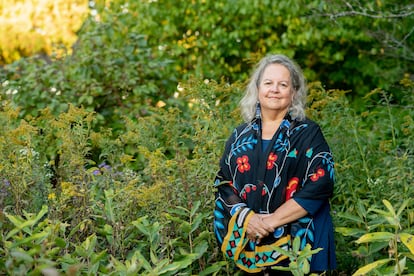
“We are practicing kindness. You can, too.” This phrase — which is ready to be used in an everyday context, be it a traffic jam or a slow-moving line at the supermarket — almost sounds subversive in times of algorithm-driven rage and constant aggression.
On her website, Robin Wall Kimmerer, 72, describes herself first as a mother, then as a scientist and decorated professor. Lastly, she notes that she’s a member of the Citizen Potawatomi Nation.
Kimmerer proposes kindness as an act of resistance. “We need to equip ourselves with a new language,” she explains, “something that affirms that this is what it means to be human.” In a world where kindness breeds distrust or is scorned, kindness, she affirms, is becoming a militant gesture.
“When you’re kind to someone, it’s not universally expected that they’ll respond with kindness, but if that seed is planted, both people feel better,” reflects the bestselling author of Braiding Sweetgrass: Indigenous Wisdom, Scientific Knowledge and the Teachings of Plants (2013), speaking via video call from her home on an old farm in upstate New York.
What if our economy were more like a forest than a stock market? What if, instead of accumulating things, we learned to give, like plants do? She explores these questions in her latest nonfiction book, The Serviceberry: Abundance and Reciprocity in the Natural World (2024). With optimism and a sense of wonder, she invites us to look at the world around us in a new light.
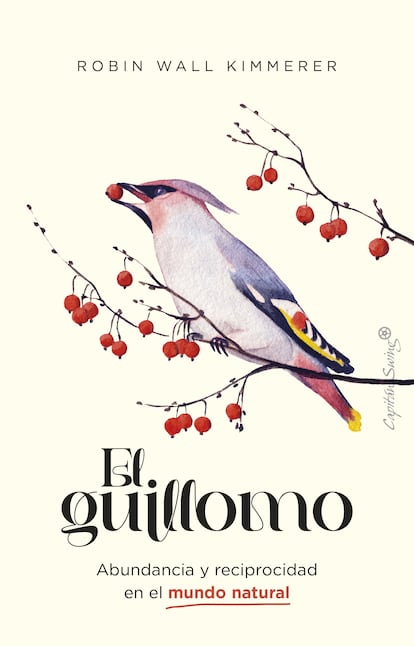
This new work revisits a theme she touched upon in Braiding Sweetgrass. She begins with the relationship between a berry bush — the serviceberry, which grows abundantly in northern lands — and its surrounding environment. She then theorizes about the gift economy, which is based on generating community bonds through reciprocity, just as plants, birds and insects do in nature.
“Where do these berries come from? They come from the sun, the rain, the air. These common goods are transmuted through photosynthesis into fruit,” the author explains. “And the plants don’t keep the berries. They give them to the birds, who, in turn, disperse the pollen that will give rise to new bushes.”
Kimmerer holds a PhD in Botany and is director of the Center for Native Peoples and the Environment. One of her motivations for writing this book, she confesses, was “to delve deeper into the ways in which changing individual practices can be a form of resistance.” She wondered: How can we live differently, when the dominant system seems to constantly push us toward competition, scarcity and isolation?
Events — such as a global pandemic and the election that made Donald Trump president of the U.S. for a second time — also played a role in her writing. “During the pandemic, we needed kindness, generosity… [we needed] to get to know our neighbors, to help each other. We relearned how to do those things. And we did them well.” But when it ended, “everyone was so eager to return to normal that we left behind what we had learned.”
Small economies, multiplying
The gift economy proposes establishing a different kind of relationship with the environment, one that allows us to resist — on a local scale — the ongoing climate disaster and crisis of democracy. “It’s been very rewarding,” Kimmerer confesses, when asked about the responses to the book since its publication in the U.S. “People write to me saying, ‘We already had a small network and I now have the language to express what we’re building.’ Every day, I receive stories about how to multiply this.” She also says that companies write to her, saying that, despite their focus on capitalism, they’re launching small gift economy projects.
For example, she recounts how a nursery began giving away serviceberry trees. “When people came to pick up their tree, they had filled the back of their truck with other plants from their garden to give to their community. That shows me that we have a hunger for kindness and generosity. Everyone leaves smiling. That’s when something becomes contagious: when those who participate feel good.”
Kimmerer isn’t naive, and she’s far from presenting the gift economy as an alternative that should compete with capitalism. “The question is always: ‘How do we scale up this good idea?’ And I want to resist that question,” she says. These economies work because they’re suited to their scale: the neighborhood, the community. “They can’t be big, but it can multiply. And that’s where their power lies,” she argues.
The emphasis on joy isn’t decorative — it’s strategic. “What motivates people to change? It’s not information,” she affirms clearly. “Fear gives you some power, but happiness, enjoyment and fun are contagious.” That’s why The Serviceberry avoids the apocalyptic tone so common in environmental discourse. Kimmerer doesn’t shirk political responsibility or the demand for accountability, but she insists that living with scarcity, materialism and individualism is also a choice. “You can choose joy, or you can choose scarcity. Both are choices,” she reflects. “Capitalism isn’t a natural phenomenon: it’s a choice. We have the power to choose our values and those who represent them.”
One of those choices, she indicates, involves gratitude and abundance. “Enumerating the gifts you’ve received creates a sense of abundance, the knowing that you already have what you need,” she writes in the book.
Isn’t that a bit utopian in a world where our phones, through social media, constantly remind us of what we lack? For Kimmerer, it all comes down to where we choose to focus our attention: “It’s important to recognize that our phones steal what’s most precious from us: our attention. If we pay attention to kindness and the living world around us, we find abundance. If we pay attention to our phones, we drown in a scarcity mindset.”
Networks of creative resistance
That same logic underlies projects like Plant, Baby, Plant. This initiative doesn’t seek to invent anything new, but rather attempts to amplify what already exists. The author has been promoting it for the past few months. “It emerged while we were reflecting on how to create a creative resistance movement,” she explains. “We wanted to turn the story on its head: let’s unite, build community to heal the Earth.”
Faced with the dismantling of environmental protection policies, Kimmerer proposes resistance at the local level: planting trees, transforming gardens, replacing lawns with meadows — and doing it together: “If you have one [garden], it doesn’t make much difference. But when you have a whole neighborhood full of these little gardens, then we see that biodiversity really responds.”
It’s no coincidence that, in her biography, the author first presents herself as a “mother.” For her, this is neither a minor detail, nor a bland metaphor. “It’s a form of resistance to the culture of credentials,” she explains. Motherhood — understood as the care of life, both one’s own and that of others — tangibly reveals the logic of the gift economy and awakens an inescapable intergenerational responsibility. “We want our children to live in a green and good world,” she says. Invoking motherhood is, in this sense, affirming that we aren’t merely isolated individuals, but part of a living continuity.
As a scientist, Kimmerer has dedicated her career to environmental restoration. But the author confesses that she came to the conclusion that, in addition to restoration, a counter-narrative was necessary: “We need a different story to live by and fight for change. We have enough money, policies and science to change, but we don’t. We lack a committed sense of purpose beyond our individuality.” Her proposal involves redefining that individuality. “I am not just me. I am my children. I am my trees. I am my air. I am my water. Economists say that we will always act in our own self-interest. That’s probably true, so what we need is to expand what ‘I’ is. That ‘I’ is our community.”
The pandemic, she says, showed us the way: “At the time, we proved it; we understood that we’re a community, even though we quickly forgot. But there’s a glimmer of hope in that: we know how to do it.”
Sign up for our weekly newsletter to get more English-language news coverage from EL PAÍS USA Edition









































