
Sheinbaum leans on a ‘Federal Police 2.0′ to strengthen Mexico’s security strategy
García Harfuch relies on leaders trained and seasoned in the now-defunct force to shape part of the president’s shift, sidelining the Armed Forces with seemingly good results
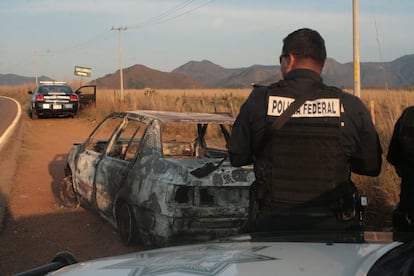

Mexico is painted cobalt blue, the color of the police — a notion that would have been unthinkable just a few years ago, when the country was witnessing the consolidation of a military-style security structure.
The administration of former president Andrés Manuel López Obrador (2018–2024) was marked by the rise of the army, which carried out an extraordinary territorial deployment, supported by the growth of a new force, the National Guard. Originally conceived as a police body at the start of his term, the National Guard grew increasingly militarized, generating considerable controversy among experts and civil society organizations.
Claudia Sheinbaum’s rise to power has brought a shift that would have been difficult to predict before she assumed office.
The defunct Federal Police are regaining influence even as Sheinbaum promises to continue López Obrador’s legacy — a balancing act unfolding before the hopeful eyes of a country mired in nearly two decades of brutal violence. Leaders trained and promoted in the old Federal Police now occupy top positions in Mexico’s Secretariat of Security and Citizen Protection (SSPC), which is led by Omar García Harfuch. These include: Francisco Almazán, director of the National Intelligence Center (CNI); Héctor Elizalde, Undersecretary of Investigation; and Omar Reyes, who has headed the Financial Intelligence Unit of the Secretariat of Finance since summer.
With the debate over the nature of the National Guard largely settled, Sheinbaum celebrates the now-militarized agency and the Armed Forces in general — a nod to her predecessor — while simultaneously nurturing the police apparatus. Next year’s budget illustrates this: with the National Guard now under the umbrella of the Defense Secretariat, Harfuch’s SSPC will have more than 60 billion pesos in 2026 (around $3.2 billion), an increase of over 20 billion pesos ($1.08 billion) from the previous year.
Leaving aside state and especially local police — long the target of general distrust, including from the federal government — the SSPC and its sister agencies now shine at the top of the Security Cabinet, much like the Federal Police once did before its dissolution under López Obrador. The former president viewed the force as a symbol of past ills, embodied in Genaro García Luna, security czar under president Felipe Calderón (2006–2012), who rose through the National Intelligence Center (CISEN) and the operational branch of the old Attorney General’s Office. García Luna is now serving a sentence in the United States for drug trafficking, while García Harfuch is seeking to honor Sheinbaum’s trust.
Quietly, Harfuch has restored much of the authority and operational capacity that the old Federal Police once held, not only within the SSPC but also in the reorganized National Intelligence Center (CNI), which is led by his close ally Francisco Almazán.
“They’ve built a Criminal Investigation Agency within the CNI,” says a source familiar with the evolution of Mexico’s security forces under this administration.
This agency mirrors the investigative branch of the Attorney General’s Office, which Harfuch himself once led during Enrique Peña Nieto’s government (2012–2018) after a career in the Federal Police. Essentially, he has transferred the investigative expertise and capabilities he managed in the Attorney General’s Office into the country’s main intelligence agency, according to this source.
The results of this apparent police revitalization are encouraging— at least for now. The decline in the homicide rate that began in López Obrador’s later years has accelerated during Sheinbaum’s first year in office. Other high-impact crimes have also fallen, except for extortion, which has risen by more than 20%. Experts consulted note that the increase in reported extortion cases does not necessarily reflect a rise in the phenomenon itself, but the fact that victims who previously did not report crimes are now coming forward. It may also be a combination: more people reporting, but there are also still more cases.
Security policy experts and analysts consulted by EL PAÍS are cautious. Eduardo Guerrero, director of the consulting firm Lantia, acknowledges Harfuch’s leadership, calling him “a professional in the field, unlike López Obrador’s secretaries, who were experienced political operators.” He adds that “Harfuch is also part of the president’s inner circle, which had not happened before: he is the leader, strategist, and evaluator of security policy.” Yet Guerrero cautions that “while the drop in violence is encouraging, we cannot yet speak of a long-term downward trend.”
Ernesto López Portillo, coordinator of the citizen security program at the Universidad Iberoamericana, also praises Harfuch’s leadership, but he does not believe that this authority necessarily signals a police revival in the country — a view shared by Guerrero. López Portillo points out that, while Harfuch is the public face of the security cabinet’s actions, “we don’t know who is actually behind the tens of thousands of arrests recorded in this first year.” Is it the Army? The National Guard, whose deployments still number tens of thousands across the country? Guerrero adds another crucial point, which López Portillo also agrees with: “We would have to see how many of these arrests end in convictions.”
This remains a long-standing challenge for Mexico. López Portillo notes that “from 2011 to 2024, rates of victims and crime, unreported crimes, and the percentage of cases properly handled by the public prosecutor have not improved.” He cites a statistic from the National Institute of Statistics: of the more than 33 million crimes committed last year in Mexico, over 90% were never reported. Overall, the institute estimates that only 0.8% of crimes “received a favorable resolution from the Attorney General’s Office.” These numbers illustrate the scale of impunity in Mexico, one of its main problems, which is blamed on the inefficiency of the public prosecutor system. Just over a decade ago, a reform aimed to strengthen the prosecutor’s offices by giving them greater independence from political influence. So far, however, the results remain the same.
Both experts express cautious anticipation regarding the future. Guerrero, for instance, calls for a more horizontal and comprehensive approach to the ongoing, quiet police reform: “So far, there is no additional funding for state and local police, they are not given a role in the security strategy, and they continue to be distrusted.” He acknowledges that the federal government has collaborated with some states in certain cases, but only to a limited extent.
López Portillo, skeptical, asks: “How extensive is Harfuch’s operational control over local authorities, given the president’s leadership?” The answer, he notes, is that no one knows.
That is the prevailing sense: much remains unknown. First, because only a year has passed since Sheinbaum took office, and the government has acted in emergency mode, tackling serious problems, such as the violence crisis in Sinaloa caused by internal conflicts within criminal networks, and ongoing governance challenges in Michoacán, Guerrero, Chiapas, and Baja California, with Guerrero and Michoacán being the most affected. Second, because there is very little data on the deployments beyond press releases. As of now, the number of personnel the SSPC has deployed nationwide and their impact on results remain unclear. Everything relies on Harfuch, his competence, and that of the police officers on his team, tasked again with leading the country’s security strategy.
Sign up for our weekly newsletter to get more English-language news coverage from EL PAÍS USA Edition









































