
Cartel recruitment in Jalisco: ‘There were two options: Undergo three months of training or be shot in the head’
The testimonies of 38 people forcibly recruited in January by the Jalisco New Generation Cartel depict the deceptions and threats employed by the criminal organization

A 20-year-old man is browsing Facebook. Among the posts scrolling across his screen, he sees one that catches his eye: a job offer, for a security guard at a company. He currently works washing cars, so it seems like a good opportunity. He resonds to the ad, and they reply. Everything is straightforward. They pay for a bus ticket from his village to the city terminal. From there, they order him a cab. Everything is going well, until, suddenly, the driver threatens him and takes his belongings. A while later, he arrives at a warehouse in the countryside, in the middle of nowhere. He sees armed people, and others like him. And then, it is explained to him that he has been brought there to become a “hitman” and that if he tries to escape, he will be “cut to pieces.”
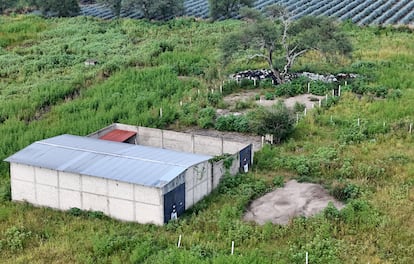
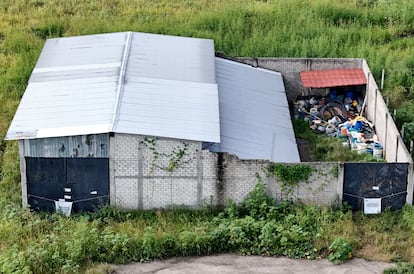
That summarizes the story of C. H. C. M., a young man from Jalisco, in central Mexico, and a victim of forced recruitment by the Jalisco New Generation Cartel (CJNG), one of the country’s largest criminal organizations. The events occurred in late January, between the metropolitan area of Guadalajara — the state capital of Jalisco — and the terror warehouse, located on a ranch known as La Vega, an hour and a half from the city. His story is one of 38, mostly young men, torn from modest lives in different regions. Most were recruited through social media, on platforms such as Facebook or TikTok. EL PAÍS has had access to part of the statements they gave weeks later before the judge, following their rescue.
The case of the La Vega ranch inevitably brings to mind another cartel atrocity: the Izaguirre ranch, located only 20-25 kilometers from La Vega, which became world-famous in March of this year after the discovery of thousands of items of clothing, bone fragments, and the remains of clandestine crematoriums. The findings led citizens to suspect the worst: the CJNG not only trained recruits, but also killed those who rebelled. The horror of the Izaguirre ranch put the phenomenon of forced recruitment in Mexico on the map and also called into question the way authorities work; they have been aware for years that organized crime has used isolated ranches for this type of activity in the region, but have been unable to put a stop to it.
To say that the military rescued the 38 captives from the La Vega ranch is perhaps a little inaccurate. The word “rescue” actually hides a somewhat more complex situation, one that again calls into question the actions of Mexican security forces, particularly the army, which has been accused on hundreds of occasions of human rights violations in the context of the so-called war on drug trafficking, which has been waged now for two decades. On January 29, when the recruits had been at the La Vega ranch for just a few days, soldiers burst into the warehouse, alerted by local residents. According to the recruits’ accounts, the soldiers mistreated them, assuming they were as embroiled in criminality as their captors. They detained them and brought them before the Attorney General’s Office, which presented charges against them.
They spent several days in prison, until the judge had heard their stories. In the end, all but two were released, whom were charged with carrying cartridges and magazines for weapons. It’s not entirely clear whether these two were actually part of the CJNG, among the forced recruits, or operated in a limbo between the two. One is 52 years old and lived in a town in the State of Mexico, where he worked as a security guard. In his statement, he said that he came to the ranch to work as a watchman and that he was simply tasked with patrolling. The other is 38 and ended up in hospital with a collapsed lung, according to his statement from the beatings the soldiers inflicted on him when they arrived at the ranch.
EL PAÍS has asked the Ministry of Defense about the alleged mistreatment of the captives, but has received no response.
Agave and tablazo
The recruiters at the La Vega ranch used different covers, although one prevailed over the rest: agave harvesting. In Jalisco, the tequila industry, which is based on the distillation of this plant, supports thousands of people each year. Therefore, few were surprised by the job offers they saw on social media, some on Facebook, others on TikTok. The cartel paid their bus fare, picked them up, and took them to the fields to harvest agave stalks. What they didn’t know was that this offer, like others — to become a security guard, for example, or to install surveillance cameras, or to be a bricklayer or construction foreman — was fake. A deception by the CJNG, which has been running similar training camps in the region since at least 2017.
On January 24, for example, A. N. G. T., a 20-year-old man from Zacatecas, found a video on TikTok “in which they were hiring agave workers,” according to the statement he gave before the judge. The young man contacted the number advertised in the video and was summoned a couple of days later to the Zapopan bus terminal, in the Guadalajara metropolitan area. There, he contacted his employers again, who immediately sent him a taxi. The problems began when the vehicle arrived. “The driver had a gun and told me not to look,” he explains. He then took him to the warehouse. There, the captors forced them to “run” and “beat” them.
Another agave cutter who arrived at the ranch is 19-year-old F. J. F. L; a resident of Zamora, Michoacán, he says that one day, at the end of January, he had an argument with his wife. He had been seeing job offers for agave cutters on TikTok for a while, so he took advantage of the fight, contacted the fake employers, and left. The process in his case was similar: he arrived in Zapopan and from there a taxi picked him up and took him to the ranch. “One of the captors said there were two options: either undergo three months of training or be shot in the head,” he says. He accepted the training and says mistreatment was commonplace. “The punishments were hitting us with a wooden board.”
Threats and abuse were a daily occurrence. G. J. G. D., a 24-year-old bus factory worker from Veracruz, for example, says they were forced to strip and do squats without clothing. J. J. J., an 18-year-old farmer from Oaxaca, who arrived under the promise of working in the “fruit and agave” harvest, says that “the bad people” stripped him naked and beat him with clubs. The CJNG also supervised every detail of their operation. Knowing that the families of many of them would report their disappearance, they forced them to record videos stating that they were there of their own free will. One of the two rescued women, R. N. S. C., 18, says she came to the ranch for a job as a cook. Once there, she was forced to record a video thanking the CJNG and “the lord of the roosters” for the opportunity — the nickname of the criminal group’s leader, Nemesio Oseguera, also known as “El Mencho.” The other woman, A. K. C. S., 30, who also arrived to work as a cook, had to record a video, “in which I stated my name and that I wasn’t being forced to remain in the cartel,” she says.
Sign up for our weekly newsletter to get more English-language news coverage from EL PAÍS USA Edition









































