
The Cuban women who whisper to cigar rollers
In the era of ChatGPT, a traditional trade continues in Havana. Women read songs and novels aloud to the workers who hand-roll cigars, while also answering their questions
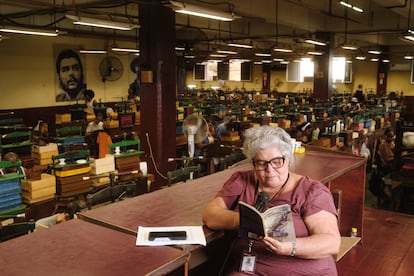

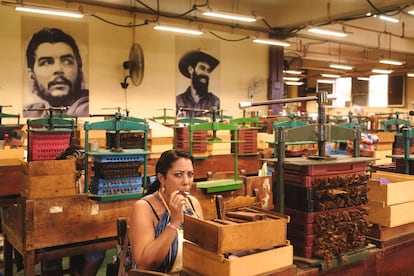
Felicia Alejandra Torres Rodríguez sits down and rings the bell. Seconds later, the cigar rollers take off their headphones and put away their cell phones. La lectora — the cigar reader — arrives punctually at 11:00 a.m. to read the second batch of the day, which is a fragment of one of Eliseo Grenet’s songs: “You will be, like green tobacco in the sea, a slumber of life in the burning and beloved land of God.”
She reads aloud from a small lectern, guarded by a carving of Che Guevara and the attentive gaze of the workers, who seek her expressions from the floor. At the Partagás Tobacco Factory in the heart of Havana, the world’s most coveted cigars pass through the final hands before being exported to Europe or China. Here, they are humidified, rolled, aged, and imbued with the voice of Torres reading the poems of José Martí, or the literature of Gabriel García Márquez. “When you open a box of cigars,” she says, “you smell the tobacco plant and hear our voices.”
Five years ago, she left the watchmaking profession to become a cigar reader at one of the country’s most traditional factories. When the pandemic began, the hired reader who held the position at the time was advised not to continue coming in, for fear of catching the virus. That’s when Torres — now 58, “the youngest cigar reader of all” — learned of a vacant position and began the 21-day selection process. For three weeks, she read alongside the other candidates for the position during the three daily shifts, so that the cigar rollers could choose whose voice they wanted to accompany them during their workday.
When it was time to vote for Torres, the clack-tack of the chavetas — the steel blades used to cut each tobacco leaf — was heard throughout the gallery. However, she admits that she had a little help…
“When I arrived,” she recalls, “I didn’t know anyone. I was competing with a tourist entertainer and one of the factory workers… and I hadn’t even spoken into a karaoke microphone. But I cheated: every time I finished an episode, I played a song by Polo Montañez (one of the country’s greatest singer-songwriters). That’s how I swayed them,” she laughs.
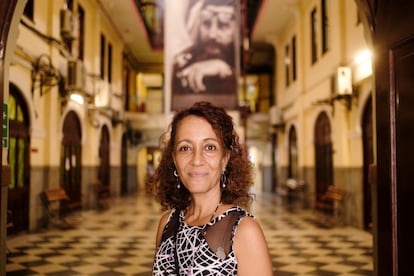
On a Friday in early July — after congratulating the group for fulfilling their quota — she took advantage of the start of the month to highlight the role of cigar rollers. “The history of the cigar roller [is] long and complex if you consider that ‘tobacco and sugar’ constitute the framework upon which our Cuban nationality is structured,” she recounts, from her carefully handwritten notes. The Cuban tobacco industry exports between 70 and 80 million cigars annually.
Who came first: the Romans or the Egyptians? What medicinal properties does basil have? Where’s the hurricane coming from and which Cuban provinces will it affect? What are the symptoms of menopause? The questions that anyone asks ChatGPT today are still being asked of the cigar readers by the cigar rollers, who make up a deeply feminized sector. “They ask a lot about sex,” Torres chuckles, amused. “I have to learn [something new] every day. Sometimes I tell them I don’t know anything about [what they’ve asked], but I’ll tell them tomorrow.” The selection of news and novels read aloud in the country’s 50 cigar factories is filtered by a reading committee, a structure in place since the 19th century.
The historic profession began on December 21, 1865, in this same factory where Torres reads today. This was announced by a now-defunct newspaper, La Aurora, when it recounted how more than 300 workers listened attentively to the first piece read to them — Las luchas sociales, “the social struggles” — which was an excerpt from the paper.
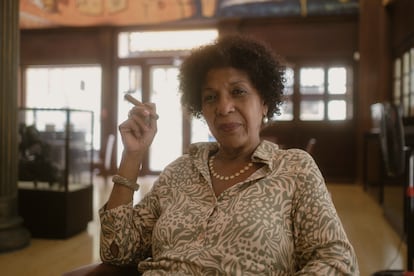
This profession, which emerged from the self-sacrifice of cigar rollers, tired of long, monotonous days, evolved over the years into something that encompassed more than mere reading to liven up the work: they became the neighborhood educators.
“People would stand at the windows of the cigar factories to catch up on the news. It got to the point where even the local residents would vote in the selection of the next novels,” historian Zoe Nocedo explains. She says it’s impossible to separate the history of tobacco from that of Cuba. “Why did cigar makers support [independence leader] José Martí? Why have they carried the banner of all cultural struggles? Because, in addition to knowing that they’re producing Cuba’s most famous product, they’ve cultivated reading [within] the cigar factory. Their function is, and continues to be, to cultivate and captivate,” she explains. “Without reading, there’s no cigar.”
Cuban tobacco growers — primarily those who emigrated to Tampa and Key West in the late-19th century — actively supported José Martí and his independence project. Their monthly donations, raffles and cultural activities provided the economic foundation for the creation of the Cuban Revolutionary Party (PRC), founded by Martí in 1892.
Nocedo, who has directed the Tobacco Museum for two decades, explains that the long-standing tobacco sector has always been cultured and politicized. The chavetas — which were clicked together to elect Torres as the chosen reader — became a symbol of resistance two centuries ago, when strikes began for wage and labor improvements.
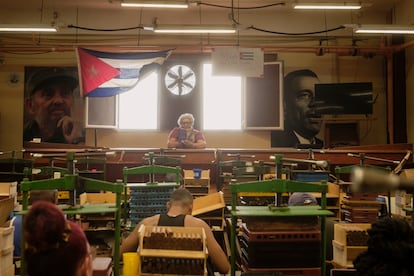
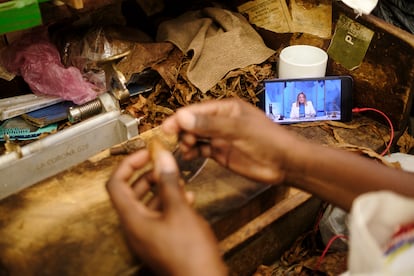
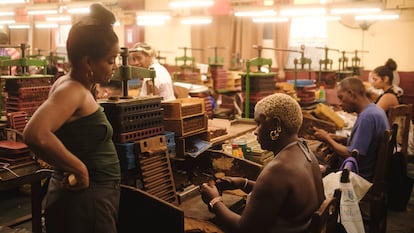
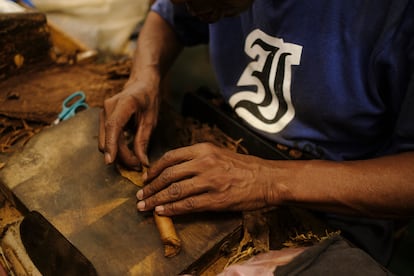
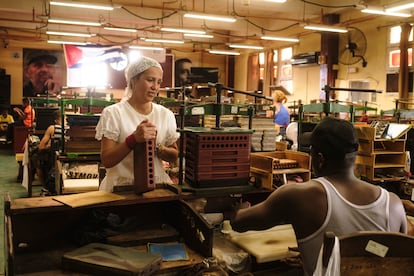
At La Corona Tobacco Factory, all the fans are on. Speedily and with great precision, 100 workers are rolling Cohiba cigars. Each sells for over $70 abroad. Some of the workers get up to refill their water bottles at the fountain, which is located beneath a portrait of Fidel Castro smoking (his favorite was the Cohiba Corona Especial). In front of the image of the communist leader, one of the rollers is looking at her cellphone screen, watching an episode of the popular Spanish-language television program Caso Cerrado – “Case Closed” – hosted by the Cuban-American attorney Dr. Ana María Polo.
Carmelo Ramírez, sitting in silence, barely looks at his cigars while he rolls them. Sometimes, he works with a cigar between his lips. He’s been making Mareva cigars for 15 years, rolling 135 each day. When Odalys Lara Reyes — a reader since 1996 — reads the novel around 2:00 p.m., Ramírez is already more than two-thirds finished. “She’s like a special teacher. Some are perfect for you, others aren’t. She’s excellent,” he affirms.
In this factory, the generators have managed to offset some of the effects of the blackouts that plague Cuba, leaving whole regions without power for up to 20 hours a day. However, Lara’s sound system isn’t immune. The typical solution, in this and other factories, has been to postpone the production schedules until the power returns. In the Partagás factory, Torres explains, she herself “climbs up on the furniture” in the gallery and goes from room to room reading. “This tradition cannot be lost, because it’s our history,” she concludes.
Although there’s documentation showing that the trade of reading to cigar rollers originated in Cuba, the practice was exported to other countries, such as Nicaragua, Puerto Rico, and the Dominican Republic. The DR was the last country where it disappeared, in 1931. However, in Cuba, the craft has endured despite the emergence of radio, television, and cell phones… and despite the outages that knock out the lights and sound systems. Nocedo insists that “workers haven’t wanted to let the craft die. Despite its ups and downs.”
For Torres, the reason is simple: “The radio isn’t going to answer your questions about your child’s homework, or celebrate your birthday, or offer condolences when a loved one dies.” For cigar rollers — in addition to being “an encyclopedia with legs” — the reader is a central part of the team.
Lara has been in this profession for three decades. She’s the oldest reader in the country. She has announced several birthdays, reminded listeners about the upcoming Covid-19 booster shots, given the latest news about a car accident in Cárdenas and listed the new bus routes. And even though she’s about six months away from retirement, she’s reluctant to hand over the reins. “This is a big family,” she explains, in the factory halls. She asks everyone for “a kiss” and a snack. “What am I going to do at home, when I’m still in great shape [and] able to continue reading to you?” she asks nostalgically.
“Reading in a factory is all about sharing. I would always advocate for preserving this profession, because with the daily hustle and bustle, [with] the needs of everyday life, we forget to learn and discover. Reading makes everything a little lighter,” she sighs.
Translated by Avik Jain Chatlani.
Sign up for our weekly newsletter to get more English-language news coverage from EL PAÍS USA Edition









































