
Roberto Saviano: ‘To be believed, you have to die, like Falcone, or risk dying. What kind of world do we live in?’
The writer has won a moral victory in court, after 17 years, against a whole movement in Italy, especially on the far right, that downplays the death threat from the Camorra hanging over him
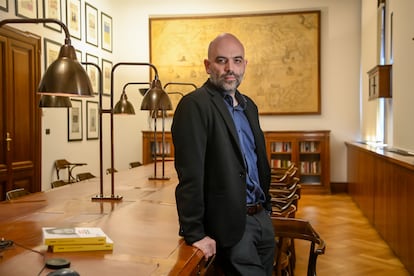

Last Monday, Roberto Saviano partially healed a wound opened 17 years ago. The Rome Court of Appeal, the court of second instance, ruled that in March 2008, the Casalesi clan, the most feared Camorra clan at the time, had indeed threatened to kill him. The court convicted capo Roberto Bidognetti and the clan’s lawyer, Michele Santonastaso, who had read a text in the courtroom during a major Camorra trial requesting the transfer of the case to another court, and directly accused Saviano, who had published Gomorrah in 2006, and journalist Rosaria Capacchione of influencing the judges with their information. In other words, Santonastaso placed the responsibility for a possible conviction, which later actually arrived, on them.
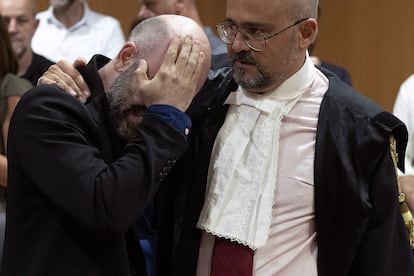
That day changed Saviano’s life because since then he has had to live in hiding and with a bodyguard, which he had already had for two years previously. He left Italy and spent several periods in the United States. The writer’s story — he has sold millions of books and has been translated in more than 50 countries — is known worldwide, but the Italian justice system had not yet established this in a sentence. For Saviano, who responded to EL PAÍS in writing, it was a moral victory, and he broke down after hearing the verdict, unable to stop crying. Over the years, he has faced numerous criticisms, especially from politicians, who have accused him of almost living off the hype and enriching himself by doing so. Silvio Berlusconi reproached him in 2010 for tarnishing Italy’s image. He has clashed primarily with the far right in his criticism of its immigration policy, which has reacted by even threatening to remove his escort. Under the Giorgia Meloni government, he also had a program on RAI suspended. The ruling now supports his position.
Question. Were you afraid for a moment that the sentence would not be favorable?
Answer: Yes, of course. Although the first-instance verdict, which was a conviction, seemed unshakeable, one can never be sure of the outcome of a trial.
Q. What was going through your head at that moment? A lot of images and memories must have come flooding back. What was your first thought?
A. As the judge read out the sentence against the head of the Casalesi clan, Francesco Bidognetti, and his former lawyer, Michele Santonastaso, my whole life flashed before my eyes, not just the last few years under guard, but also, and above all, the years before that, the years of freedom. I thought about how much of my life I’ve wasted in a fight that has made me a target not only for criminal organizations but also for the politicians who, unable to confront the criminal phenomenon, accuse anyone who speaks about it of defaming Italy.
Q. A foreign reader, unfamiliar with the whole story, might think the sentences are very light (a year and a half for Bidognetti, 14 months for his lawyer). Can you explain the importance of the sentence, its significance?
A. First of all, this is the sentence imposed for that type of crime: a threat with mafia-like aggravating circumstances. I’d add an important detail: this type of crime is extremely difficult to prove, so the fact that the boss and his former lawyer have been convicted indicates that the threat was made so blatantly that it leaves no room for doubt. This conviction also has immense value because it establishes and demonstrates for the first time that criminal organizations fear being talked about, that someone will speak out, more than anything else. Investigations, trials, and convictions, if no one tells the tale, are limited to the few who follow the matter. The story reaches everyone, reveals the dynamics, and makes them recognizable.
Q. Outside Italy, it’s hard to understand why what happened in 2008 wasn’t already crystal clear, that it was a Mafia threat. Perhaps that’s why the news has had such an impact abroad, because it’s surprising that in Italy it wasn’t already clear.
A. That text was immediately described as a “proclamation” by the then-Attorney General of the Republic, Vincenzo Galgano, and the National Anti-Mafia Prosecutor, Pier Luigi Vigna, who were familiar with the dynamics of the trial, and in particular, of that type of trial, because it echoed the statements of terrorist organizations. That document declared that if the bosses were convicted, it would be our fault: because of our articles, our denunciations, our influence on the magistrates. After reading the document — something completely unusual, since requests for referral [transfer of the case to a court in another location] are usually filed and not read in public — Bidognetti’s lawyer removed his robes. A symbolic gesture to indicate that, from then on, the game would be played outside those walls, because the reading of that proclamation had precisely that purpose: to inform those outside, in the event of a conviction, who was responsible. So I’d say that in Italy too, everything was clear from the start, especially since, after reading that document, they increased my protection from the third level to the second. What was missing was a final verdict, and we could open a very long chapter on this, talking about the slowness of the Italian judicial system, a slowness that effectively protects criminal organizations: a crime committed today will be punished after 10, 15, or 20 years.
Q. What does it mean that it took almost 17 years for the judicial system to establish the truth?
A. It’s not justice if it doesn’t protect the victims in humane timeframes... and 17 years is objectively too long.
Q. Listening to your words, and even in the article you published in Corriere della Sera on the day of the hearing, it almost seems as if you were blaming yourself for everything, as if you felt guilty about it all. You said after the sentencing: “They stole my life, and I let them steal it.” But what should you have done differently?
A. The list is long, that is, the list of things I could have done differently to protect myself, to avoid ruining my life, ruining it for myself and those who love me. When writing Gomorrah, I could have used fictitious names; that would have been the first parachute. I could have stopped defending my words, even in the face of an obtuse politician who preferred to accuse me of enriching myself, who promised to eliminate my escort, rather than see the mafia’s turnover and get my hands on what Mestre’s CGIA defines as the fourth largest industry in the country, with an annual turnover of more than €40 billion — a low estimate, considering only what comes to light in investigations and convictions in trials. Instead, I exposed myself, continued writing, without realizing that I would be alone.
Q. The impression is that you are very hard on yourself, almost as if you had made the mistake of seeking notoriety or success.
A. The matter seems complex, but it’s actually very simple. I wanted to talk about my territory and what was happening there. I managed to show that criminal organizations take labor from where there is poverty, but invest in the richest areas of the country, mainly in northern Italy. When I told all this, I was attacked by the criminal organizations I had talked about and by a large part of national politics, which wanted and continues to want to defend its inertia in the face of the criminal economy. They accused me of reporting to seek fame and success, and they did so despite the fact that I have lived a shielded life for 20 years. I believe it is my responsibility not to have saved my body from this torment.
Q. You’ve been saying in interviews for years that Gomorrah ruined your life, but there was still a force that kept you going. Lately, it’s as if something has changed; you’re more pessimistic, you seem more tired. What’s happened? Has there been a specific moment that triggered a crisis?
A. If you’re threatened by the Camorra and sued by Prime Minister Giorgia Meloni and her deputy Matteo Salvini, I think my pessimism is understandable. [Salvini has denounced him for calling him a “minister of malavita" (crime). Meloni filed a complaint against him in 2020 for calling her a “bastard” after the death of a migrant child in the Mediterranean and her attacks on NGOs that save lives at sea. Saviano was ordered to pay her €1,000 in 2023.]
Q. Do you think having the Camorra death threat hanging over your head for years has made you less afraid of everything else? Criticism, controversy, lawsuits... You’re an author who doesn’t shy away from any debate or political battle.
A. Exactly, that’s right. Over the years, I’ve thought there’s nothing worse than mafia threats. If on the one hand this is true because of their danger, on the other, political attacks are very insidious because they seek to construct a parallel and false narrative about you. Many politicians have used me, and continue to use me, for political propaganda, and this has generated a climate of hatred and distrust toward me.
Q. Have you received messages of support and solidarity from politicians?
A. No, none. I’m not counting private messages, because politicians should have the courage to show their solidarity publicly. Private messages are of little use.
Q. How is it possible that Italian politics does not support one of the most widely read and well-known Italian writers?
A. Because most Italian politicians are completely incompetent when it comes to criminal organizations and their infiltration into the legal economic fabric, from construction to healthcare, from waste management to tourism to the control of Italy’s main ports. So incompetent that they prefer silence, and they also prefer that anyone who speaks out have as little visibility as possible. And when it’s not possible to silence them, threats arise: “When we govern, we will remove Saviano’s escort,” Salvini threatened during his election campaign. He’s a broken record.
Q. From outside Italy, it’s incomprehensible that politicians like Salvini and Meloni’s party question whether you should have a bodyguard. How do you explain this? Ignorance, bad faith?
A. Political propaganda. Furthermore, they need to assure their voters that they will do everything possible to silence Saviano, who, by denouncing criminal infiltration, is damaging Italy’s reputation.
Q. Have you recognized the isolation and abandonment by institutions that many other people who have fought against the mafia — police officers, judges, journalists — have suffered before you?
A. I don’t want to make an inappropriate comparison: Giovanni Falcone, the judge murdered by the Mafia in 1992, only had friends after his death. Before that, he was accused of every kind of infamy. A genius of anti-Mafia law, the man who laid the foundations for the global fight against criminal organizations, in Italy he was called “vain,” accused of doing everything for his career and visibility.
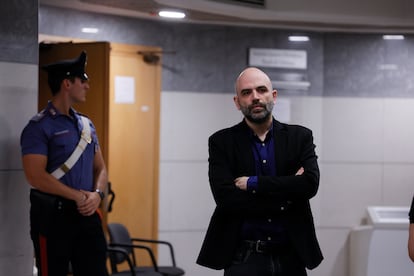
Q. But over the years, have you always felt lonely? Have you been unable to have a girlfriend, friends, or Christmas dinner with loved ones?
A. I answer thus, and I believe that what I mean is perfectly understood: in captivity nothing good can be born, nothing good can resist.
Q. You often talk about your desire to ride a motorcycle. How long has it been since you last did so, and why do you miss it?
A. It’s a wish I’ve always had. To start a motorcycle and go, with no destination and without having to tell anyone where I’m going. Well, I’ve never done it. The last time I rode a motorcycle, I was behind the escort cars.
Q. What would have to happen for you to regain your freedom and peace of mind? Is it possible, so to speak, for the Casalesi clan to overturn the sentence, a public reversal of the death threats against you, or will it never happen?
A. I have no idea. My freedom is a dream, I don’t know if or when it will come true. I have the feeling that a lot depends on me, but the truth is, I don’t know where to start.
Q. I suppose you’ve thought at some point that many mafiosi who cooperate with the authorities manage to rebuild a new life and are never found, why can’t you do the same?
A. Because I would have to go far away, leave everything and everyone behind. I’m not capable of doing that.
Q. You have a similar story to Salman Rushdie, and you’re friends. Were you shocked by what happened to him in 2022, when a young man attacked him with a knife?
A. It terrified me, but I’m going to say something absurd, which I also discussed with Rushdie. After the attack, we spoke, we saw each other on video, and then in person, and I noticed an enormous calm in him. I thought about it for a while before doing so, but then I asked him: “Salman, tell me the truth. You seem calm. Could it be that this attack has proven that the fatwa against you was real?” I felt immense pain when I heard his answer: “Yes.” To be believed, you have to die, like Falcone, or risk dying. What kind of world do we live in?
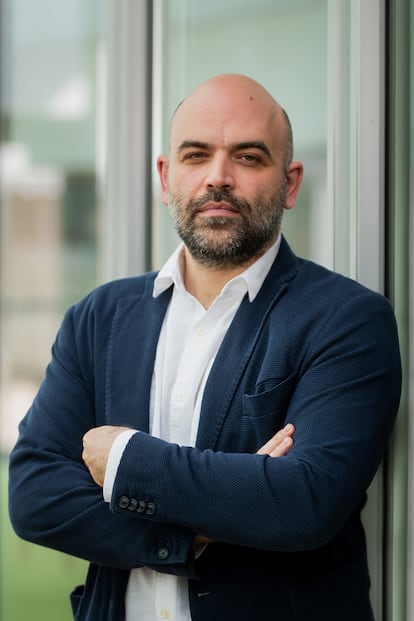
Q. The young man who attacked Rushdie wasn’t even born when the fatwa was issued against him in 1989. Is the fanaticism that haunts you the same?
A. It’s very similar, yes. You accept a mission, even years later, that allows you to rise in the Mafia hierarchy. Domenico Noviello was a businessman from Castel Volturno who reported extortion in 2001, inspiring other accusations. He was murdered on May 16, 2008, as punishment for the courage he showed in reporting it. His bodyguard had just been removed, and the clan had waited almost 10 years for revenge.
Sign up for our weekly newsletter to get more English-language news coverage from EL PAÍS USA Edition









































