
Macaroni against fascism: Why pasta is a symbol of resistance in Italy
On July 25, the fall of Mussolini’s regime is commemorated with ‘pastasciutta antifascista,’ a dish that was considered an enemy by the dictatorship

In an iconic scene from 1954’s An American in Rome by the director Steno, the movie’s protagonist played by Alberto Sordi comes face to face with a plate of pasta. “Macaroni, you have provoked me and now I am going to eat you,” he says before sinking his fork into a salad bowl full of at least a pound of said pasta. His character is fascinated by everything associated with the United States. But when a plate of pasta is placed before him, it is impossible to resist. He spits out a mouthful of bread with mustard — “that’s for the cat,” he says — and submerges his face in the bowl. The image fulfills every idea of mid-1950s Italian identity, many of which have survived intact in the collective imagination through to this very day.
Nearly a decade before, fascism had a different idea of what it meant to be a real Italian man — and the model male fascist did not eat pasta. The regime considered the food to be a foreign-born trend that did not fit with the rural and nationalist spirit of its new man, and attempted to block its consumption, with middling results. When on July 25, 1943, Benito Mussolini, popularly known as Il Duce, was arrested, some Italians took to the streets to celebrate while munching on a plate of macaroni, a gesture of defiance of the culture that the dictatorship had tried to instill. So was born the pastasciutta antifascista, a tradition that has been reborn in recent decades.
Between July 26 and 27 of 1943, news of the fall of the fascist regime was slowly beginning to spread. A farming family of the Reggio Emilia province in northeastern Italy prepared pound upon pound of macaroni with water and flour, flavoring it with cheese and butter bought on credit from the local shop. They packed the pasta into milk cans and took it to the town square to celebrate the end of the dictatorship, and what they believed to be the end of the war, with their neighbors. Alcide Cervi, the family’s patriarch, had become a member of the resistance along with his seven sons, who were executed a few months later.
“Pasta was an uncommon dish in our area. That spontaneous moment was at once a show of solidarity during wartime rationing and a political challenge,” explains Mirco Zanoni, cultural coordinator of the Instituto Alcide Cervi de Gattatico, a research center of fascism and the resistance. “During July 25 and the following days, all control went out the window and people were able to freely express their dissatisfaction not only with fascism, but above all, with the conditions in which the country had found itself due to war,” he says.
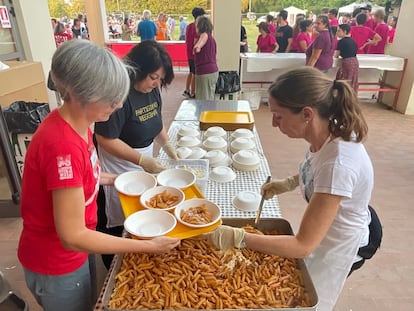
That defiant macaroni had been confined to local memories for many years until the mid-1990s, when the Instituto Cervi brought it back to life. “It started out almost as a game to commemorate the fall of fascism, but it’s grown every year. We’ve been joined by friends, partisan associations, citizen’s groups, museums, everyday citizens… until it became a new tradition, with around 300 events of all shapes taking place on the same day, even abroad,” says Zanoni. It’s not necessary to recreate the Cervi family’s original recipe to celebrate anti-fascism. Any kind of pasta, industrial or homemade, will do.
“There’s no longer a fascist party per se, but the reasons that allow for the birth of fascism continue to exist, and not just in Italy. That’s why it’s important to remain vigilant and keep the spirit of brotherhood that represents anti-fascism alive,” says Zanoni. In his opinion, eating pastasciutta is a “liberating” gesture that revindicates democratic values and solidarity, values that can be applied to any circumstance.
The Cervi family’s original macaroni feed was “more of a celebration than a rebellion in the strictest sense,” says Professor Alberto Grandi, author of La Cucina Italiana Non Esiste (Italian Cuisine Doesn’t Exist). “It was kind of a people’s party, put together with what they had. But they used a product that also touched a nerve of the cultural imagination of fascism,” he adds.
Macaroni, a not-so-Italian dish
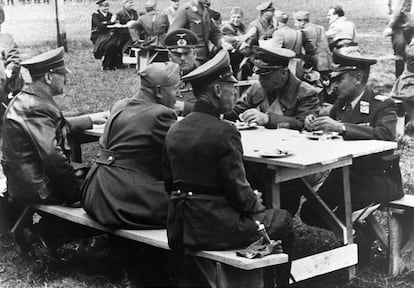
In May 1938, Adolf Hitler traveled to Italy to meet with Mussolini. When they sat down to dine, Il Duce was eating chicken breast. In contrast, the Führer requested pasta. The cook overcooked it to be soft, better suited to the German palate. “At the time, it was already a recognizable product for the Italians, but only after World War II did they see a true macaroni boom,” says Grandi, economics professor at the University of Parma and expert in the history of nutrition.
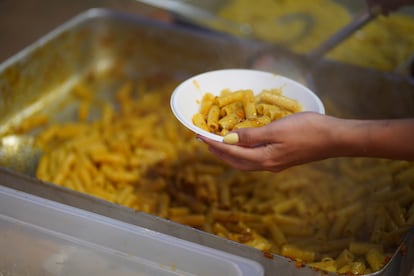
“For the most part, Italians learned about pasta in America and later, when many of those migrants returned, it became the national dish. Fascism considered macaroni a kind of imported American fashion, but Italians fell in love with it,” continues Grandi. The professor’s studies have caused quite a stir in his country. Il Duce’s granddaughter herself, Alessandra Mussolini, has accused him of frivolity, inconsistency and a lack of patriotism.
The consumption of pasta in Italy between the two world wars stood at 44 pounds per capita, less than half of today’s 99 pounds. Between 1925 and 1926, the fascist regime attempted to reduce wheat imports, which were indispensable to the making of macaroni. To rebalance the market, it launched a campaign promoting the consumption of rice produced in Italy.
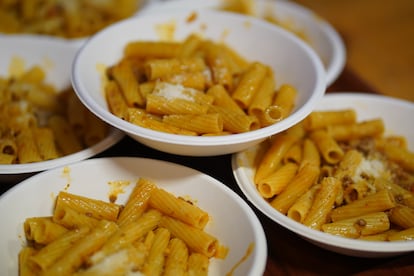
“In the ruralist rhetoric of fascism, Italians had always eaten vegetable, polenta, soups — but not macaroni,” says Grandi. The futurist movement went even further and blamed pasta for being responsible for turning Italians into neutral pacifists, saying that because the food can be difficult to digest, the weight of the post-pasta stomach can obscure rational thinking. Despite institutional support for rice, its consumption remains limited to its zones of production in the northern part of the country. South of Rome, it continued to be relatively unknown until after the war. “Fascism has always tried to deeply condition the diet of the Italians in the intention of building the new man, the Italian warrior. They came out against pasta consumption in every way possible, but they were unsuccessful. It was just another one of the regime’s many failures,” sums up Grandi.









































