
Lula accuses Trump of blackmailing Brazil over Bolsonaro trial
In a public letter, the US president urges the South American country to ‘immediately’ stop the legal proceedings against the former far-right president and keeps up his threat of tariffs
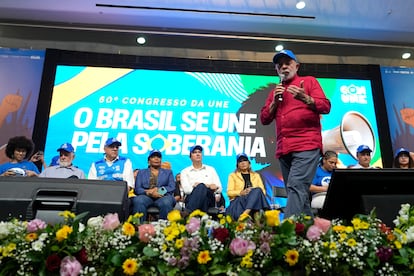
A week after U.S. President Donald Trump threatened to raise tariffs on Brazil to 50%, the atmosphere remains heated, and may even be rising. President Luiz Inácio Lula da Silva is alternating statesmanlike assertions with more fiery speeches defending national sovereignty, while Trump increases the pressure via social media. On Thursday night, the two, who have never even held a telephone conversation, clashed: Lula with a recorded message to the nation; Trump with a letter addressed to former president Jair Bolsonaro published on Truth, his social media platform.
In the letter, Trump reinforces the idea that the tariff hike against Brazil is motivated by politics rather than economics, and makes no secret of his interference in Brazil’s internal affairs. “I have seen the terrible treatment you are receiving at the hands of an unjust system turned against you. This trial should end immediately!” reads the letter to the far-right leader and signed by Trump. The message comes two days after the Brazilian Prosecutor’s Office requested a prison sentence for Bolsonaro and his closest associates for organizing a coup against Lula. Bolsonaro is facing up to 43 years in prison.
Trump raised the tone by expressing concern about “the attacks on free speech — both in Brazil and in the United States — coming out of the current government” and expressing his disapproval through the tariff policy. “It is my sincere hope that the Government of Brazil changes course, stops attacking political opponents, and ends their ridiculous censorship regime. I will be watching closely,” the Republican’s letter concludes, in a renewed warning.
Lula, for his part, gave a recorded speech before the publication of Trump’s letter in which, in a solemn tone and without directly mentioning the U.S. president, he emphasized that attempting to interfere with Brazilian justice is a “serious attack” on Brazil’s sovereignty. Lula recalled that, before that, Brazil had negotiated with the U.S. for months: “We were waiting for a response, and what came instead was unacceptable blackmail, in the form of threats to Brazilian institutions, and with false information about trade between Brazil and the United States.” Hours earlier, at an event with thousands of students, Lula, somewhat more inflamed, once again boasted with a patriotic speech: “A gringo will not give orders to this president!” he proclaimed.
Trump’s latest attack is the final twist in the U.S. administration’s pressure strategy toward Brazil. The penultimate chapter came this week, when the Department of Commerce announced it would investigate Brazil for unfair practices, citing deforestation, attempts to regulate big tech, electronic payment methods like Pix (created by the Central Bank and extremely popular in Brazil), and even piracy in a street in downtown São Paulo, something that provoked disbelief among the political class.
Lula countered with data on the decline in deforestation rates and insisted that social media, like all other companies, must be subject to Brazilian law and stop spreading disinformation and hate speech. As he has done in all his public statements on the issue, he affirmed that Brazil will use all legal instruments to defend itself, including the Economic Reciprocity Law, which could increase tariffs on products from the United States if Trump ultimately carries out his threat.
While the speeches and letters continue, the Brazilian government meets daily with representatives of the sectors that could be most affected if Trump’s tariff threat goes into effect on August 1, and has achieved a unity not seen in a long time. In the sea of uncertainty that has become the relationship between the United States and Brazil, the only certainty is that each threat from Trump further isolates Bolsonaro and strengthens Lula.
Polls are already detecting an improvement in the president’s ratings, who until four days ago was experiencing the worst popularity crisis of his term. A Quaest survey released this Thursday indicates that Lula would defeat any of the possible right-wing candidates in 2026, and his lead has widened significantly compared to June.
Lula knows he has a golden opportunity to unite the country against the Bolsonaro clan. In his televised address, he stated that his outrage is even greater knowing that the attack on Brazil has the support of some Brazilian politicians: “They are the true traitors to the country; they believe ‘the worse, the better,’ they don’t care about the country’s economy or the damage caused to our people,” he added. One of the former president’s sons, Congressman Eduardo Bolsonaro, has been living in the United States for months, lobbying Trump to come to his father’s defense.
Sign up for our weekly newsletter to get more English-language news coverage from EL PAÍS USA Edition









































